
Formal Email Structure
Learn the structure of a professional Japanese email: 拝啓 opening, 本文 (body), 以上 closing, and 署名 signature. Write emails for requests, apologies, and meeting arrangements.
🎯 Goal: By the end of this lesson, you will be able to draft a structurally sound, professional Japanese business email from scratch, utilizing appropriate N2-level keigo, standard formatting conventions, and polite opening and closing formulas suitable for external clients and internal colleagues.
Introduction
Mastering the art of Japanese business correspondence is a crucial milestone for N2 learners aiming to succeed in a professional environment. Writing a formal email in Japanese requires more than just advanced vocabulary and honorifics (keigo); it demands strict adherence to traditional structural conventions. This lesson deconstructs the essential components of a standard Japanese business email—from crafting concise subject lines and appropriate opening greetings to organizing the main body logically and concluding with polite sign-offs. By understanding these structural expectations, you will gain the confidence to communicate with Japanese clients and colleagues smoothly, professionally, and respectfully.
Lesson Content
Master the Art of Japanese Business Writing: Formal Email Structure (N2)
In the Japanese professional world, writing an email is not just about transmitting information; it is a vital ritual of mutual respect. For N2 learners, mastering the Business Email (ビジネスメール) is the ultimate test of pragmatic competence.
This guide breaks down the standard 6-part blueprint of a formal Japanese email, complete with essential N2 grammar and vocabulary.
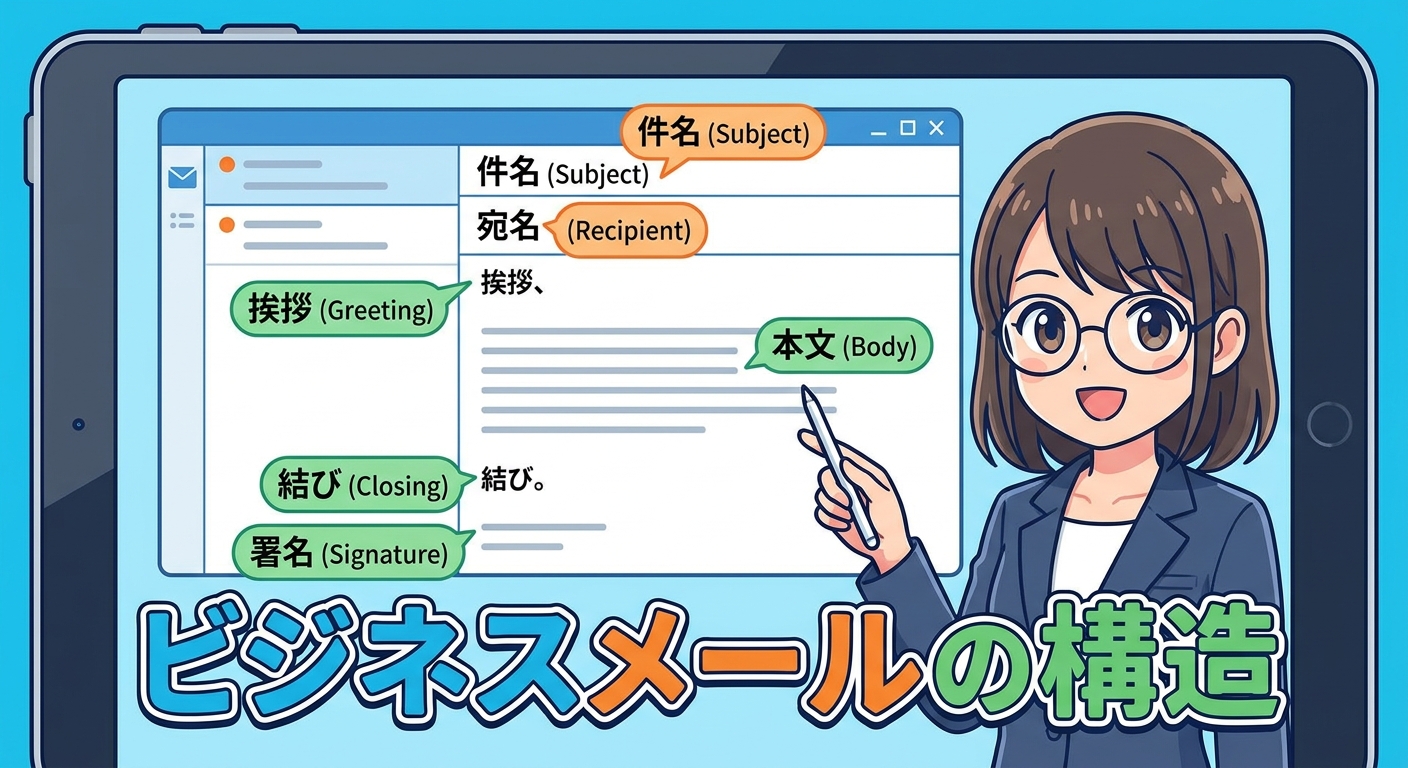
The 6-Part Anatomy of a Business Email
graph TD
    1[1. 件名: Subject Line] --> 2[2. 宛名: Recipient]
    2 --> 3[3. 挨拶・名乗り: Greeting & ID]
    3 --> 4[4. 本文: Main Body]
    4 --> 5[5. 結び: Closing]
    5 --> 6[6. 署名: Signature]
1. 件名 (けんめい) — Subject Line
Your subject line must be concise and actionable. Never leave it blank or write vague titles like "Hello."
- Formula:
[Action/Topic] + [Your Company Name] + [Your Name] - Example:
- 【ご相談】新規プロジェクト日程について(サクラ工業・佐藤)
- (Consultation: Regarding the new project schedule [Sakura Industry, Sato])
2. 宛名 (あてな) — Recipient
Address the recipient in descending order of organizational hierarchy. Never use 〜様 (sama) for your own colleagues in an external email.
- Formula:
Company Name + Department + Title + Name + 様 - Example:
- 株式会社ABC 営業部 部長 田中様
- (ABC Corporation, Sales Department, Manager Tanaka-sama)
- N2 Note: Use 貴社 (きしゃ - Kisha) in writing to refer to their company. (Do not use Onsha 御社, which is strictly for spoken Japanese). Refer to your own company as 弊社 (へいしゃ - Heisha).
3. 挨拶・名乗り (あいさつ・なのり) — Greeting & Identification
Before stating your business, always open with a standard greeting, followed by your identity.
- Standard Greeting:
- いつも大変お世話になっております。
- (Thank you very much for your continued support.)
- Identification:
- サクラ工業の佐藤でございます。
- (I am Sato from Sakura Industry. [Humble Kenjougo])
4. 本文 (ほんぶん) — Main Body
State your purpose clearly. Use paragraph breaks (改行) frequently to ensure readability.
- N2 Grammar Focus: Humble Requests
- Instead of the direct 〜てください, use the humble 〜ていただければ幸いです (I would be grateful if you could...).
- Example: 資料をご一読(いちどく)いただければ幸いです。 (I would appreciate it if you could read through the document.)
5. 結びの挨拶 (むすびのあいさつ) — Closing Remarks
Always end with a polite sign-off.
- Standard Closing:
- お忙しいところ恐縮ですが、何卒よろしくお願い申し上げます。
- (I apologize for taking up your time, but thank you very much for your kind consideration.)
6. 署名 (しょめい) — Signature Block
Separate your signature from the text using text dividers (e.g., --- or ===). Include your company name, department, name, address, phone number, and email.
Annotated Model Email
Here is a complete, professional email requesting a meeting:
件名:【ご相談】新規プロジェクト日程について(サクラ工業・佐藤)

株式会社ABC
営業部 部長 田中様

いつも大変お世話になっております。
サクラ工業の佐藤でございます。

さて、先日ご相談いたしました「新規プロジェクト」の件につきまして、
一度お打ち合わせのお時間をいただけますでしょうか。

下記の日程にて、ご都合のよろしい日時はございますでしょうか。

1. 10月15日(火) 10:00〜12:00
2. 10月16日(水) 13:00〜15:00

上記日程が難しい場合は、田中様のご都合の良い日時をご教示いただければ幸いです。

ご多忙のところ恐縮ですが、何卒よろしくお願い申し上げます。

--------------------------------------------------
サクラ工業株式会社 企画部
佐藤 健太(Sato Kenta)
〒100-0001 東京都千代田区1-1-1
TEL:03-XXXX-XXXX / Email: sato@sakura-ind.co.jp
--------------------------------------------------
Key N2 Business Vocabulary Quick-Reference
| Japanese (Kanji) | Reading | English Translation | Usage Context |
|---|---|---|---|
| ご査収ください | ごさしゅうください | Please check/verify | Used when attaching files. |
| ご教示ください | ごきょうじください | Please instruct/tell me | Formal way to ask for information. |
| 恐縮ですが | きょうしゅくですが | I am sorry/troubled, but... | Used to cushion a request. |
| 拝受いたしました | はいじゅいたしました | I have received (it) | Humble form of "received" (e.g., mail). |
Exercises
Formal Email Structure (Exercises)
Exercises for Formal Email Structure
Review the grammar and vocabulary, and try to fill in the blanks or write sentences based on the prompts.
Examples
いつもお世話になっております。株式会社AAAの山田でございます。
Itsumo osewa ni natte orimasu. Kabushikigaisha AAA no Yamada de gozaimasu.
Thank you as always for your continued support. This is Yamada from AAA Corporation.
さて、先ほどご相談いただきました新規プロジェクトの件につきまして、資料を添付いたしましたのでご査収ください。
Sate, sakihodo gosōdan itadakimashita shinki purojekto no ken ni tsukimashite, shiryō o tenpu itashimashita node gosashū kudasai.
Regarding the new project we discussed earlier, I have attached the documents, so please review them.
お忙しいところ大変恐縮ではございますが、来週金曜日までにご返答いただけますようお願い申し上げます。
Oisogashii tokoro taihen kyōshuku de wa gozaimasu ga, raishū kin'yōbi made ni gohentō itadakemasu yō onegai mōshiagemasu.
I am very sorry to trouble you during your busy schedule, but I would appreciate it if you could reply by next Friday.
Practice Drills
Lesson Materials
Vocabulary (5)
Kanji (0)
No kanji characters in this lesson.
Kana (0)
No kana characters in this lesson.