
尊敬語 and 謙譲語 — Respectful and Humble Forms
Master the two core registers of polite Japanese: 尊敬語 (honorific — elevating others) and 謙譲語 (humble — lowering yourself). Learn the 20 most important verb pairs.
🎯 Goal: By the end of this lesson, you will be able to confidently identify and apply 尊敬語 and 謙譲語 in professional and formal Japanese contexts. You will master irregular honorific verbs (such as いらっしゃる, 伺う, and 申し上げる), construct regular respectful and humble forms using standard prefixes and suffixes (お〜になる, お〜する), and accurately choose the appropriate register based on social distance, hierarchy, and the "in-group/out-group" (uchi/soto) dynamic required for the JLPT N2 exam and real-world business scenarios.
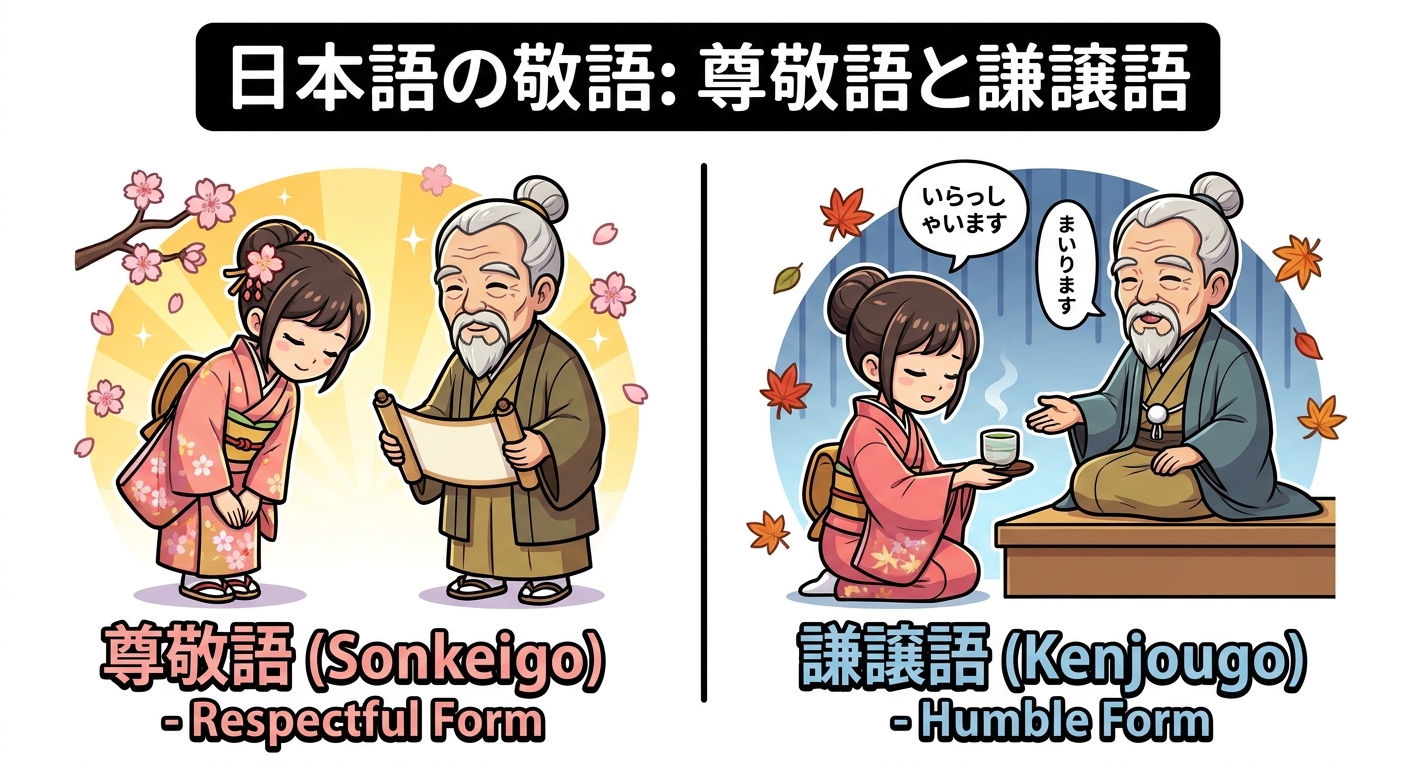
Introduction
Welcome to your N2 lesson on Keigo, focusing on the critical distinction between 尊敬語 (Sonkeigo - respectful language) and 謙譲語 (Kenjougo - humble language). While standard polite Japanese (Teineigo) serves well in daily life, mastering these advanced honorific systems is essential for professional success and natural social integration in Japan. In this lesson, we will demystify the rules governing when to elevate your interlocutor’s actions and when to humble your own. Through contextual examples, common business idioms, and structural patterns, you will develop the linguistic maturity required to navigate complex social hierarchies and workplace dynamics with absolute confidence.
Lesson Content
Mastering Japanese Keigo: The N2 Guide to 尊敬語 (Sonkeigo) and 謙譲語 (Kenjougo)
For many intermediate learners, advanced honorifics (Keigo) feel like an impenetrable fortress. However, passing the JLPT N2 and operating professionally in Japan requires mastering the psychological distance and social hierarchy embedded in the language.
The secret to mastering Keigo is not memorization—it is understanding the direction of the action.
The Golden Rule: Who is performing the action?
Before you speak, ask yourself: Who is the subject of the verb?
[Out-Group / Superior]  ─── (Elevate the Subject) ───>  尊敬語 (Sonkeigo)
[In-Group / Yourself]   ─── (Lower the Subject)   ───>  謙譲語 (Kenjougo)
- 尊敬語 (Sonkeigo - Respectful): Used when the superior (your boss, a client, a teacher) performs the action. You are elevating them.
- 謙譲語 (Kenjougo - Humble): Used when you (or your in-group) perform an action that involves or impacts a superior. You are lowering yourself to show respect.
1. 尊敬語 (Sonkeigo) — Elevating the Superior
Use Sonkeigo when describing the actions, state, or possessions of someone of higher status.
Grammatical Formulas
- The Standard Formula:
お / ご + Verb [Stem] + になる- Example: 書く (to write) → お書きになります
- The Passive Form:
Verb [Passive Form] (〜られる)- Example: 帰る (to go home) → 帰られます
- Note: This is slightly less polite than
お〜になる, but very common in daily business.
Special Irregular Sonkeigo Verbs (Must-Know for N2)
| Dictionary Form | Sonkeigo (Respectful) | Example Sentence |
|---|---|---|
| 行く / 来る / いる | いらっしゃる / おいでになる | 社長は明日、アメリカへいらっしゃいます。 |
| 食べる / 飲む | 召し上がる (めしあがる) | どうぞ、温かいうちに召し上がってください。 |
| 言う | おっしゃる | 先生がそうおっしゃいました。 |
| する | なさる | 休日は何をなさいますか。 |
| 知っている | ご存じだ | そのニュースはもうご存じですか。 |
2. 謙譲語 (Kenjougo) — Humbling Yourself
Use Kenjougo when you perform an action directed toward, or for the benefit of, a superior.
Grammatical Formulas
- The Standard Formula:
お / ご + Verb [Stem] + する / いたす- Example: 持ちます (to hold/carry) → お持ちします / お持ちいたします (I will carry it for you).
Special Irregular Kenjougo Verbs (Must-Know for N2)
| Dictionary Form | Kenjougo (Humble) | Example Sentence |
|---|---|---|
| 行く / 来る | 参る (まいる) | ただいま参ります。 |
| 言う | 申し上げる / 申す | 田中と申します。/ 心よりお詫び申し上げます。 |
| 食べる / 飲む / もらう | いただく | お土産をいただきました。 |
| 会う | お目にかかる | 先生にお目にかかれて光栄です。 |
| 見る | 拝見する (はいけんする) | 資料を拝見しました。 |
| 知っている | 存じ上げている | 奥様のお名前は存じ上げております。 |
The Ultimate N2 Trap: Avoid "Double Keigo" (二重敬語)
A common mistake made by both language learners and native Japanese speakers is 二重敬語 (Nijuu Keigo)—applying two honorific rules to a single verb.
-
❌ Incorrect: おっしゃられました (Combining ossharu + passive rareru)
-
⭕ Correct: おっしゃいました
-
❌ Incorrect: ご覧になられました (Combining goran ni naru + passive rareru)
-
⭕ Correct: ご覧になりました
Quick Practice Challenge
Identify the error in the following business scenario:
Scenario: You are speaking to a client (Mr. Yamada) on the phone. You want to ask if he has read the document you sent.
Client: 「昨日送ってくれた資料だけど...」
You: 「はい、拝見しましたか。」 ❌
Why is this wrong?
拝見する (haiken suru) is Kenjougo (humble). By using it for the client's action, you have accidentally humbled the client!
The Correction:
Since the client is the one doing the reading, you must use Sonkeigo:
⭕ 「はい、ご覧になりましたか。」
Exercises
尊敬語 and 謙譲語 — Respectful and Humble Forms (Exercises)
Exercises for 尊敬語 and 謙譲語 — Respectful and Humble Forms
Review the grammar and vocabulary, and try to fill in the blanks or write sentences based on the prompts.
Practice Drills
Lesson Materials
Vocabulary (5)
Grammar (0)
No grammar rules in this lesson.
Kanji (0)
No kanji characters in this lesson.
Kana (0)
No kana characters in this lesson.