
Meetings and Workplace Requests
Understand office conversation patterns: requesting tasks, offering help, giving updates, and confirming understanding. Use 〜ていただけますか for polite requests.
🎯 Goal: To confidently participate in Japanese business meetings and make polite, effective workplace requests using advanced honorifics (keigo), appropriate cushion language, and culturally appropriate indirect expressions to foster smooth professional collaboration.
Introduction
Welcome to this N2-level lesson on "Meetings and Workplace Requests." Navigating the Japanese corporate environment requires not just grammatical accuracy, but a deep understanding of business etiquette and subtle interpersonal dynamics. At the N2 level, you will move beyond basic polite language to master nuanced expressions for making persuasive proposals, softening requests, and handling disagreements constructively during meetings. This lesson focuses on natural business Japanese, including humble and respectful verbs, cushion words, and indirect phrasing. By mastering these communicative strategies, you will build stronger professional relationships and express your ideas with confidence and authority in any Japanese workplace.
Lesson Content
Master Class: Meetings and Workplace Requests (JLPT N2)
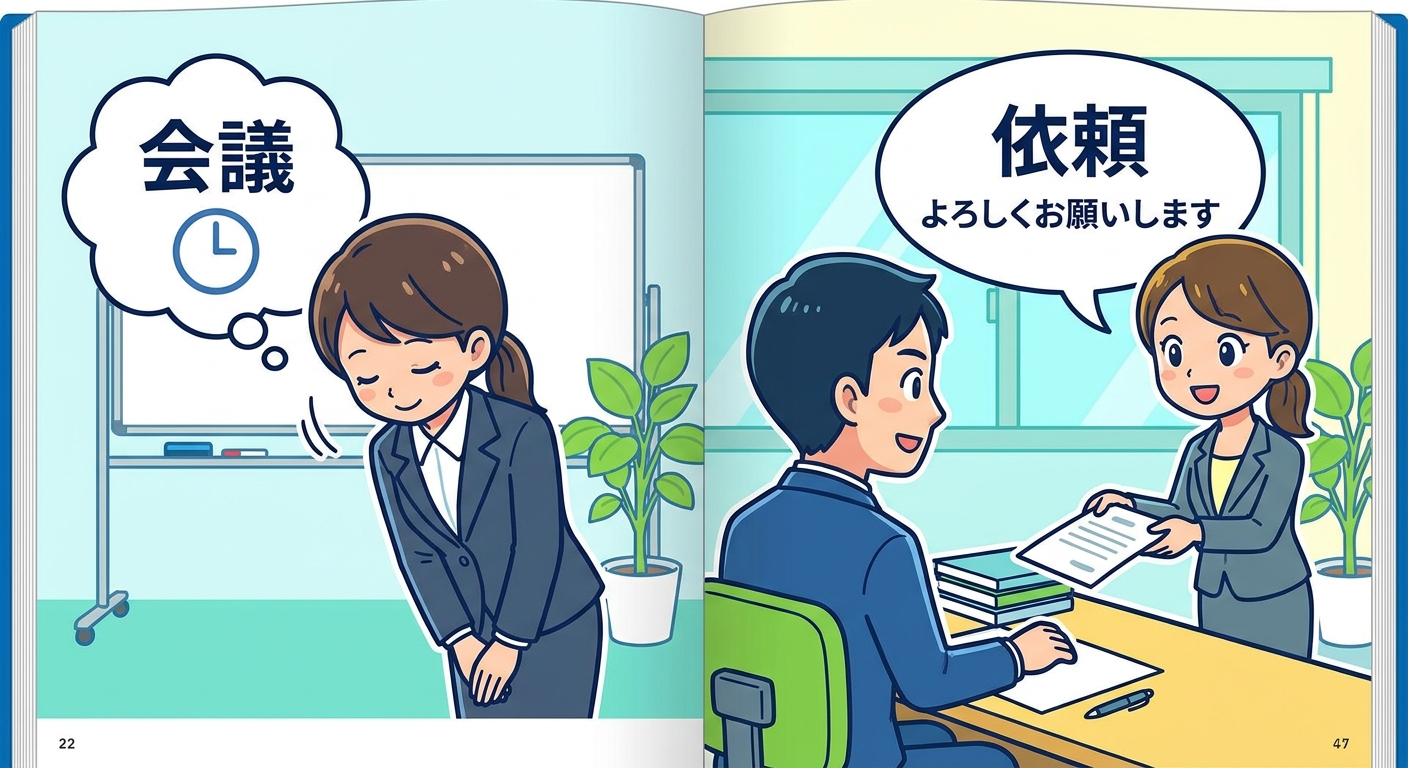
Navigating a Japanese corporate environment (職場) requires more than just vocabulary; it demands an understanding of social distance, hierarchy, and indirectness. In this lesson, we will master N2-level grammar patterns, polite request structures, and key kanji essential for professional meetings (会議) and workplace requests (依頼).
1. Key N2 Grammar for Meetings & Requests
To sound professional, you must move away from casual imperatives. Use these N2 grammar points to express scheduling, conditions, and polite refusals.
A. 〜に際して (On the occasion of / Prior to)
- Form:
Noun + に際して/Verb (Dictionary Form) + に際して - Nuance: A formal, written, or spoken expression used when starting something important (like a project or a meeting).
- Example:
- 会議を行うに際して、事前にアジェンダをご一読ください。
- On the occasion of holding the meeting, please read through the agenda in advance.
B. 〜かねる (Unable to / Can difficultly do)
- Form:
Verb (Masu-stem) + かねる - Nuance: Safely declines a request. It expresses that you want to do something, but due to circumstances, you cannot. It sounds much more professional than directly saying できません.
- Example:
- その件につきましては、私の一存では決定しかねます。
- Regarding that matter, I am unable to make a decision on my own authority.
C. 〜次第 (As soon as)
- Form:
Verb (Masu-stem) + 次第 - Nuance: Used to show that you will immediately perform the next action once a condition is met. Highly common in follow-up emails.
- Example:
- スケジュールが決まり次第、共有いたします。
- As soon as the schedule is decided, I will share it with you.
2. Polishing Workplace Requests (Keigo & Cushion Words)
When asking a colleague or superior to do something, never use 〜てください. Instead, soften your request using Cushion Words (クッション言葉) and humble/honorific queries.
| Cushion Word | Meaning | Usage |
|---|---|---|
| お手数ですが、 | I'm sorry to trouble you, but... | Asking for a task to be done. |
| 恐れ入りますが、 | I am filled with trepidation, but... | Introducing an inquiry or request. |
| 差し支えなければ、 | If it's not inconvenient... | Asking for sensitive information. |
The Golden Formula for Requests:
[Cushion Word] + [Verb -て形] + いただけないでしょうか / いただければ幸いです。
- Example:
お手数ですが、本日中に資料を修正していただけないでしょうか。
(I apologize for the trouble, but could you please revise the document by the end of today?)
3. Kanji Masterclass: 議 (Discussion/Proposal)
Understanding the construction of workplace kanji helps with writing and recall. Let's analyze 議 (ぎ - discussion/deliberation).
議 (19 Strokes)
言 (Left: Words/To speak) + 義 (Right: Righteousness/Justice)
Stroke Order & Writing Tips:
- Left Radical (言 - 7 strokes): Keep this narrow. The first horizontal stroke should be slightly longer than the others.
- Right Element (義 - 12 strokes):
- Write the top part (羊 - sheep) with three parallel horizontal lines.
- The bottom part (我 - self) requires a strong, sweeping diagonal stroke going down-left, and a sharp hook on the right-hand vertical-diagonal stroke.
- Balance: Ensure the left side (言) does not crowd the right side (義). They should stand side-by-side with equal height.
4. Practical Application Challenge
Translate the following English corporate request into professional N2-level Japanese using the grammar and Keigo formulas learned above:
"As soon as the client's feedback arrives, I will share it with you. I apologize for the trouble, but could you please check the attached materials?"
Model Answer:
クライアントからのフィードバックが届き次第、共有いたします。お手数ですが、添付資料をご確認いただけないでしょうか。
Exercises
Meetings and Workplace Requests (Exercises)
Exercises for Meetings and Workplace Requests
Review the grammar and vocabulary, and try to fill in the blanks or write sentences based on the prompts.
Practice Drills
Lesson Materials
Vocabulary (5)
Grammar (0)
No grammar rules in this lesson.
Kanji (0)
No kanji characters in this lesson.
Kana (0)
No kana characters in this lesson.