
Numbers 1–10,000
Learn Japanese counting: 一 to 十, then 百, 千, 万. Practice reading prices, ages, and quantities. Learn counter words: 〜人 (people), 〜冊 (books), 〜枚 (flat things).
🎯 Goal: By the end of this lesson, students will be able to confidently count, read, and write numbers from 1 to 10,000 in Japanese, recognize key phonetic irregularities (such as in the hundreds and thousands columns), and apply this knowledge to understand prices and basic numerical data in everyday N5-level contexts.
Introduction
Numbers are the backbone of daily communication in Japanese, essential for shopping, telling time, sharing contact information, and stating ages. In this lesson, we will demystify the Japanese numerical system from 1 all the way to 10,000. You will learn the core digits, how to combine them to form larger numbers, and the crucial transition points where pronunciation changes (such as 300, 600, and 8,000). We will also introduce the concept of "man" (10,000), which is the fundamental unit for large numbers in Japanese. By mastering these patterns, you will build a solid foundation for practical, real-world conversations.
Lesson Content
Master Japanese Numbers 1–10,000 (JLPT N5)
Welcome! Mastering Japanese numbers is one of the most rewarding milestones in your language journey. Unlike English, Japanese numbers are incredibly logical. Once you learn the basic building blocks, you can construct almost any number up to 10,000 with ease.
Let’s unlock this system step-by-step.
1. The Foundation: Numbers 1–10
These ten numbers are your building blocks. Pay close attention to the numbers with multiple readings (4, 7, and 9); these are highly tested at the N5 level.
| Number | Kanji | Hiragana | Romaji | Tutor Note |
|---|---|---|---|---|
| 1 | 一 | いち | ichi | |
| 2 | 二 | に | ni | |
| 3 | 三 | さん | san | |
| 4 | 四 | よん / し | yon / shi | Shi is associated with death (死); yon is safer and more common. |
| 5 | 五 | ご | go | |
| 6 | 六 | ろく | roku | |
| 7 | 七 | なな / しち | nana / shichi | Nana is preferred to avoid confusion with ichi (1). |
| 8 | 八 | はち | hachi | |
| 9 | 九 | きゅう / く | kyuu / ku | Ku is associated with suffering (苦); kyuu is standard. |
| 10 | 十 | じゅう | juu |
2. Building 11 to 99: Simple Math
Japanese uses basic arithmetic to build numbers. You do not need new words like "eleven" or "twenty."
- Teens (11–19): 10 + [Single Digit]
- 11 = 十一 (juu-ichi) — lit. "ten-one"
- 14 = 十四 (juu-yon)
- Tens (20–90): [Single Digit] x 10
- 20 = 二十 (ni-juu) — lit. "two-tens"
- 70 = 七十 (nana-juu)
- Combined (21–99): [Tens] + [Single Digit]
- 45 = 四十五 (yon-juu-go) — lit. "four-tens-five"
- 99 = 九十九 (kyuu-juu-kyuu)
3. The Big Leagues: 100 to 10,000
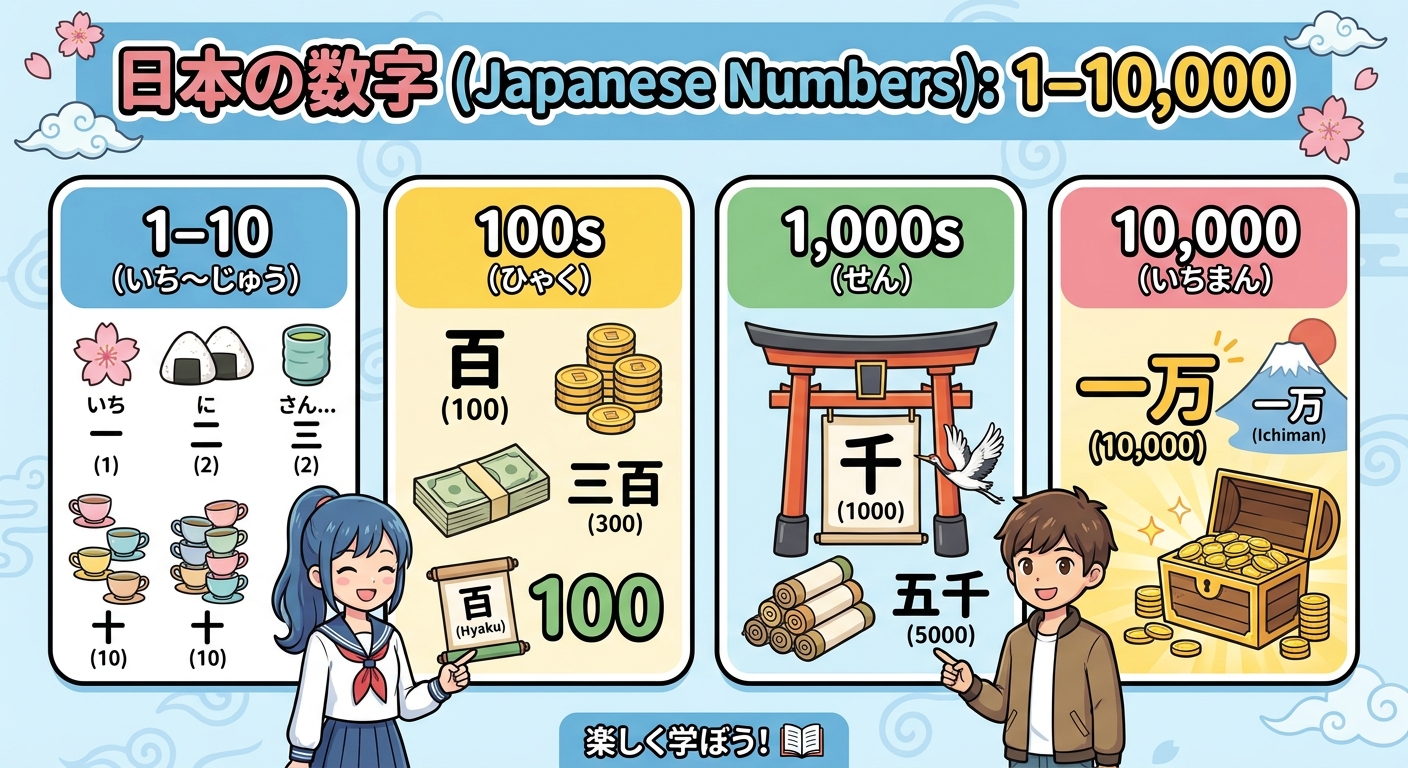
When we cross into the hundreds and thousands, we introduce new base units: 百 (100), 千 (1,000), and 万 (10,000).
百 (ひゃく - hyaku) = 100
Be careful! Sound changes (called rendaku) occur to make pronunciation smoother. These are prime targets for N5 listening exams:
- 100: 百 (hyaku) — Note: Do NOT say "ichi-hyaku"
- 300: 三百 (さんびゃく - sanbyaku)
- 600: 六百 (ろっぴゃく - roppyaku)
- 800: 八百 (はっぴゃく - happyaku)
千 (せん - sen) = 1,000
- 1,000: 千 (sen) — Note: Do NOT say "ichi-sen"
- 3,000: 三千 (さんぜん - sanzen)
- 8,000: 八千 (はっせん - hassen)
万 (まん - man) = 10,000
This is the ultimate N5 milestone. Unlike English, which counts in groups of three zeros (thousands), Japanese counts in groups of four zeros (myriads/ten-thousands).
- 10,000: 一万 (いちまん - ichiman) — Note: You MUST include "ichi" here!
4. Putting It All Together
To read any large Japanese number, break it down from the largest unit to the smallest.
-
3,452
- 3,000 (三千 / sanzen) + 400 (四百 / yonhyaku) + 50 (五十 / gojuu) + 2 (二 / ni)
- = 三千四百五十二 (sanzen-yonhyaku-gojuu-ni)
-
8,619
- 8,000 (八千 / hassen) + 600 (六百 / roppyaku) + 10 (十 / juu) + 9 (九 / kyuu)
- = 八千六百十九 (hassen-roppyaku-juu-kyuu)
Quick Practice Challenge
Can you translate these numbers into Japanese? (Scroll down for answers)
- 84
- 600
- 1,300
- 10,000
Answers:
- 八十四 (hachi-juu-yon)
- 六百 (roppyaku) — Watch out for the double 'p'!
- 千三百 (sen-sanbyaku) — Remember, no "ichi" before "sen", but 300 becomes "byaku".
- 一万 (ichiman) — Don't forget the "ichi"!
Exercises
Numbers 1–10,000 (Exercises)
Exercises for Numbers 1–10,000
Review the grammar and vocabulary, and try to fill in the blanks or write sentences based on the prompts.
Examples
この本は千五百円です。
Kono hon wa sen gohyaku en desu.
This book is 1,500 yen.
私の学校には学生が三百人います。
Watashi no gakkō ni wa gakusei ga sanbyaku nin imasu.
There are 300 students in my school.
その自転車は九千円でした。
Sono jitensha wa kyūsen en deshita.
That bicycle was 9,000 yen.
Practice Drills
Lesson Materials
Vocabulary (47)
Grammar (3)
Kanji (0)
No kanji characters in this lesson.
Kana (0)
No kana characters in this lesson.