
Days, Months, and Clock Time
Learn days of the week (〜曜日), months (〜月), dates (〜日), and telling time (〜時〜分). Practice reading schedules and asking the time.
🎯 Goal: By the end of this lesson, you will be able to read, write, and pronounce the days of the week, months of the year, specific dates (including irregular counters), and tell the time in hours and minutes to confidently schedule appointments and describe your daily schedule in Japanese.
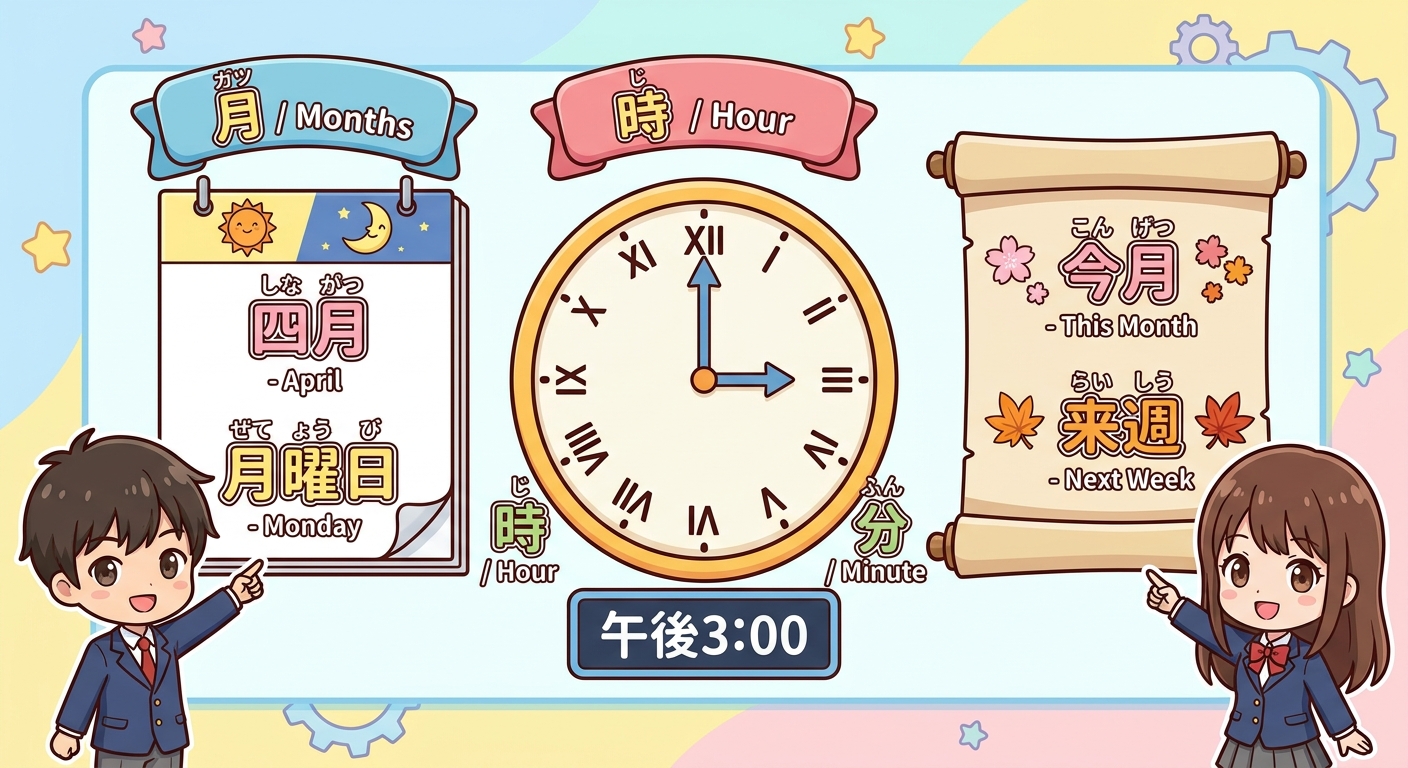
Introduction
Welcome to your essential guide to navigating time in Japanese! Mastering days, months, and clock time is a fundamental milestone in your JLPT N5 journey, enabling you to make plans, schedule appointments, and talk about your daily routine. In this lesson, we will break down the patterns of Japanese calendar terms—including the tricky irregular days of the month—and demystify how to tell time using hours and minutes. By understanding these core structures, you will transition from simple vocabulary to active, real-world communication. Let’s unlock the tools to talk about 'when' with confidence!
Lesson Content
Mastering Japanese Time: Clock Time, Months, and Days (JLPT N5)
Welcome to your ultimate guide to mastering time in Japanese! Expressing when things happen is a core pillar of the JLPT N5 exam. While the system is highly logical, it features several critical phonetic irregularities that examiners love to test.
Let's break down clock time, months, and days step-by-step.
1. Telling Time: Hours (時) and Minutes (分)
To tell the time, Japanese uses the formula: [Number] + 時 (ji) for hours, and [Number] + 分 (fun/pun) for minutes.
To specify AM or PM, place 午前 (gozen - AM) or 午後 (gogo - PM) before the time.
The Hours (〜時)
Most hours are straightforward, but 4, 7, and 9 are irregular. Do not use standard cardinal numbers for these!
| Hour | Japanese | Romaji | Pronunciation Note |
|---|---|---|---|
| 1:00 | 一時 | ichiji | Standard |
| 4:00 | 四時 | yoji | NOT yon-ji or shi-ji |
| 7:00 | 七時 | shichiji | NOT nana-ji |
| 9:00 | 九時 | kuji | NOT kyū-ji |
The Minutes (〜分)
The pronunciation of 分 alternates between fun and pun depending on the preceding number to make pronunciation smoother (euphony).
- Ends in fun: 2 (に分 - nifun), 5 (五分 - gofun), 7 (七分 - nanafun), 9 (九分 - kyūfun).
- Ends in pun (with a small っ): 1 (一分 - ippun), 3 (三分 - sampun), 4 (四分 - yonpun), 6 (六分 - roppun), 8 (八分 - happun), 10 (十分 - juppun).
💡 Tip: To say "half-past" (e.g., 2:30), use 半 (han) instead of 30分.
Example: 午後二時半 (gogo niji han - 2:30 PM).
2. Months of the Year (〜月)
Naming months in Japanese is incredibly simple: [Number 1-12] + 月 (gatsu).
However, watch out for April, July, and September!
| Month | Kanji | Romaji | Irregularity |
|---|---|---|---|
| January | 一月 | ichigatsu | Standard |
| April | 四月 | shigatsu | NOT yongatsu |
| July | 七月 | shichigatsu | NOT nanagatsu |
| September | 九月 | kugatsu | NOT kyūgatsu |
3. Days of the Month (〜日)
This is the most challenging part of N5 time vocabulary. Days 1 through 10, along with 14, 20, and 24, use unique, traditional Japanese readings instead of the standard [Number] + 日 (nichi) formula.
| Day | Japanese | Romaji | Day | Japanese | Romaji |
|---|---|---|---|---|---|
| 1st | 一日 | tsuitachi | 7th | 七日 | nanoka |
| 2nd | 二日 | futsuka | 8th | 八日 | yōka (long 'o') |
| 3rd | 三日 | mikka | 9th | 九日 | kokonoka |
| 4th | 四日 | yokka | 10th | 十日 | tōka |
| 5th | 五日 | itsuka | 14th | 十四日 | jūyokka |
| 6th | 六日 | muika | 20th | 二十日 | hatsuka |
| 24th | 二十四日 | nijūyokka |
For other days, simply use the Chinese reading: [Number] + 日 (nichi). For example, the 15th is 十五日 (jūgō-nichi).
4. Grammar & Particles in Action
To use these time words in sentences, you need three essential particles:
A. The Time Particle: に (ni)
Use に to mark the specific time an action occurs. Do not use に with relative time words like "today" (今日 - kyō) or "tomorrow" (明日 - ashita).
- 七時に起きます。
- Shichiji ni okimasu.
- I wake up at 7:00.
B. From and Until: から (kara) & まで (made)
Use から (from/since) and まで (until/to) to define time spans.
- 会議は九時から十時半までです。
- Kaigi wa kuji kara jūjihan made desu.
- The meeting is from 9:00 until 10:30.
Quick Practice Challenge
Translate this sentence into Japanese using what you've learned:
"The Japanese exam is on April 20th, from 1:00 PM to 3:00 PM."
Answer Key:
日本語の試験は四月二十日に午後一時から三時までです。
(Nihongo no shiken wa shigatsu hatsuka ni gogo ichiji kara sanji made desu.)
Exercises
Days, Months, and Clock Time (Exercises)
Exercises for Days, Months, and Clock Time
Review the grammar and vocabulary, and try to fill in the blanks or write sentences based on the prompts.
Examples
毎朝七時に起きます。
Maiasa shichiji ni okimasu.
I wake up at 7 o'clock every morning.
私の誕生日は五月十日です。
Watashi no tanjoubi wa gogatsu tooka desu.
My birthday is May 10th.
日曜日に友達と映画を見ます。
Nichiyoubi ni tomodachi to eiga o mimasu.
I will watch a movie with my friend on Sunday.
Practice Drills
Lesson Materials
Vocabulary (47)
Grammar (3)
Kanji (0)
No kanji characters in this lesson.
Kana (0)
No kana characters in this lesson.