
Family Words
Learn family terms in two registers: plain form (ちち, はは) used when talking about your own family, and polite form (おとうさん, おかあさん) used for others' families.
🎯 Goal: To confidently identify, pronounce, and apply the correct Japanese vocabulary for both your own family members and someone else's in basic, polite everyday conversations.
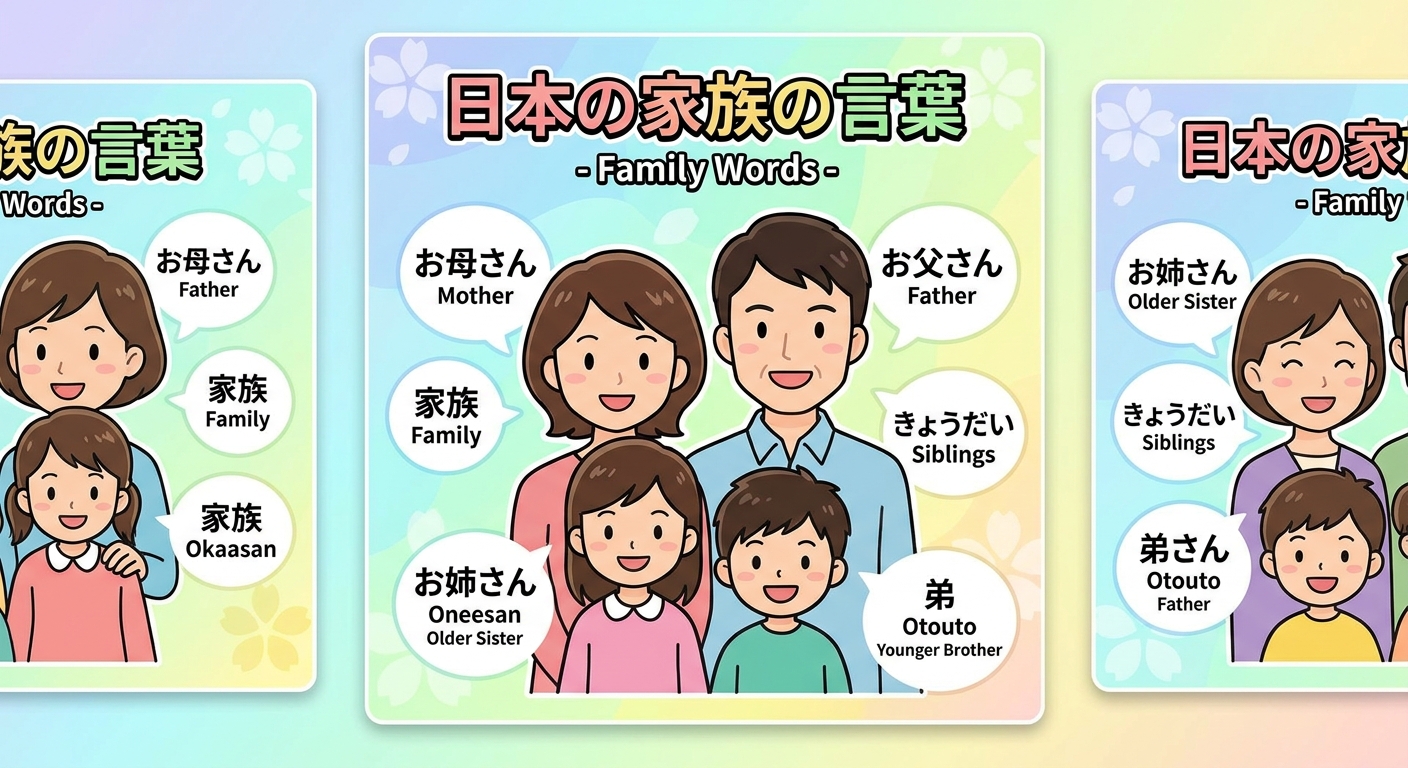
Introduction
Welcome to the 'Family Words' lesson, a fundamental step in your Japanese learning journey at the JLPT N5 level. In Japanese culture, talking about family involves a unique and respectful distinction between your own family members and someone else's family. In this lesson, you will learn how to navigate these two distinct sets of vocabulary—such as referring to your own mother as 'haha' versus someone else's mother as 'okaasan.' Mastering these terms will not only build your core vocabulary but also deepen your understanding of Japanese social etiquette and polite communication.
Lesson Content
Elite Japanese Lesson: Mastering Family Terms (N5)
In Japanese culture, the way you talk about family depends entirely on who you are speaking to. This is rooted in the concept of Uchi (内 - inside) and Soto (外 - outside).
To master N5 Japanese, you must learn two distinct sets of family vocabulary:
- Humble Terms (Uchi): Used when talking about your own family to someone outside your circle.
- Polite/Honorific Terms (Soto): Used when talking about someone else’s family, or when addressing your own family members directly.
1. The Core Family Vocabulary Matrix
Study this comparative table. Notice how polite terms often use the respectful prefix お (o-) and end with the polite suffix さん (-san).
| Family Member | My Family (Humble / Uchi) | Someone Else's Family (Polite / Soto) |
|---|---|---|
| Father | 父 (chichi) | お父さん (otōsan) |
| Mother | 母 (haha) | お母さん (okāsan) |
| Older Brother | 兄 (ani) | お兄さん (onīsan) |
| Older Sister | 姉 (ane) | お姉さん (onēsan) |
| Younger Brother | 弟 (otōto) | 弟さん (otōtosan) |
| Younger Sister | 妹 (imōto) | 妹さん (imōtosan) |
| Husband | 夫 (otto) | ご主人 (goshujin) |
| Wife | 妻 (tsuma) | 奥さん (okusan) |
2. Key Rules for Usage
Rule 1: Talking About Your Own Family (To an Outsider)
When speaking to a teacher, boss, or stranger, always use the humble form for your own family. Never use okāsan or otōsan to describe your parents to outsiders; it sounds like you are elevating your own family above the listener.
- Example:
- 母は日本語の先生です。
- Haha wa nihongo no sensei desu.
- (My) mother is a Japanese teacher.
Rule 2: Talking to Your Own Family Members (Directly)
When you are at home talking directly to your parents or older siblings, use the Polite (Soto) terms. It shows affection and respect.
Note: Younger siblings are usually called directly by their first names, not by "otōto" or "imōto".
- Example:
- お父さん、朝ご飯ですよ。
- Otōsan, asagohan desu yo.
- Dad, breakfast is ready!
Rule 3: Talking About Someone Else's Family
Always use the polite form, and pair it with the possessive particle の (no) to clarify whose family you are discussing.
- Example:
- 鈴木さんの奥さんは親切です。
- Suzuki-san no okusan wa shinsetsu desu.
- Suzuki-san's wife is kind.
3. Grammar Spotlight: Particle Connection
To ask about someone's family, use this standard N5 pattern:
$$\text{[Person]} + \text{の} + \text{[Polite Family Member]} + \text{は} + \text{[Question/Statement]}$$
- Example Q:
- トムさんのお姉さんは何歳ですか。
- Tomu-san no onēsan wa nansai desu ka.
- How old is Tom's older sister?
- Example A:
- 姉は二十歳です。
- Ane wa hatachi desu.
- My older sister is 20 years old.
4. Tutor's Pro-Tip: The "Haha/Chichi" Memory Trick
To remember which is which:
- Haha (母) sounds like laughter. Your mother makes you laugh.
- Chichi (父) sounds like "chief." The father is traditionally the chief of the household.
- These short, simple words are humble. The longer, grander words (okāsan, otōsan) are polite.
Exercises
Family Words (Exercises)
Exercises for Family Words
Review the grammar and vocabulary, and try to fill in the blanks or write sentences based on the prompts.
Examples
わたしの家族は四人です。
Watashi no kazoku wa yonin desu.
There are four people in my family.
わたしは妹が二人います。
Watashi wa imouto ga futari imasu.
I have two younger sisters.
父は会社員です。
Chichi wa kaishain desu.
My father is a company employee.
Practice Drills
Lesson Materials
Vocabulary (47)
Grammar (3)
Kanji (0)
No kanji characters in this lesson.
Kana (0)
No kana characters in this lesson.