
Food and Drink Vocabulary
Learn 40+ common food, drink, and restaurant words: ごはん, パン, おちゃ, みず, たまご, さかな, にく. Learn restaurant phrases: 〜をください, おいくらですか.
🎯 Goal: By the end of this lesson, you will be able to identify and use basic Japanese vocabulary for common foods and drinks, express your personal preferences using simple N5 sentence structures, and confidently order a meal or beverage in a Japanese dining setting.
Introduction
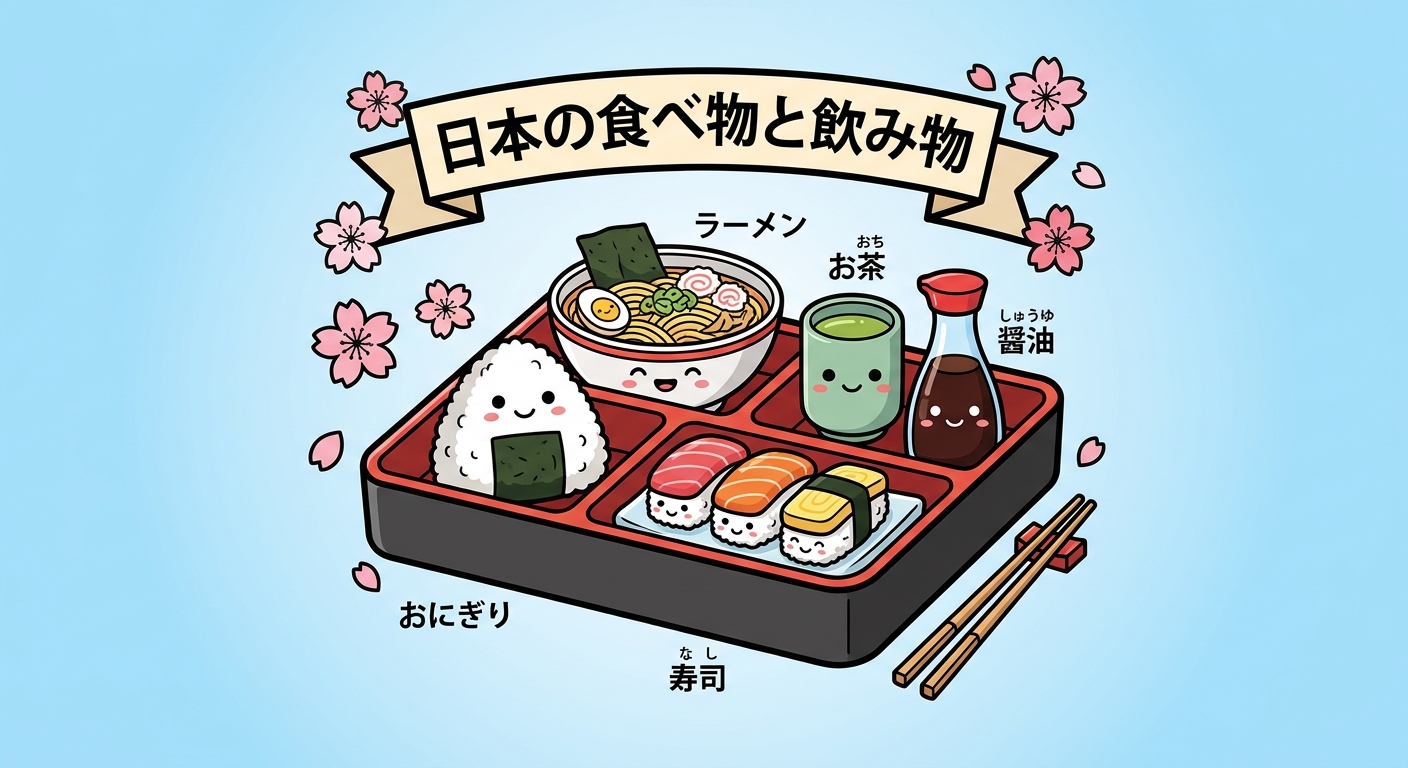
Welcome to the "Food and Drink Vocabulary" lesson, designed specifically for JLPT N5 learners. Food is not only a daily necessity but also a vibrant gateway to Japanese culture. In this lesson, you will build a foundational vocabulary of essential Japanese foods (tabemono) and drinks (nomimono), ranging from everyday staples like rice and water to popular dishes like sushi and ramen. You will also learn crucial verbs like "to eat" (taberu) and "to drink" (nomu), alongside basic particles. By mastering these high-frequency terms, you will gain the confidence to express your preferences, order at restaurants, and navigate daily dining situations in Japan.
Lesson Content
Master N5 Japanese: Food and Drink (食べ物と飲み物)
Welcome to your ultimate guide to mastering N5-level food and drink vocabulary! Whether you are preparing for the JLPT or planning your first trip to a Japanese restaurant, knowing how to talk about what you eat and drink is essential.
In this lesson, we will cover key vocabulary, fundamental particles, and polite sentence structures to get you speaking immediately.
1. Essential Vocabulary (単語 - Tango)
In Japanese, "food" is 食べ物 (たべもの - tabemono) and "drink" is 飲み物 (のみもの - nomimono). Notice how both words combine a verb stem (tabe from taberu / nomi from nomu) with 物 (mono), which means "thing." Literally: "eating things" and "drinking things."
Food (食べ物)
| Kanji / Katakana | Hiragana | Romaji | English |
|---|---|---|---|
| ご飯 | ごはん | gohan | Rice / Meal |
| 肉 | にく | niku | Meat |
| 魚 | さかな | sakana | Fish |
| 卵 | たまご | tamago | Egg |
| 野菜 | やさい | yasai | Vegetables |
| パン | ぱん | pan | Bread |
| 果物 | くだもの | kudamono | Fruit |
Drinks (飲み物)
| Kanji / Katakana | Hiragana | Romaji | English |
|---|---|---|---|
| 水 | みず | mizu | Water |
| お茶 | おちゃ | ocha | Green Tea |
| 牛乳 | ぎゅうにゅう | gyūnyū | Milk |
| コーヒー | こーひー | kōhī | Coffee |
| ジュース | じゅーす | jūsu | Juice |
Note: Western foods and drinks (like bread, coffee, and juice) are written in Katakana because they are loanwords.
2. Key Grammar & Particles
To build sentences, we need to connect our nouns to verbs using the direct object marker particle: を (o).
The Particle を (o)
In Japanese, the particle を marks the object that receives the action of the verb. Although written as "wo" on keyboards, it is pronounced simply as "o."
Sentence Structure:
[Noun] + を + [Verb]
Key N5 Verbs
- 食べます (tabemasu) = to eat
- 飲みます (nomimasu) = to drink
Examples:
-
お茶を飲みます。
Ocha o nomimasu.
I drink green tea. -
パンを食べます。
Pan o tabemasu.
I eat bread.
3. How to Order Food in Japan
When you are at a restaurant or convenience store, you can easily order by using the polite phrase 〜をください (~ o kudasai), which means "Please give me [item]."
Structure:
[Food/Drink] + をください (o kudasai)
Examples:
- 水をください。
Mizu o kudasai.
Water, please. - コーヒーをください。
Kōhī o kudasai.
Coffee, please.
4. Cultural & Writing Tip: The Prefix 「お」 (o-)
You might have noticed that "green tea" is お茶 (o-cha) and "water" can sometimes be called お水 (o-mizu).
The prefix お (o-) is a polite, beautifying prefix (美化語 - bikago) added to certain nouns. It softens the language and makes your speech sound refined and respectful. Always use お茶 (ocha) rather than just cha!
5. Practice Challenge
Test your knowledge! Translate the following sentences into Japanese. (Scroll down for answers)
- I eat fish.
- Please give me juice.
- I drink milk.
Answers:
- 魚を食べます。 (Sakana o tabemasu.)
- ジュースをください。 (Jūsu o kudasai.)
- 牛乳を飲みます。 (Gyūnyū o nomimasu.)
Exercises
Food and Drink Vocabulary (Exercises)
Exercises for Food and Drink Vocabulary
Review the grammar and vocabulary, and try to fill in the blanks or write sentences based on the prompts.
Examples
毎日水を飲みます。
Mainichi mizu o nomimasu.
I drink water every day.
昨日、お寿司を食べました。
Kinō, osushi o tabemashita.
I ate sushi yesterday.
朝ご飯にパンと卵を食べます。
Asagohan ni pan to tamago o tabemasu.
I eat bread and eggs for breakfast.
Practice Drills
Lesson Materials
Vocabulary (45)
Grammar (3)
Kanji (0)
No kanji characters in this lesson.
Kana (0)
No kana characters in this lesson.