
Hiragana H–W Rows
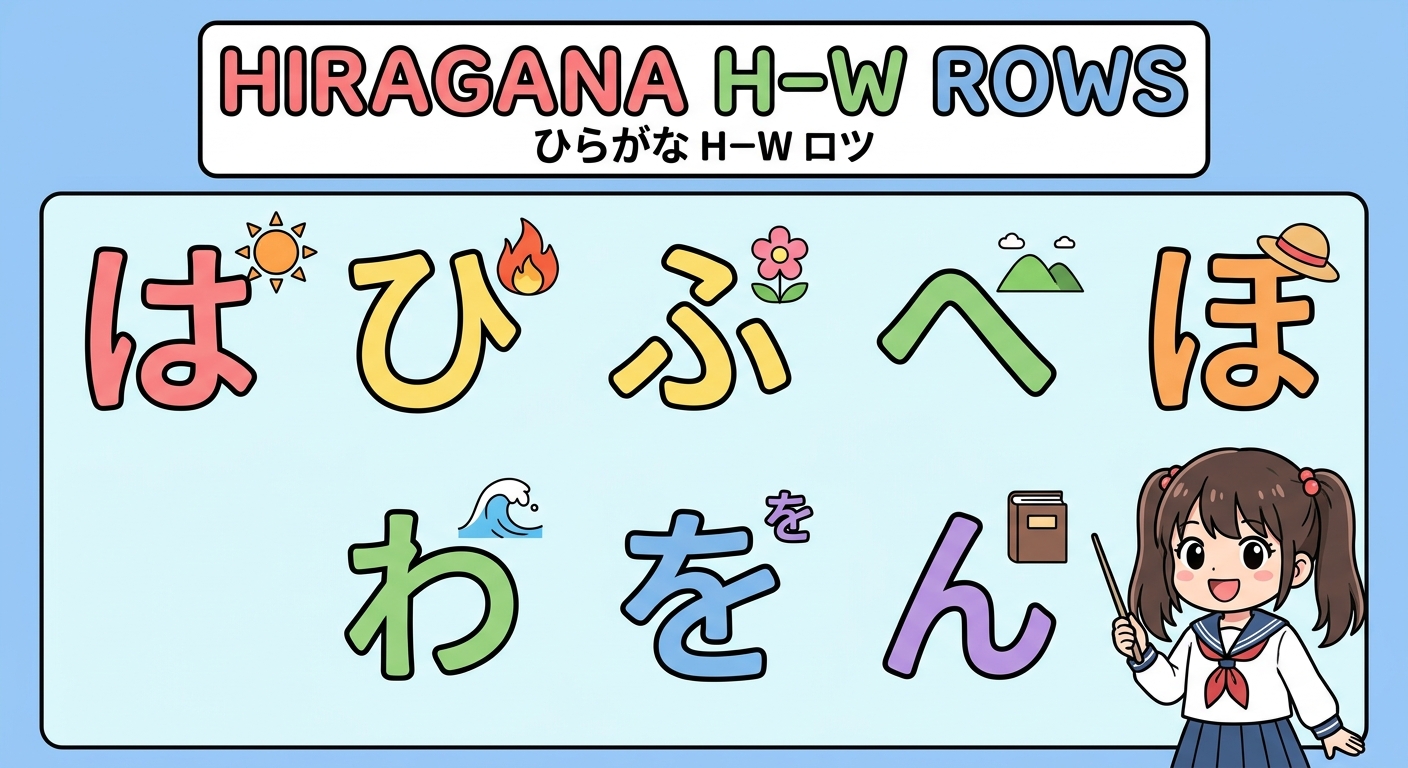
Learn は row through わ row and the standalone ん character. Understand how ん sounds before different consonants.
🎯 Goal: To accurately recognize, pronounce, and write all characters in the Hiragana H, M, Y, R, and W rows, including the nasal "n" (ん), and to apply this knowledge to read and write basic N5-level Japanese words.
Introduction
Welcome to the final stretch of your Hiragana journey! In this lesson, we will master the remaining consonant groups: the H, M, Y, R, and W rows, along with the singular "n" (ん) sound. By conquering these final characters, you will unlock the ability to read and write virtually any native Japanese word. We will explore the unique stroke orders, pronunciation nuances—such as the soft Japanese "R" sound and the unique characters of the W-row—and practice building essential N5 vocabulary. You are just one step away from complete Hiragana literacy. Let’s finish strong!
Lesson Content
Mastering Hiragana: The H to W Rows & Beyond (N5)
Welcome back to your journey toward Japanese fluency! You have already conquered the first half of the Hiragana syllabary. Today, we will master the final stretch: the H, M, Y, R, and W rows, along with the singular nasal consonant ん (n).
By the end of this guide, you will be ready to read and write dozens of essential N5 vocabulary words. Let’s dive in!
1. The Character Breakdown
Let's examine these final rows. Pay close attention to pronunciation nuances and visual traps.
H-Row:  は (ha)   ひ (hi)   ふ (fu)   へ (he)   ほ (ho)
M-Row:  ま (ma)   み (mi)   む (mu)   め (me)   も (mo)
Y-Row:  や (ya)             ゆ (yu)             よ (yo)
R-Row:  ら (ra)   り (ri)   る (ru)   れ (re)   ろ (ro)
W/N:    わ (wa)   を (wo)   ん (n)
Key Pronunciation & Usage Notes:
- ふ (fu): This is not a harsh English "fu" (as in "food"). Do not let your upper teeth touch your lower lip. Instead, blow air gently between your lips as if blowing out a candle. It is a hybrid of "hu" and "fu."
- The Japanese "R" (ら, り, る, れ, ろ): This is not the English retroflex "R." It is a "flap" consonant, produced by tapping your tongue quickly against the roof of your mouth, just behind your teeth. It sounds like a blend of "L," "R," and "D" (similar to the "tt" in the American pronunciation of "watter").
- を (wo): In modern Japanese, this is pronounced exactly like お (o). It is used exclusively as a grammatical particle marking the direct object of a sentence.
- ん (n): The only hiragana character consisting of a single consonant with no vowel sound. It can never start a word.
2. Visual Pitfalls: Don't Get Tripped Up!
Many hiragana characters look similar. Train your eyes to spot these subtle differences:
- は (ha) vs. ほ (ho) vs. ま (ma):
- は has one horizontal stroke and a loop.
- ほ has two horizontal strokes and a "hat" on top that must not be crossed by the vertical line.
- ま has two horizontal strokes, but the vertical line crosses through the top.
- わ (wa) vs. れ (re) vs. ね (ne):
- わ curves gently inward at the end.
- れ sweeps sharply outward.
- ね ends in a loop.
3. Sound Mutations: Dakuten & Handakuten
The H-row is unique because it can transform into two different sound groups using diacritical marks:
- Dakuten (゛) turns H into B:
- は (ha) $\rightarrow$ ば (ba) | ひ (hi) $\rightarrow$ び (bi) | ふ (fu) $\rightarrow$ ぶ (bu) | へ (he) $\rightarrow$ べ (be) | ほ (ho) $\rightarrow$ ぼ (bo)
- Handakuten (゜) turns H into P:
- は (ha) $\rightarrow$ ぱ (pa) | ひ (hi) $\rightarrow$ ぴ (pi) | ふ (fu) $\rightarrow$ ぷ (pu) | へ (he) $\rightarrow$ ぺ (pe) | ほ (ho) $\rightarrow$ ぽ (po)
4. N5 Vocabulary Practice
Let’s combine your new knowledge to read real Japanese words:
- はい (hai) – Yes
- やま (yama) – Mountain
- くるま (kuruma) – Car
- さくら (sakura) – Cherry blossom
- わたし (watashi) – I / Me
- にほん (nihon) – Japan
- てんぷら (tenpura) – Tempura
5. Quick Challenge
Can you romanize and translate the following N5 phrases? (Answers below)
- はる (Hint: A warm season)
- ふゆ (Hint: A cold season)
- ほん を よみます (Hint: "read a book")
Challenge Answers:
- haru (Spring)
- fuyu (Winter)
- hon o yomimasu (Read a book — notice how を is written as "wo" but pronounced "o", and は as a topic marker would be "wa").
Exercises
Hiragana H–W Rows (Exercises)
Exercises for Hiragana H–W Rows
Review the grammar and vocabulary, and try to fill in the blanks or write sentences based on the prompts.
Examples
わたしはほんをよみます。
Watashi wa hon o yomimasu.
I read books.
へやにしろいはながあります。
Heya ni shiroi hana ga arimasu.
There are white flowers in the room.
ふゆにゆきがふります。
Fuyu ni yuki ga furimasu.
It snows in winter.
Practice Drills
Lesson Materials
Grammar (3)
Kanji (0)
No kanji characters in this lesson.
Kana (0)
No kana characters in this lesson.