
Dakuten & Handakuten
Learn voiced and semi-voiced sound changes: が、ざ、だ、ば and ぱ rows. Understand when and how to add the diacritic marks.
🎯 Goal: To accurately identify, write, and pronounce Japanese characters modified by Dakuten and Handakuten, allowing you to correctly read and differentiate foundational N5 vocabulary.
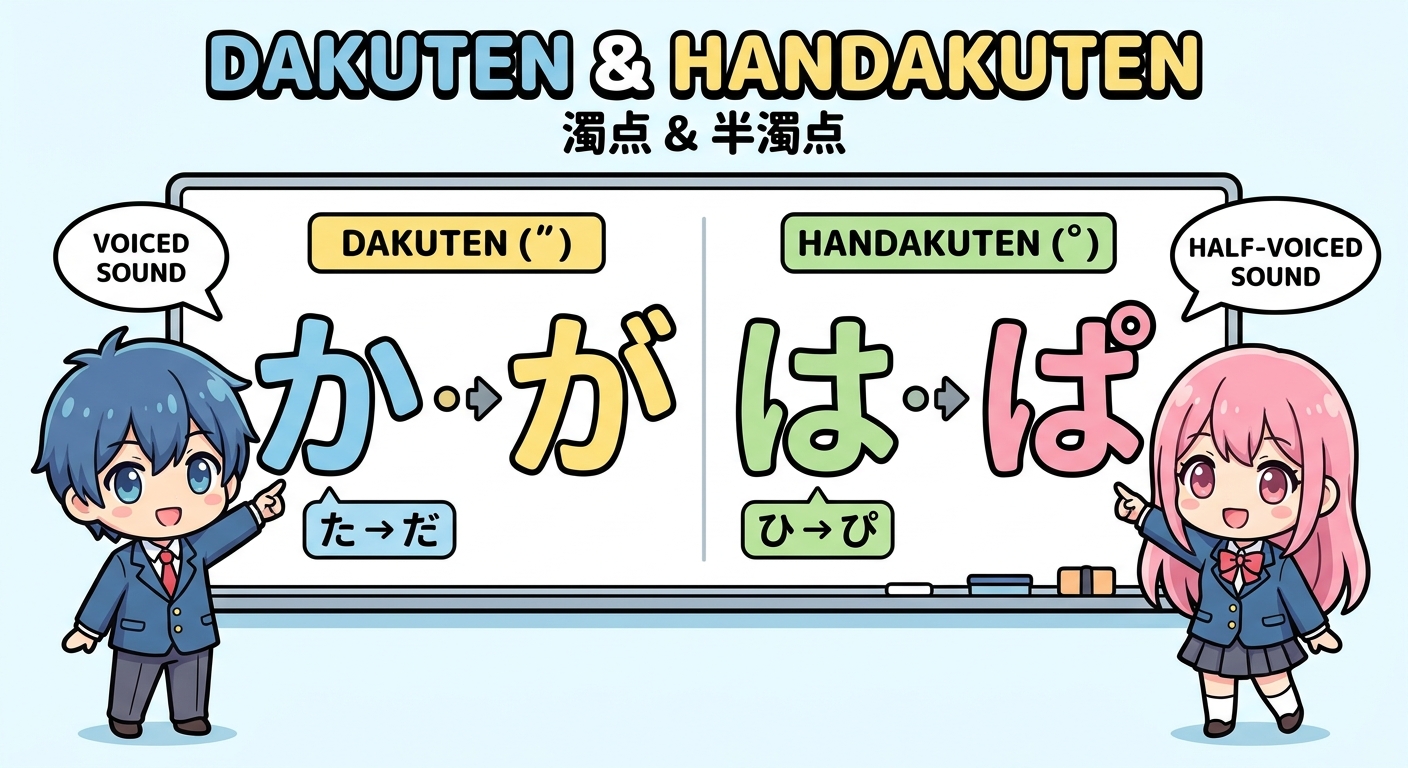
Introduction
Welcome to the essential guide to Dakuten (゛) and Handakuten (゜), the diacritical marks that unlock a whole new range of sounds in the Japanese writing system. As an N5 student, mastering these small symbols is crucial for accurate reading, writing, and pronunciation. By adding these marks to basic hiragana and katakana characters, you will transform unvoiced consonants into voiced ones—turning 'ka' into 'ga,' 'ta' into 'da,' and 'ha' into 'ba' or 'pa.' Understanding this phonetic shift is a major milestone that will instantly expand your vocabulary and boost your confidence in everyday Japanese.
Lesson Content
Master Japanese Phonetics: Dakuten (゛) & Handakuten (゜)
Welcome to your first major upgrade in reading and writing Japanese! If you already know your basic Hiragana and Katakana, you are ready to unlock 36 new sounds without learning a single new character.
We do this using two simple diacritical marks: Dakuten and Handakuten.
1. What are Dakuten and Handakuten?
These are small marks placed at the top-right corner of a Hiragana or Katakana character to change its pronunciation. They are always written last.
- Dakuten (゛): Often called tenten ("dots"). It looks like a double quotation mark. It "voices" a sound, meaning you vibrate your vocal cords.
- Handakuten (゜): Often called maru ("circle"). It looks like a tiny degree symbol. It turns "H" sounds into "P" sounds.
2. The Dakuten Transformation (The "Voiced" Sounds)
Dakuten turns unvoiced consonants into voiced ones. Think of it as adding a "buzz" to the sound. Four character rows can take a Dakuten:
| Original Row | Dakuten Row | Sound Shift | Example (Hiragana) | Example (Katakana) |
|---|---|---|---|---|
| K-row (か, き...) | G-row | K $\rightarrow$ G | か (ka) $\rightarrow$ が (ga) | カ (ka) $\rightarrow$ ガ (ga) |
| S-row (さ, し...) | Z-row | S $\rightarrow$ Z | さ (sa) $\rightarrow$ ざ (za) | サ (sa) $\rightarrow$ ザ (za) |
| T-row (た, ち...) | D-row | T $\rightarrow$ D | た (ta) $\rightarrow$ だ (da) | タ (ta) $\rightarrow$ ダ (da) |
| H-row (は, ひ...) | B-row | H $\rightarrow$ B | は (ha) $\rightarrow$ ば (ba) | ハ (ha) $\rightarrow$ バ (ba) |
💡 Elite Tutor Tip: The "Ji" and "Zu" Exceptions
Pay close attention to these irregular sounds:
- し (shi) + ゛ = じ (ji)
- ち (chi) + ゛ = ぢ (ji) (pronounced the same as じ)
- す (su) + ゛ = ず (zu)
- つ (tsu) + ゛ = づ (zu) (pronounced the same as ず)
Which one do I use? 99% of the time, you will use じ (ji) and ず (zu). The characters ぢ and づ are very rare and only used in specific compound words (like hanaji / はなぢ / nosebleed).
3. The Handakuten Transformation (The "P" Sounds)
The Handakuten (゜) is exclusive. It only pairs with the H-row (は, ひ, ふ, へ, ほ). It transforms the soft breathing "H" sound into a crisp, popping "P" sound.
| Original Character | Handakuten Character | Romaji |
|---|---|---|
| は (ha) | ぱ | pa |
| ひ (hi) | ぴ | pi |
| ふ (fu) | ぷ | pu |
| へ (he) | ぺ | pe |
| ほ (ho) | ぽ | po |
4. Stroke Order & Placement
To write these marks like a native:
- Write the base kana completely first.
- Place the mark in the upper-right clearance of the character.
- For Dakuten (゛): Write two short, diagonal strokes slanting down from left to right. Write the left stroke first, then the right.
- For Handakuten (゜): Draw a tiny, perfect circle in one clockwise stroke.
5. N5 Vocabulary Practice
Let's see these marks in action with essential JLPT N5 vocabulary:
- かぜ (kaze) — Wind / Cold (illness)
- まんが (manga) — Manga / Comic
- たべもの (tabemono) — Food
- てんぷら (tenpura) — Tempura
- ベッド (beddo) — Bed (Katakana)
By mastering these two tiny symbols, you have officially expanded your Japanese reading capacity exponentially. Keep practicing, and look out for these marks in your daily reading!
Exercises
Dakuten & Handakuten (Exercises)
Exercises for Dakuten & Handakuten
Review the grammar and vocabulary, and try to fill in the blanks or write sentences based on the prompts.
Examples
わたしはパンを食べます。
watashi wa pan o tabemasu.
I eat bread.
わたしは学生です。
watashi wa gakusei desu.
I am a student.
これは鉛筆です。
kore wa enpitsu desu.
This is a pencil.