
Hiragana A–N Rows
Learn あいうえお to なにぬねの with correct stroke order and pronunciation. Each character is introduced with a mnemonic image and audio.
🎯 Goal: To accurately recognize, pronounce, and write all Hiragana characters from the 'A' row to the 'N' row, establishing the essential phonetic and written foundation required to read basic Japanese words and progress to JLPT N5 grammar.
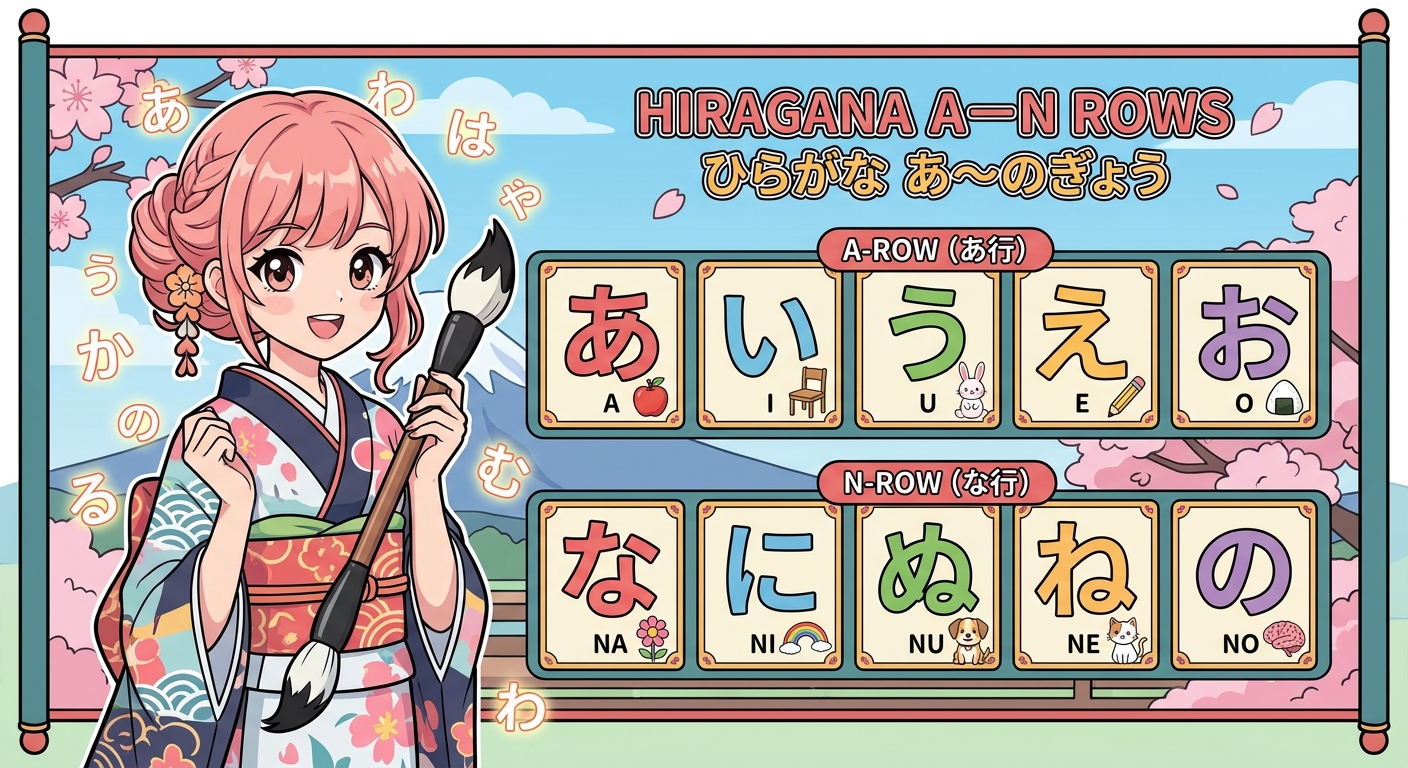
Introduction
Welcome to your very first step in mastering the Japanese language! In this lesson, we will explore Hiragana, the foundational phonetic alphabet essential for reading and writing Japanese. We will focus on the rows from 'A' (あ) through 'N' (ん), which form the backbone of Japanese pronunciation and vocabulary. By understanding the stroke order, pronunciation, and visual structure of these characters, you will transition from romaji to reading authentic Japanese. This critical milestone will unlock your ability to read basic words, signboards, and grammar particles, setting a strong, confident foundation for your JLPT N5 journey.
Lesson Content
Master the Hiragana: The Complete あ (A) to ん (N) Guide
Welcome to your first major milestone in Japanese! Hiragana (ひらがな) is the phonetic backbone of the Japanese language. Every sound you speak can be written in Hiragana.
As your tutor, I will guide you through the structure, pronunciation secrets, visual pitfalls, and essential N5 vocabulary to help you master all 46 basic characters from あ (A) to ん (N).
1. The Structure of Hiragana (The Gojūon)
Hiragana is organized into a grid of 5 vowels (あ, い, う, え, お) combined with 9 consonant rows (K, S, T, N, H, M, Y, R, W) and the singular nasal sound ん (N).
| Row | あ (a) | い (i) | う (u) | え (e) | お (o) |
|---|---|---|---|---|---|
| Vowel | あ | い | う | え | お |
| K-Row | か | き | く | け | こ |
| S-Row | さ | し (shi) | す | せ | そ |
| T-Row | た | ち (chi) | つ (tsu) | て | と |
| N-Row | な | に | ぬ | ね | の |
| H-Row | は | ひ | ふ (fu) | へ | ほ |
| M-Row | ま | み | む | め | も |
| Y-Row | や | ゆ | よ | ||
| R-Row | ら | り | る | れ | ろ |
| W-Row | わ | を (wo) | |||
| N | ん (n) |
2. Key Pronunciation & Stroke Order Rules
To write and speak like a native, keep these three golden rules in mind:
The Golden Rules of Stroke Order
- Left to Right, Top to Bottom: This is the universal rule of Japanese calligraphy.
- Horizontal Before Vertical: Draw horizontal anchor strokes before crossing them vertically (e.g., 十).
- Control the Ending: Pay attention to how a stroke ends:
- Stop (Tome): A clean, abrupt halt.
- Release (Harai): A sweeping fade-out.
- Hook (Hane): A sharp upward flick.
Pronunciation Quirks
- し (shi), ち (chi), つ (tsu): Notice these do not follow the standard "S" and "T" sounds. つ (tsu) sounds like the "ts" in "cats".
- ふ (fu): Do not bite your lower lip like the English "F". Instead, blow air gently between your lips as if blowing out a candle.
- The R-Row (ら, り, る, れ, ろ): This is not the English "R". It is a "lateral flap"—flick your tongue against the roof of your mouth, right behind your front teeth. It sounds like a blend of L, R, and D (similar to the "tt" in the American pronunciation of "watter").
3. Tutor's Warning: Avoid These Visual Pitfalls!
Many N5 students lose points on exams by confusing look-alike characters. Memorize these distinctions early:
- あ (a) vs. お (o):
- あ has a loop that integrates with the vertical cross-stroke.
- お has a distinct right-side dot and a loop that flows outward.
- さ (sa) vs. き (ki):
- さ has one horizontal bar.
- き has two horizontal bars.
- ぬ (nu) vs. め (me):
- ぬ ends with a loop (like a nutshell).
- め ends with a sharp sweep (like a messy tail).
- は (ha) vs. ほ (ho):
- ほ has a horizontal cap on top; は does not.
4. N5 Vocabulary Practice
Let’s put your reading to the test. Try pronouncing these essential JLPT N5 words:
- あおい (aoi) — Blue
- いぬ (inu) — Dog
- ねこ (neko) — Cat
- さくら (sakura) — Cherry Blossom
- わたし (watashi) — I / Me
- にほん (nihon) — Japan
5. Your Action Plan
To master Hiragana in one week:
- Write by Hand: Do not just look; muscle memory is key. Write each character 20 times daily.
- Use Mnemonics: Associate shapes with pictures (e.g., し looks like a fishing shi-shook).
- Read Active Text: Download an N5 vocabulary list and practice sounding out words, even if you do not know the meanings yet.
Ganbatte! (Do your best!) You are now ready to conquer the Japanese writing system.
Exercises
Hiragana A–N Rows (Exercises)
Exercises for Hiragana A–N Rows
Review the grammar and vocabulary, and try to fill in the blanks or write sentences based on the prompts.
Examples
いぬとねこがいます。
Inu to neko ga imasu.
There is a dog and a cat.
あそこにさかながいます。
Asoko ni sakana ga imasu.
There is a fish over there.
あなたのなまえはなんですか。
Anata no namae wa nan desu ka?
What is your name?