
Greetings and Introductions Audio
Listen to slow-paced beginner conversations about greetings and self-introductions. Focus on understanding names, countries, and occupations from spoken Japanese.
🎯 Goal: By the end of this lesson, you will be able to confidently introduce yourself in Japanese, use appropriate time-of-day greetings, and understand basic spoken self-introductions from native speakers at an N5 level.
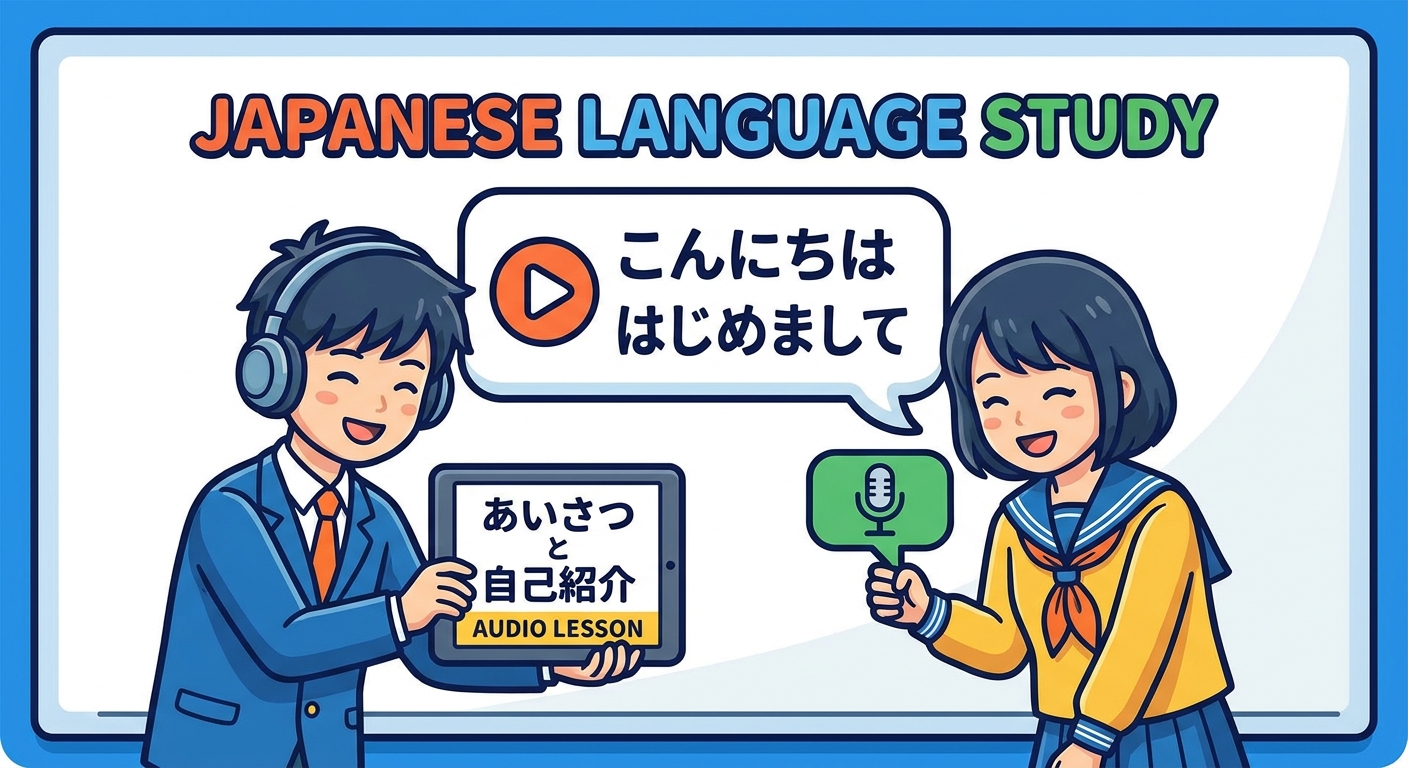
Introduction
Welcome to "Greetings and Introductions Audio," an essential listening and speaking lesson designed for JLPT N5 learners. In Japanese culture, first impressions are vital, and mastering natural greetings sets the foundation for all future interactions. This lesson focuses on high-frequency, everyday expressions used to greet others, introduce yourself, and respond politely in various social contexts. Through authentic audio examples, you will train your ears to recognize natural Japanese pitch, intonation, and rhythm. By practicing along with native speakers, you will build the confidence needed to initiate conversations and make a lasting, polite impression in Japan.
Lesson Content
Elite Japanese Study Guide: Mastering Greetings & Introductions (N5)
Welcome to your definitive guide to Japanese greetings (aisatsu) and self-introductions (jikoshoukai). At the JLPT N5 level, mastering these phrases is not just about memorizing words; it is about training your ears to recognize natural phonetic transitions, vowel devoicing, and polite speech patterns in audio comprehension.
1. Core Vocabulary & Audio Phonetics
When listening to native speakers, pay close attention to pitch accent and vowel devoicing (where vowels like u and i become nearly silent).
| Japanese (Kana) | Romaji | English | Audio & Pronunciation Key |
|---|---|---|---|
| はじめまして | Hajimemashite | Nice to meet you. | Literally, "We are starting (a relationship)." The hi is soft. |
| ~です | ...desu | I am... / It is... | Pronounced "des" (the final u is devoiced). |
| どうぞ よろしく | Douzo yoroshiku | Please favor me. | Elongate the ou in Douzo (Do-ozo). |
| こちらこそ | Kochira koso | Likewise / Me, too. | High pitch on co, falling on koso. |
2. Structural Grammar of Introductions
To comprehend spoken introductions, you must instantly decode two fundamental N5 particles: は (wa) and の (no).
Pattern 1: The Topic Marker — [A] は [B] です
- Structure:
[Noun/Pronoun] は [Name/Occupation/Nationality] です - Grammar Rule: The particle は is written as "ha" but pronounced "wa". It marks the main topic of the sentence.
- Audio Cue: In natural speech, there is a micro-pause immediately after は.
Example:
わたし は マイク です。
Watashi wa Maiku desu.
(As for me, I am Mike.)
Pattern 2: The Association Particle — [A] の [B]
- Structure:
[Organization/Country] の [Name/Status] - Grammar Rule: の (no) connects two nouns, showing possession or affiliation (A's B, or B of A).
Example:
ABC大学 の さくら です。
ABC-daigaku no Sakura desu.
(I am Sakura of ABC University.)
3. Audio Comprehension: Listening Simulation
Analyze this standard N5 listening script. Read the dialogue while visualizing the audio flow.
[Audio Scene: A university classroom. Two students meet for the first time.]

John:   はじめまして。ジョン です。アメリカ から 来ました。
        Hajimemashite. Jon desu. Amerika kara kimashita.
        (Nice to meet you. I am John. I came from America.)

Hana:   はじめまして、ハナ です。こちらこそ、よろしくお願いします。
        Hajimemashite, Hana desu. Kochira koso, yoroshiku onegai shimasu.
        (Nice to meet you, I am Hana. Likewise, please treat me well.)
Key Listening Cues to Identify:
- から来ました (kara kimashita): This means "came from." Listen for the rapid transition kara-ki-mash-ta. The i in shita is devoiced.
- よろしくお願いします (yoroshiku onegai shimasu): In fast speech, this sounds like one continuous word: yorosh'konegai-shimas.
4. Tutor's Tips for Audio & Cultural Success
- The Muffled "U": Whenever you hear verbs ending in
~ます(-masu) or the copulaです(desu), train your brain to drop the "u" sound. It is shimas, not shimazu. - The Bow (Rei): In Japanese culture, greeting audio is accompanied by physical movement. Do not speak while bowing; speak your greeting clearly, then bow. This keeps your voice projected and polite.
Exercises
Greetings and Introductions Audio (Exercises)
Exercises for Greetings and Introductions Audio
Review the grammar and vocabulary, and try to fill in the blanks or write sentences based on the prompts.
Examples
はじめまして。マイクです。どうぞよろしくお願いします。
Hajimemashite. Maiku desu. Douzo yoroshiku onegaishimasu.
Nice to meet you. I am Mike. Pleased to meet you.
お名前は何ですか。
O-namae wa nan desu ka.
What is your name?
私は日本から来ました。
Watashi wa Nihon kara kimashita.
I came from Japan.
Practice Drills
Lesson Materials
Vocabulary (5)
Grammar (3)
Kanji (0)
No kanji characters in this lesson.
Kana (0)
No kana characters in this lesson.