
Shopping and Restaurant Audio
Listen to basic daily-life interactions: ordering at a restaurant and buying items at a shop. Understand numbers, items, and polite request phrases.
🎯 Goal: To accurately comprehend basic spoken Japanese in shopping and dining contexts, enabling you to identify prices, understand simple customer-staff interactions, and confidently order food or purchase items in real-world scenarios.
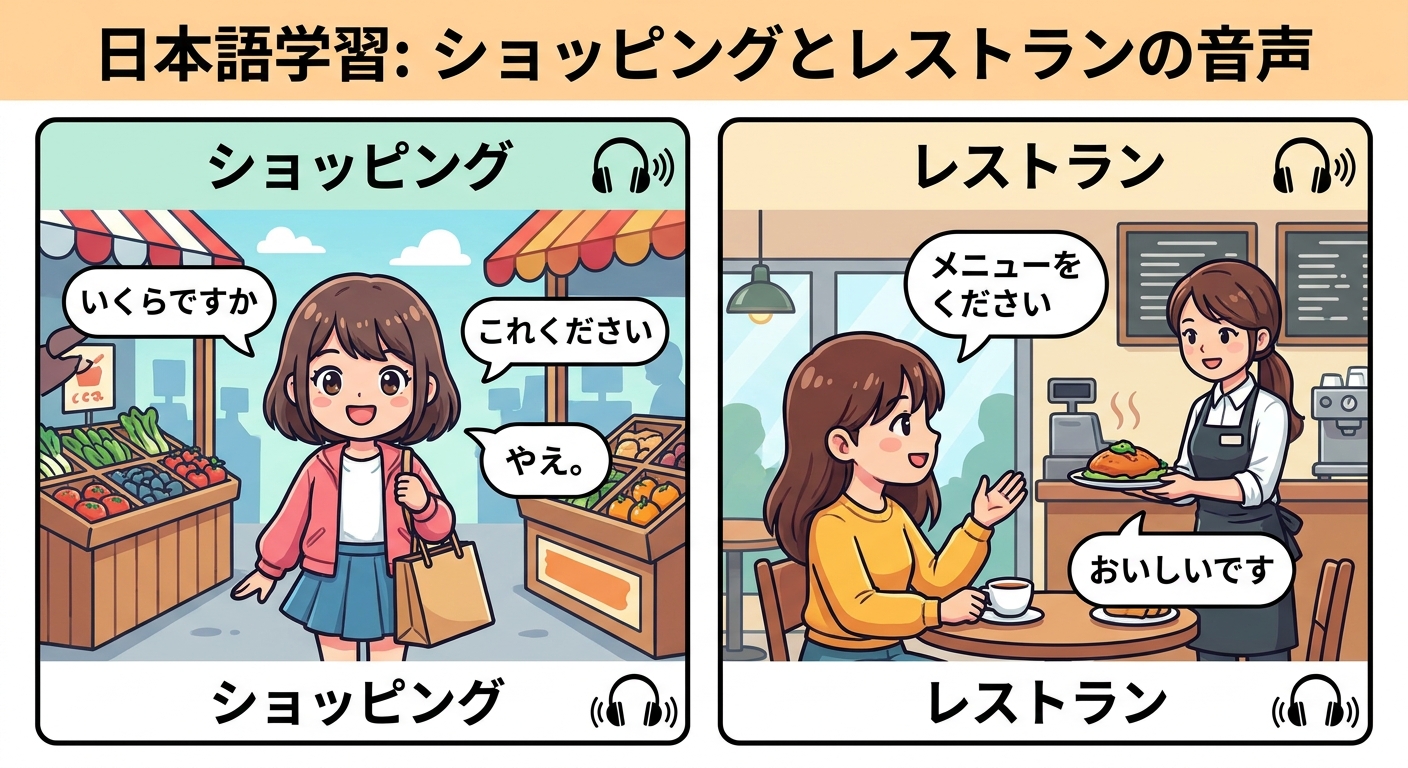
Introduction
Welcome to the "Shopping and Restaurant Audio" lesson! Navigating Japanese stores and restaurants is one of the most exciting and practical parts of using the language in daily life. This N5-level listening lesson is designed to help you train your ears to recognize key vocabulary, common phrases, and polite expressions used by staff and customers alike. Through realistic audio scenarios, you will practice identifying prices, ordering food, asking for recommendations, and understanding basic transactions. By listening closely to natural speech patterns, you will build the confidence needed to handle real-world interactions in Japan with ease.
Lesson Content
Master N5 Japanese: Shopping & Restaurant Audio Guide
Navigating a Japanese restaurant or convenience store (konbini) is one of the most exciting milestones for a beginner. However, listening to native speakers in these fast-paced environments can feel overwhelming.
This guide breaks down the essential audio cues, vocabulary, and grammar patterns you need to confidently handle shopping and dining situations at the JLPT N5 level.
1. What You Will Hear: Key Audio Cues
When you enter a shop or restaurant, staff will call out to you using polite, standard expressions. You do not need to reply to all of them, but you must recognize them.
| Japanese (Kana) | Romaji | English Meaning | Cultural Note |
|---|---|---|---|
| いらっしゃいませ | Irasshaimase | Welcome! | No response needed. A polite nod is sufficient. |
| 何名様ですか。 | Nan-mei sama desu ka? | How many people? | Answer with: [Number] です (e.g., Hitori desu - One person). |
| ご注文はお決まりですか。 | Go-chūmon wa okimari desu ka? | Have you decided on your order? | Say はい (Hai) or すみません、まだです (Sumimasen, mada desu - Sorry, not yet). |
2. Essential Grammar & Particles for Ordering
To order items, you will use the direct object marker particle を (o) combined with polite requests.
Pattern 1: Ordering Items
$$\text{[Item]} + \mathbf{\text{を}} + \mathbf{\text{ください (kudasai)}} \quad \text{or} \quad \mathbf{\text{お願いします (onegai shimasu)}}$$
- を (o): The object particle. It links the item you want to the verb/action.
- ください (kudasai): "Please give me..." (Used for physical objects).
- お願いします (onegai shimasu): "Please do this for me..." (Slightly more polite; used for both items and services).
Examples:
- 水をください。 (Mizu o kudasai.)
- Water, please.
- メニューをお願いします。 (Menyū o onegai shimasu.)
- The menu, please.
Pattern 2: Adding Quantities (N5 Counters)
In Japanese, counters are placed after the particle を.
$$\text{[Item]} + \mathbf{\text{を}} + \text{[Counter]} + \mathbf{\text{ください}}$$
- 一つ (ひとつ - hitotsu): One item
- 二つ (ふたつ - futatsu): Two items
- 三つ (みっつ - mittsu): Three items
Example:
- これをごつください。 (Kore o futatsu kudasai.)
- Please give me two of these.
3. Asking for Prices and Paying
When shopping, you need to identify objects using demonstrative pronouns (これ/それ/あれ) and ask for the price.
- これ (kore): This (close to the speaker)
- それ (sore): That (close to the listener)
- あれ (are): That over there (far from both)
The Price Formula:
$$\text{[Pronoun]} + \mathbf{\text{は}} + \mathbf{\text{いくらですか。}} \quad (\text{How much is... ?})$$
- これはいくらですか。 (Kore wa ikura desu ka?)
- How much is this?
Listening for the Bill:
At the register, the cashier will tell you the total using 〜円 (えん - en):
- お会計は三千円です。 (O-kaikei wa san-sen en desu.)
- Your total is 3,000 yen.
4. Real-World Audio Dialogue Practice
Read this realistic restaurant dialogue aloud to practice your listening and speaking flow:
- Staff: いらっしゃいませ!何名様ですか。
(Irasshaimase! Nan-mei sama desu ka?)
Welcome! How many people? - You: 二人です。
(Futari desu.)
Two people. - Staff: こちらへどうぞ。
(Kochira e dōzo.)
This way, please. - You: すみません!これとこれを二つください。
(Sumimasen! Kore to kore o futatsu kudasai.)
Excuse me! Please give me this, and two of these. (Note: と means "and"). - Staff: はい、かしこまりました。
(Hai, kashikomarimashita.)
Certainly.
Exercises
Shopping and Restaurant Audio (Exercises)
Exercises for Shopping and Restaurant Audio
Review the grammar and vocabulary, and try to fill in the blanks or write sentences based on the prompts.
Examples
これはいくらですか。
Kore wa ikura desu ka.
How much is this?
ラーメンを一つお願いします。
Rāmen o hitotsu onegai shimasu.
One ramen, please.
お会計をお願いします。
Okaikei o onegai shimasu.
The bill, please.
Practice Drills
Lesson Materials
Vocabulary (5)
Grammar (3)
Kanji (0)
No kanji characters in this lesson.
Kana (0)
No kana characters in this lesson.