
いつも・よく・ときどき — Frequency
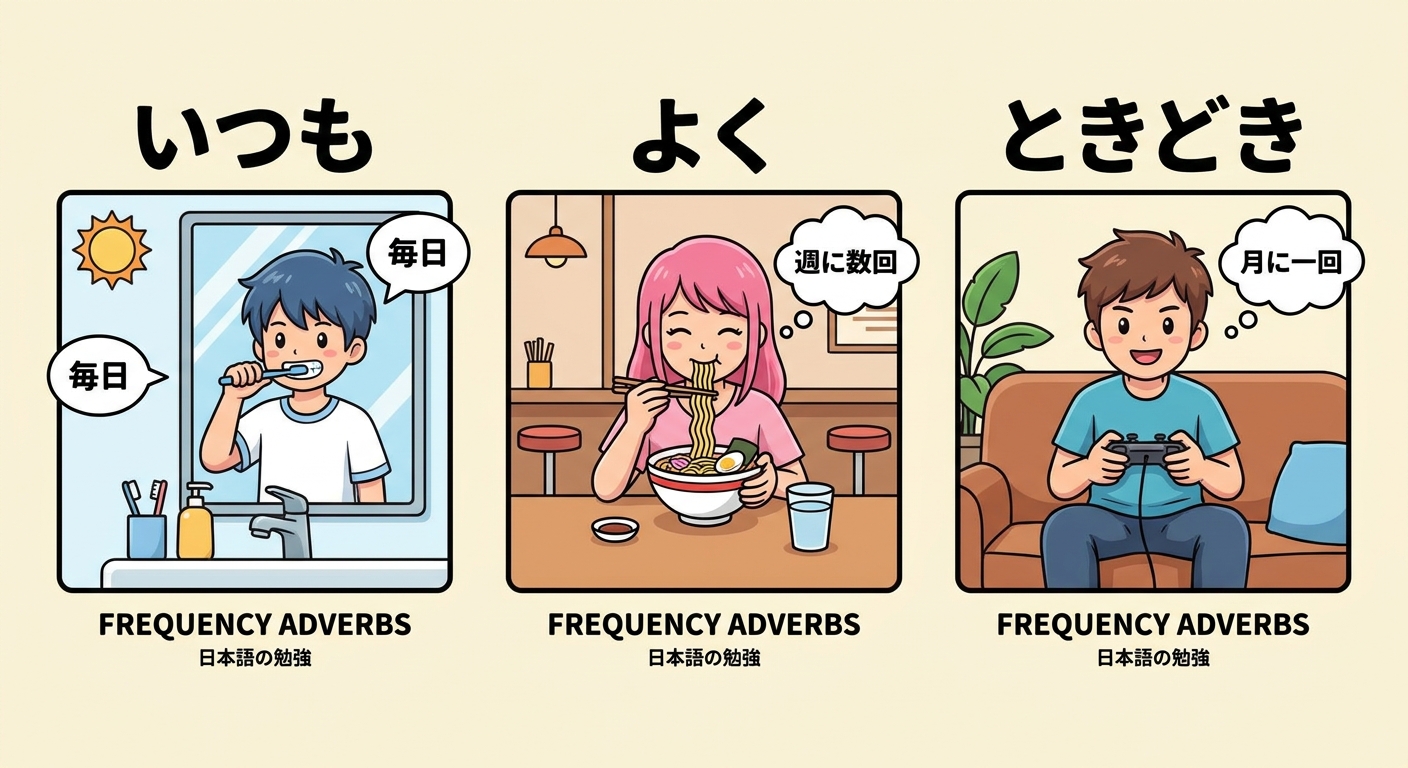
Learn frequency adverbs: いつも (always), よく (often), ときどき (sometimes), あまり (not much), ぜんぜん (never). Place them correctly before verbs.
🎯 Goal: To confidently use 'いつも', 'よく', and 'ときどき' to describe the frequency of your daily activities, habits, and hobbies in grammatically correct Japanese sentences.
Introduction
Welcome to your guide on expressing how often you do things in Japanese! In this lesson, we will master three essential frequency adverbs: いつも (always), よく (often), and ときどき (sometimes). These simple yet powerful words are key to describing your daily routines, hobbies, and lifestyle habits naturally. You will learn where to place them in a sentence—typically right before the verb or at the beginning—and how they pair with polite (~masu) verb forms. By the end of this lesson, you will be able to share details about your personal schedule and daily habits with confidence.
Lesson Content
Master Class: Expressing Frequency in Japanese (いつも, よく, ときどき)
Welcome to your ultimate guide to talking about your habits and routines in Japanese! To sound natural, you need to know how to express how often you do things.
In this lesson, we will master the "Big Three" N5 frequency adverbs: いつも (always), よく (often), and ときどき (sometimes).
The Frequency Spectrum
Think of frequency in Japanese as a slider from 100% to 50%:
| Adverb | Hiragana | Romaji | Meaning | Frequency |
|---|---|---|---|---|
| いつも | いつも | itsumo | Always | 100% |
| よく | よく | yoku | Often | 70% - 80% |
| ときどき | ときどき (時々) | tokidoki | Sometimes | 40% - 50% |
Sentence Structure: Where do they go?
In Japanese, frequency adverbs are highly flexible. However, for natural and grammatically perfect N5 sentences, place the adverb directly before the verb or right after the topic particle (は - wa).
Standard Pattern:
[Topic] は + [Frequency Adverb] + [Object] を + [Verb]
- 私は よく 本を 読みます。
- Watashi wa yoku hon o yomimasu.
- I often read books.
Deep Dive & Examples
Let’s look at each adverb in action with realistic N5-level daily scenarios.
1. いつも (itsumo) — Always (100%)
Use いつも for daily habits, unchanging routines, or things that happen without fail.
- 朝、いつもコーヒーを飲みます。
- Asa, itsumo kōhī o nomimasu.
- In the morning, I always drink coffee.
- 日本語のクラスは いつも 楽しいです。
- Nihongo no kurasu wa itsumo tanoshii desu.
- Japanese class is always fun.
2. よく (yoku) — Often (70-80%)
よく is your go-to word for regular hobbies or common occurrences.
(Note: "よく" can also mean "well" or "skilfully" depending on the context, but at N5, it most frequently means "often".)
- 私は よく 映画を見ます。
- Watashi wa yoku eiga o mimasu.
- I often watch movies.
- 週末、よくデパートに行きます。
- Shūmatsu, yoku depāto ni ikimasu.
- On weekends, I often go to the department store.
3. ときどき (tokidoki) — Sometimes (40-50%)
Use ときどき for occasional activities.
Kanji Tip: You will often see this written as 時々. The symbol 々 is a repetition mark, meaning you repeat the kanji before it (toki + toki = tokidoki).
- ときどき 寿司を食べます。
- Tokidoki sushi o tabemasu.
- I sometimes eat sushi.
- ときどき 日本語で話します。
- Tokidoki nihongo de hanashimasu.
- I sometimes speak in Japanese.
Pro-Tip: The Negative Counterparts (N5 Bonus)
To express "not often" or "never," you must use a negative verb combined with these specific adverbs:
- あまり (amari) + Negative Verb = Not much / Rarely (20%)
- あまりテレビを見ません。 (Amari terebi o mimasen. - I don't watch TV much.)
- ぜんぜん (zenzen) + Negative Verb = Never / Not at all (0%)
- ぜんぜんお酒を飲みません。 (Zenzen osake o mimasen. - I never drink alcohol.)
Quick Practice!
Translate these sentences into Japanese using いつも, よく, or ときどき:
- I always listen to music. (Music = 音楽 / ongaku, To listen = 聞きます / kikimasu)
- I sometimes walk in the park. (Park = 公園 / kōen, To walk = 歩きます / arukimasu)
- My friend often comes to my house. (Friend = 友達 / tomodachi, House = うち / uchi, To come = 来ます / kimasu)
Answers:
- いつも音楽を聞きます。 (Itsumo ongaku o kikimasu.)
- ときどき公園を歩きます。 (Tokidoki kōen o arukimasu.)
- 友達はよくうちに来ます。 (Tomodachi wa yoku uchi ni kimasu.)
Congratulations! You have mastered N5 frequency adverbs. Try using them in your next Japanese conversation!
Exercises
いつも・よく・ときどき — Frequency (Exercises)
Exercises for いつも・よく・ときどき — Frequency
Review the grammar and vocabulary, and try to fill in the blanks or write sentences based on the prompts.
Examples
私はいつも朝ご飯を食べます。
Watashi wa itsumo asagohan o tabemasu.
I always eat breakfast.
彼はよく図書館に行きます。
Kare wa yoku toshokan ni ikimasu.
He often goes to the library.
私はときどき日本語で映画を見ます。
Watashi wa tokidoki nihongo de eiga o mimasu.
I sometimes watch movies in Japanese.
Practice Drills
Lesson Materials
Vocabulary (5)
Grammar (3)
Kanji (0)
No kanji characters in this lesson.
Kana (0)
No kana characters in this lesson.