
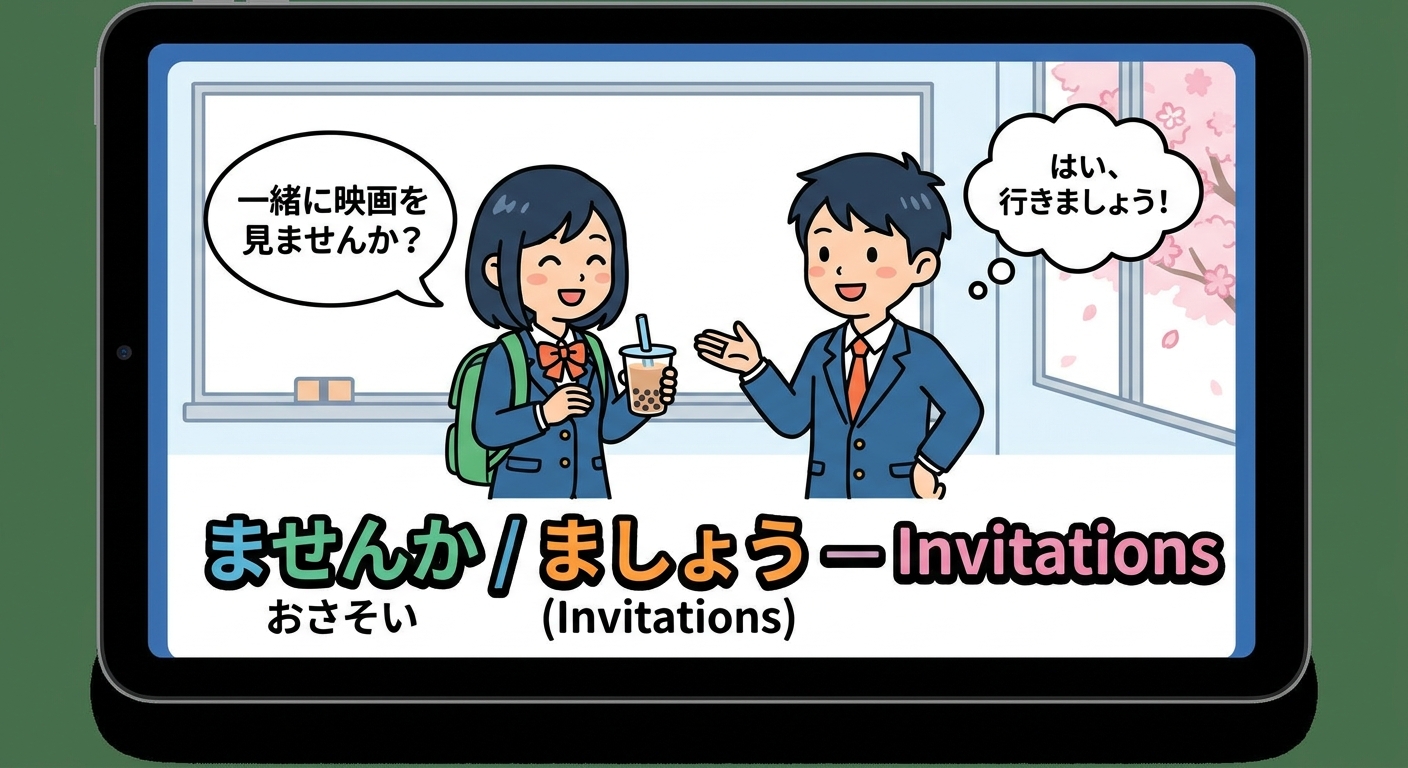
ませんか / ましょう — Invitations
Learn ませんか (Won't you...?) for invitations and ましょう (Let's...) for suggestions. Practice creating natural invitation dialogues for daily situations.
🎯 Goal: To confidently invite others to activities using 〜ませんか, make proactive suggestions using 〜ましょう, and respond appropriately to invitations in polite, everyday Japanese.
Introduction
Ready to take your Japanese social skills to the next level? In this lesson, we will master the art of making invitations and suggestions using the essential N5 grammar patterns 〜ませんか (masenka) and 〜ましょう (mashou). While both are used to propose actions, they carry distinct nuances. You will learn how to politely invite someone to join you using 〜ませんか ('won't you?'), and how to enthusiastically propose an activity using 〜ましょう ('let's'). By mastering these structures, you will be able to confidently initiate plans, make friendly suggestions, and connect more naturally with Japanese speakers in everyday social situations.
Lesson Content
Master Japanese Invitations: 〜ませんか vs 〜ましょう
In Japanese culture, consideration for others is deeply embedded in the language. When inviting someone to do something, how you phrase your offer matters.
Today, we will master two essential JLPT N5 grammar patterns for making invitations and suggestions: 〜ませんか (~masen ka) and 〜ましょう (~mashou).
1. How to Conjugate: Finding the "Masu-Stem"
Both grammar points attach to the Masu-stem (the base of the verb before adding masu).
| Dictionary Form | Masu-Form | Masu-Stem |
|---|---|---|
| 行く (iku / to go) | 行きます (ikimasu) | 行き (iki) |
| 食べる (taberu / to eat) | 食べます (tabemasu) | 食べ (tabe) |
| する (suru / to do) | します (shimasu) | し (shi) |
2. 〜ませんか (*~masen ka*) — The Polite Invitation
Meaning: "Won't you...?" / "Would you like to...?"
This is the gold standard for inviting someone out. Because it literally asks, "Won't you do [activity]?", it is incredibly polite. It gives the listener an easy opportunity to decline without feeling pressured.
Sentence Structure:
[Activity/Destination] + Particle + Verb (Masu-Stem) + ませんか
Examples:
- いっしょに京都へ行きませんか。
- Issho ni Kyōto e ikimasen ka?
- Won't you go to Kyoto with me?
- お茶を飲みませんか。
- Ocha o nomimasen ka?
- Would you like to drink some tea?
💡 Particle Focus: Notice を (o) marks the object (tea), and へ (e) or に (ni) marks the direction/destination (Kyoto). いっしょに (issho ni) means "together" and is often paired with this grammar.
3. 〜ましょう (*~mashou*) — The Proactive Proposal
Meaning: "Let's..." / "Shall we..."
Use this when a decision has already been mutually agreed upon, or when you want to make a proactive, enthusiastic suggestion. It assumes the other person is likely to say yes.
Sentence Structure:
Verb (Masu-Stem) + ましょう
Examples:
- 12時に会いましょう。
- Jū-ni-ji ni aimashou.
- Let's meet at 12 o'clock.
- 映画を見ましょう!
- Eiga o mimashou!
- Let's watch a movie!
| Feature | 〜ませんか (~masen ka) | 〜ましょう (~mashou) |
|---|---|---|
| Nuance | "Would you like to...?" (Considerate) | "Let's do it!" (Direct/Enthusiastic) |
| Best used for... | Initiating a brand-new invitation. | Confirming plans / Wrapping up a decision. |
| Example | "Shall we eat lunch?" (Opening the idea) | "Great, let's eat sushi!" (Deciding the food) |
5. How to Respond
When someone invites you using 〜ませんか, how do you reply?
Accepting (Yes):
- いいですね。そうしましょう!
- Ii desu ne. Sō shimashou!
- That sounds good. Let's do that!
Declining Politely (No):
Directly saying "No" (いいえ) is considered rude. Instead, use this classic, polite Japanese cushion phrase:
- すみません、ちょっと...
- Sumimasan, chotto...
- I'm sorry, [that time/day] is a bit [inconvenient]... (Leaving the sentence unfinished is highly polite!)
Quick Practice!
Translate these sentences into Japanese using the correct form:
- Won't you study together? (together = いっしょに / to study = 勉強します)
- Let's take a photo! (photo = 写真 / to take = 撮ります)
Answers:
- いっしょに勉強しませんか。 (Issho ni benkyō shimasen ka?)
- 写真を撮りましょう! (Shashin o torimashou!)
Exercises
ませんか / ましょう — Invitations (Exercises)
Exercises for ませんか / ましょう — Invitations
Review the grammar and vocabulary, and try to fill in the blanks or write sentences based on the prompts.
Examples
一緒に晩ご飯を食べませんか。
Issho ni bangohan o tabemasen ka.
Would you like to have dinner together?
ちょっと休みましょう。
Chotto yasumimashou.
Let's take a short break.
明日、映画を見に行きませんか。
Ashita, eiga o mi ni ikimasen ka.
Would you like to go see a movie tomorrow?
Practice Drills
Lesson Materials
Vocabulary (5)
Kanji (0)
No kanji characters in this lesson.
Kana (0)
No kana characters in this lesson.