
ません Form — Polite Negative
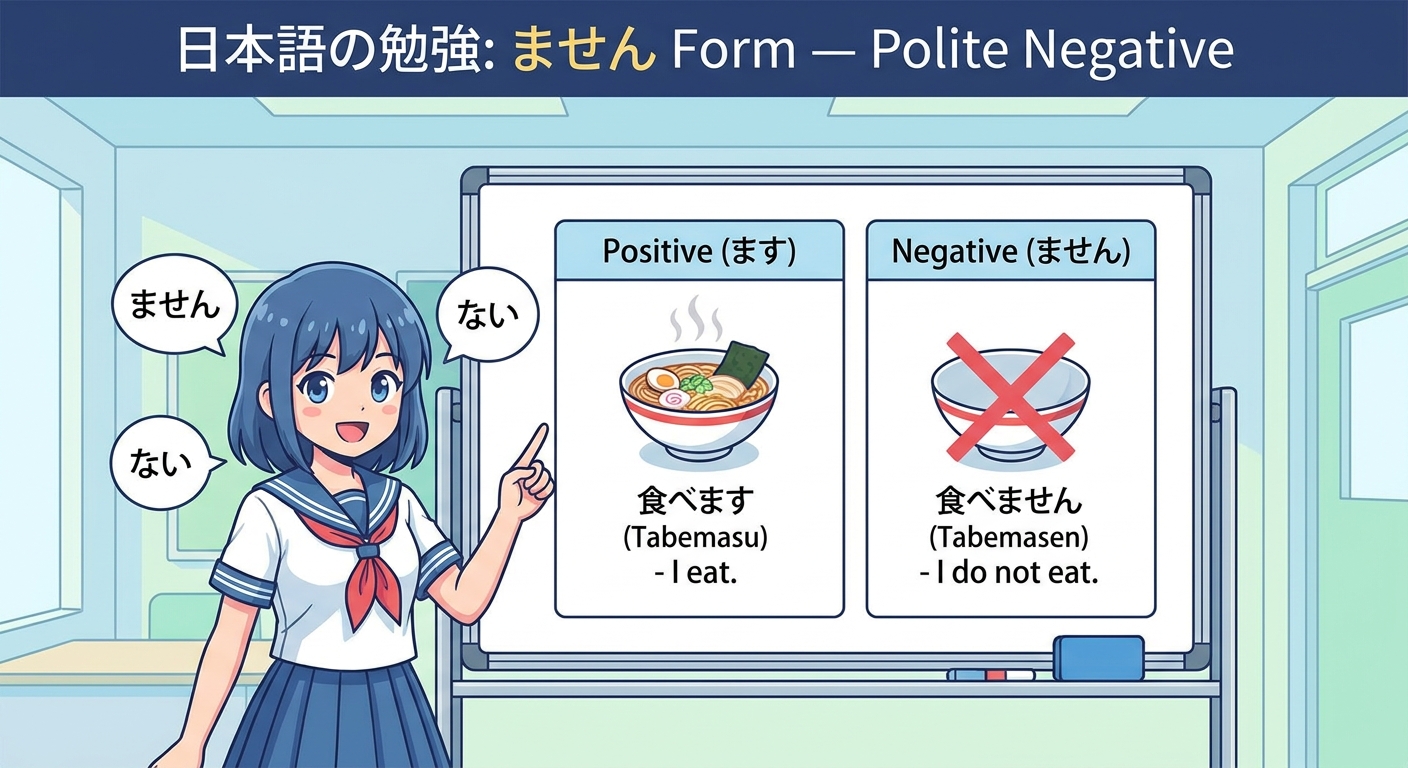
Learn ません, the polite negative form. Transform positive sentences into negatives. Practice with common verbs like 食べます→食べません, 行きます→行きません.
🎯 Goal: By the end of this lesson, you will be able to confidently conjugate Group 1 (U-verbs), Group 2 (Ru-verbs), and irregular verbs from their polite positive (~masu) form to their polite negative (~masen) form, and use them to construct polite, grammatically correct negative sentences in everyday conversations.
Introduction
Welcome to the world of polite Japanese communication! In this lesson, you will master the 〜ません (masen) form, the standard way to express negative actions politely in the present and future tense. Just as 〜ます (masu) allows you to say what you do or will do, 〜ません lets you politely say what you do not or will not do—such as "I don't eat" (tabemasen) or "I won't go" (ikimasen). Mastering this form is a crucial milestone for N5 learners, enabling you to decline invitations politely and speak respectfully in everyday social situations.
Lesson Content
Master Japanese Polite Negatives: The 〜ません (~masen) Form
Welcome to your definitive guide to mastering the 〜ません (~masen) form.
In Japanese, politeness is key. When speaking to teachers, bosses, acquaintances, or strangers, you will use the Polite Form (丁寧語 - Teineigo). While 〜ます (~masu) is used to say "will do" or "does," 〜ません (~masen) is its negative counterpart, meaning "will not do" or "does not."
1. How to Conjugate: From Dictionary Form to 〜ません
To create the polite negative form, we must first look at the verb's dictionary (plain) form and identify its group.
Group 1: U-Verbs (Godan)
For Group 1 verbs, change the final ~u vowel sound of the dictionary form to its corresponding ~i sound, then add 〜ません.
| Dictionary Form | Romaji | ~i Stem | Polite Negative | English Translation |
|---|---|---|---|---|
| 行く (iku) | To go | 行き (iki) | 行きません (ikimasen) | Will not / Do not go |
| 飲む (nomu) | To drink | 飲み (nomi) | 飲みません (nomimasen) | Will not / Do not drink |
| 話す (hanasu) | To speak | 話し (hanashi) | 話しません (hanashimasen) | Will not / Do not speak |
Group 2: Ru-Verbs (Ichidan)
For Group 2 verbs, conjugation is simple: drop the final 〜る (ru) and add 〜ません.
| Dictionary Form | Romaji | Stem | Polite Negative | English Translation |
|---|---|---|---|---|
| 食べる (taberu) | To eat | 食べ (tabe) | 食べません (tabemasen) | Will not / Do not eat |
| 見る (miru) | To see/watch | 見 (mi) | 見ません (mimasen) | Will not / Do not watch |
Group 3: Irregular Verbs
There are only two irregular verbs in Japanese. Memorize these conversions directly:
| Dictionary Form | Romaji | Polite Negative | English Translation |
|---|---|---|---|
| する (suru) | To do | しません (shimasen) | Will not / Do not do |
| 来る (kuru) | To come | 来ません (kimasen) | Will not / Do not come |
Note: Notice how the kanji pronunciation for 来る changes from "ku-ru" to "ki-masen".
2. Sentence Examples in Action
In Japanese, the same verb form is used for both the present habitual tense (things you do/don't do regularly) and the future tense (things you will/will not do). Context tells you which one is meant.
Example 1: Habitual Action (Present)
- Affirmative: 私は朝ごはんを食べます。
- Watashi wa asagohan o tabemasu.
- I eat breakfast.
- Negative: 私は朝ごはんを食べません。
- Watashi wa asagohan o tabemasen.
- I do not eat breakfast.
Example 2: Future Intention (Future)
- Affirmative: 明日、学校へ行きます。
- Ashita, gakkou e ikimasu.
- I will go to school tomorrow.
- Negative: 明日、学校へ行きません。
- Ashita, gakkou e ikimasen.
- I will not go to school tomorrow.
3. Quick Practice Challenge
Test your understanding! Convert the following dictionary-form verbs into the polite negative (〜ません) form:
- 買う (kau - to buy)
- 起きる (okiru - to wake up)
- 勉強する (benkyou suru - to study)
Answers:
- 買いません (kaimasen) — Group 1: 'u' becomes 'i' (u $\rightarrow$ i), add masen.
- 起きません (okimasen) — Group 2: Drop 'ru', add masen.
- 勉強しません (benkyou shimasen) — Group 3: 'suru' becomes 'shimasen'.
Tutor Pro-Tip 💡
To sound like a natural speaker, keep the "n" sound at the end of 〜ません crisp. Do not drop the final "n" sound, but do not over-pronounce it as "mu". It is a nasalized "n" that gently closes the sentence. Happy studying!
Exercises
ません Form — Polite Negative (Exercises)
Exercises for ません Form — Polite Negative
Review the grammar and vocabulary, and try to fill in the blanks or write sentences based on the prompts.
Examples
朝ご飯を食べません。
Asagohan o tabemasen.
I do not eat breakfast.
今日は学校に行きません。
Kyō wa gakkō ni ikimasen.
I will not go to school today.
日本語がわかりません。
Nihongo ga wakarimasen.
I do not understand Japanese.
Practice Drills
Lesson Materials
Vocabulary (5)
Kanji (0)
No kanji characters in this lesson.
Kana (0)
No kana characters in this lesson.