
ます Form — Polite Present/Future
Learn to conjugate verbs into the polite ます form for present and future actions. Cover Group 1 (五段), Group 2 (一段), and irregular verbs (する, くる). Build sentences about daily routines.
🎯 Goal: By the end of this lesson, you will be able to confidently conjugate Group 1 (u-verbs), Group 2 (ru-verbs), and irregular verbs into their polite non-past (ます) form, and use them to describe daily habits and future plans.
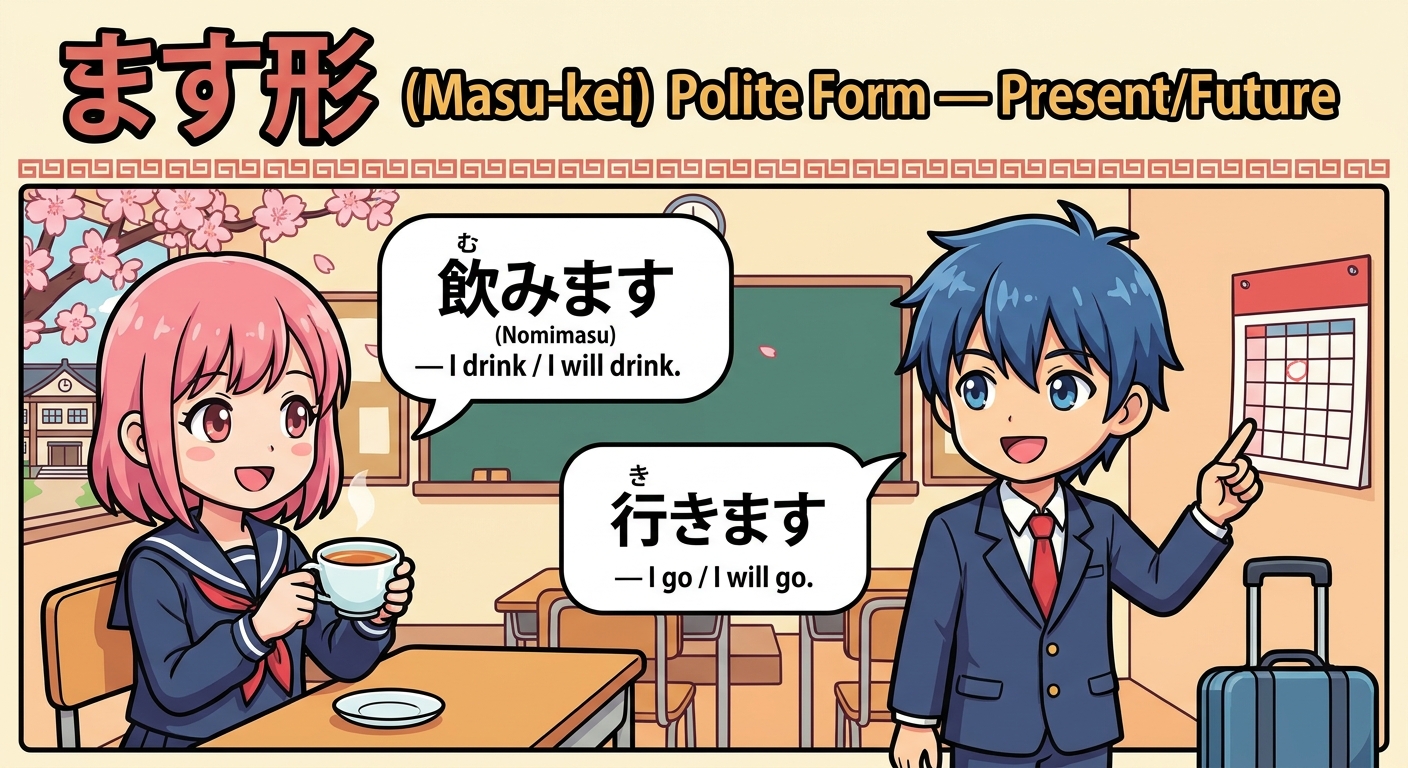
Introduction
Welcome to the cornerstone of polite Japanese communication: the ます (masu) form. As an N5 learner, mastering this form is your gateway to speaking respectfully and confidently in daily life. In Japanese, verbs do not change based on the subject, but they do conjugate to show politeness and tense. The ます form represents the polite non-past tense, meaning it is used to express habitual actions in the present or events that will happen in the future. By learning how to conjugate verbs into this form, you will be able to interact smoothly with teachers, colleagues, and acquaintances.
Lesson Content
Master the 〜ます Form: The Gateway to Polite Japanese (JLPT N5)
Welcome to your first major milestone in Japanese grammar!
In Japanese, the level of politeness you use depends entirely on who you are speaking to. The 〜ます (~masu) form is the standard polite form (Teineigo). It is the perfect, "safe" register to use with teachers, strangers, coworkers, and acquaintances.
In this guide, you will learn how to conjugate verbs into the Polite Present/Future Form and understand how to use them in everyday sentences.
1. The Dual Nature of 〜ます: Present & Future
Unlike English, Japanese does not have a distinct future tense. The 〜ます form serves two purposes depending on the context:
- Habitual/Present Action: Actions you do regularly.
- Future Action: Actions you intend to do in the future.
- 毎日、お茶を飲みます。
- Mainichi, ocha o nomimasu.
- "I drink green tea every day." (Habitual Present)
- 明日、お茶を飲みます。
- Ashita, ocha o nomimasu.
- "I will drink green tea tomorrow." (Future)
2. How to Conjugate: The 3 Verb Groups
To conjugate any verb into the 〜ます form, you must first identify which of the three verb groups it belongs to.
Group 1: U-Verbs (Godan Verbs)
These verbs end in dictionary sounds like ~u, ~ku, ~gu, ~su, ~tsu, ~nu, ~bu, ~mu, or ~ru.
- The Rule: Change the final ~u vowel sound of the dictionary form to its corresponding ~i sound, then add ます.
| Dictionary Form | Romaji | Step 1: Change to ~i | Step 2: Add ます | Polite Form | Meaning |
|---|---|---|---|---|---|
| 行く | iku | 行き (iki) | + ます | 行きます (ikimasu) | to go / will go |
| 飲む | nomu | 飲み (nomi) | + ます | 飲みます (nomimasu) | to drink / will drink |
| 話す | hanasu | 話し (hanashi) | + ます | 話します (hanashimasu) | to speak / will speak |
Group 2: Ru-Verbs (Ichidan Verbs)
These verbs usually end in 〜いる (~iru) or 〜える (~eru).
- The Rule: Simply drop the final る (~ru) and add ます.
| Dictionary Form | Romaji | Step 1: Drop る | Step 2: Add ます | Polite Form | Meaning |
|---|---|---|---|---|---|
| 食べる | taberu | 食べ (tabe) | + ます | 食べます (tabemasu) | to eat / will eat |
| 見る | miru | 見 (mi) | + ます | 見ます (mimasu) | to watch / will watch |
| 起きる | okiru | 起き (oki) | + ます | 起きます (okimasu) | to wake up / will wake up |
Group 3: Irregular Verbs
There are only two irregular verbs in Japanese. You must memorize these.
- する (suru - to do) $\rightarrow$ します (shimasu)
- 来る (kuru - to come) $\rightarrow$ 来ます (kimasu)
3. Sentence Structure & Key Particles
Let's look at how to build a complete sentence using the 〜ます form and basic N5 particles:
$$\text{[Subject/Time]} + \text{[Object]} + \mathbf{\text{を (o)}} + \mathbf{\text{Verb-ます}}$$
-
日本語を勉強します。
- Nihongo o benkyou shimasu.
- "I study Japanese." / "I will study Japanese."
- (Note: The particle を marks the direct object).
-
明日、友達が来ます。
- Ashita, tomodachi ga kimasu.
- "Tomorrow, my friend will come."
- (Note: The particle が marks the subject performing the action).
4. Quick Challenge!
Try conjugating these three dictionary-form verbs into the 〜ます form yourself:
- 買う (kau - to buy) [Group 1]
- 寝る (neru - to sleep) [Group 2]
- 散歩する (sanpo suru - to take a walk) [Group 3]
(Answers: 1. 買います / 2. 寝ます / 3. 散歩します)
Exercises
ます Form — Polite Present/Future (Exercises)
Exercises for ます Form — Polite Present/Future
Review the grammar and vocabulary, and try to fill in the blanks or write sentences based on the prompts.
Examples
毎日水を飲みます。
Mainichi mizu o nomimasu.
I drink water every day.
明日映画を見ます。
Ashita eiga o mimasu.
I will watch a movie tomorrow.
8時に学校へ行きます。
Hachiji ni gakkou e ikimasu.
I go to school at 8 o'clock.
Practice Drills
Lesson Materials
Vocabulary (5)
Kanji (0)
No kanji characters in this lesson.
Kana (0)
No kana characters in this lesson.