
ました / ませんでした — Past Forms
Learn the polite past tense (ました) and past negative (ませんでした). Practice describing what you did or didn't do yesterday.
🎯 Goal: By the end of this lesson, you will be able to confidently conjugate polite Japanese verbs into their past affirmative (〜ました) and past negative (〜ませんでした) forms, and use them to describe past actions, habits, and events in polite, everyday conversations.
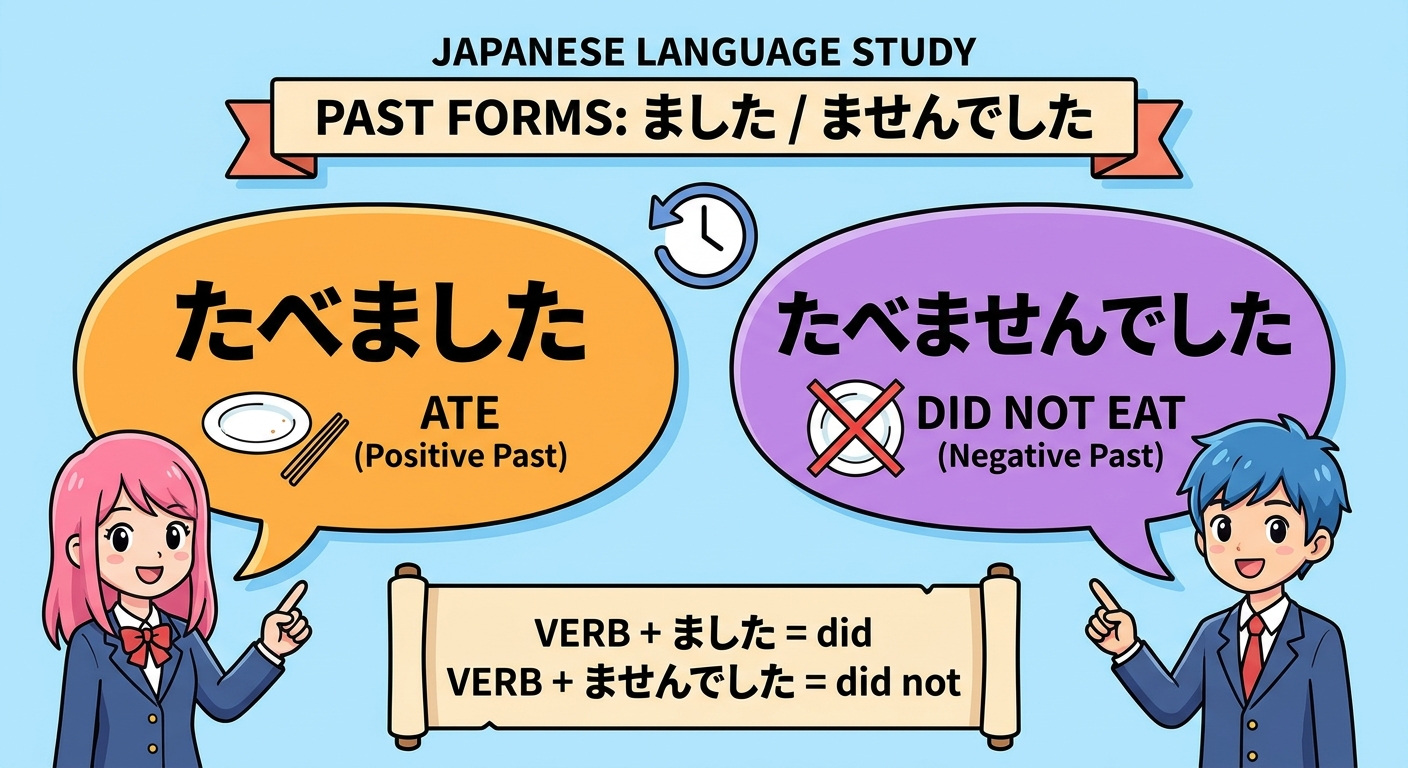
Introduction
Welcome to the world of Japanese past tense! In this lesson, you will learn how to talk about completed actions and past events using polite verbs. Building upon the friendly and polite 〜ます (-masu) form, we will introduce its past affirmative counterpart, 〜ました (-mashita), and its past negative counterpart, 〜ませんでした (-masen deshita). Mastering these structures is a crucial milestone in your N5 journey, as they allow you to share your daily experiences, discuss yesterday's activities, and politely decline past invitations. Let’s unlock the ability to reflect on the past with confidence and politeness!
Lesson Content
Master JLPT N5: Talking About the Past with 〜ました and 〜ませんでした
Welcome to your journey toward Japanese fluency! Today, we are mastering the polite past tense. By the end of this lesson, you will be able to share what you did (and didn't do) yesterday, last week, or this morning with perfect politeness and natural pronunciation.
1. The Core Concept
In Japanese, verbs change their endings to show tense (present/future vs. past) and politeness.
To speak politely about the past, we use two key endings:
- 〜ました (-mashita): "Did" (Polite Past Affirmative)
- 〜ませんでした (-masendeshita): "Did not" (Polite Past Negative)
2. How to Conjugate
The beauty of these forms is their simplicity. If you already know the polite present form (〜ます / 〜ません), you are 90% there! You simply swap the endings.
The Conjugation Formula
| Polite Present (Non-Past) | $\rightarrow$ | Polite Past | Meaning |
|---|---|---|---|
| 〜ます (-masu) | $\rightarrow$ | 〜ました (-mashita) | "Did / Have done" |
| 〜ません (-masen) | $\rightarrow$ | 〜ませんでした (-masendeshita) | "Did not / Have not done" |
Let's practice with three common N5 verbs:
-
食べます (tabemasu — to eat)
- Affirmative Past: 食べました (tabemashita) — Ate
- Negative Past: 食べませんでした (tabemasendeshita) — Did not eat
-
行きます (ikimasu — to go)
- Affirmative Past: 行きました (ikimashita) — Went
- Negative Past: 行きませんでした (ikimasendeshita) — Did not go
-
します (shimasu — to do)
- Affirmative Past: しました (shimashita) — Did
- Negative Past: しませんでした (shimasendeshita) — Did not do
3. Real-World Examples
Let’s look at these grammar points in action. Pay attention to the time markers (like "yesterday" or "this morning") which naturally trigger the past tense.
- 昨日、日本語を勉強しました。
- Kinō, nihongo o benkyō shimashita.
- Yesterday, I studied Japanese.
- 今朝、コーヒーを飲みませんでした。
- Kesa, kōhī o nomimasendeshita.
- I did not drink coffee this morning.
- 友達はパーティーに来ました。
- Tomodachi wa pātī ni kimashita.
- My friend came to the party.
4. Tutor Pro-Tips 💡
Tip 1: The "Silent I" Pronunciation
In standard Japanese, the "i" in shita is often whispered or dropped entirely.
- Instead of saying "ma-shee-tah", pronounce it as "mash-tah".
- Instead of "ma-sen-deh-shee-tah", pronounce it as "ma-sen-desh-tah".
This single adjustment will instantly make your Japanese sound incredibly natural!
Tip 2: No Double-Past Tense
Once you change the verb to 〜ました or 〜ませんでした, the sentence is fully past tense. Do not add other past-tense words like でした (deshita) after the verb.
- ❌ Tabemashita deshita (Incorrect)
- Tabemashita (Correct)
5. Quick Check: Test Yourself!
Translate the following sentences into Japanese. (Scroll down for answers)
- I bought a book yesterday. (To buy = 買います kaimasu / Book = 本 hon)
- I did not watch TV this morning. (To watch = 見ます mimasu / TV = テレビ terebi)
Answers
- 昨日、本を買いました。 (Kinō, hon o kaimashita.)
- 今朝、テレビを見ませんでした。 (Kesa, terebi o mimasendeshita.)
Congratulations! You have just unlocked the ability to talk about your history, experiences, and daily habits in polite Japanese. Keep practicing, and ganbatte (do your best)!
Exercises
ました / ませんでした — Past Forms (Exercises)
Exercises for ました / ませんでした — Past Forms
Review the grammar and vocabulary, and try to fill in the blanks or write sentences based on the prompts.
Examples
今朝、コーヒーを飲みました。
Kesa, kōhī o nomimashita.
I drank coffee this morning.
昨日は勉強しませんでした。
Kinō wa benkyō shimasendeshita.
I did not study yesterday.
田中さんは学校に来ませんでした。
Tanaka-san wa gakkō ni kimasendeshita.
Mr. Tanaka did not come to school.