
Daily Schedule Passage
Read a simple daily routine paragraph (100–150 characters). Identify times, actions, and places from the text.
🎯 Goal: To accurately comprehend a short Japanese passage detailing a daily routine, identify specific times and corresponding activities, and comfortably utilize basic verbs and time particles to describe a personal schedule.
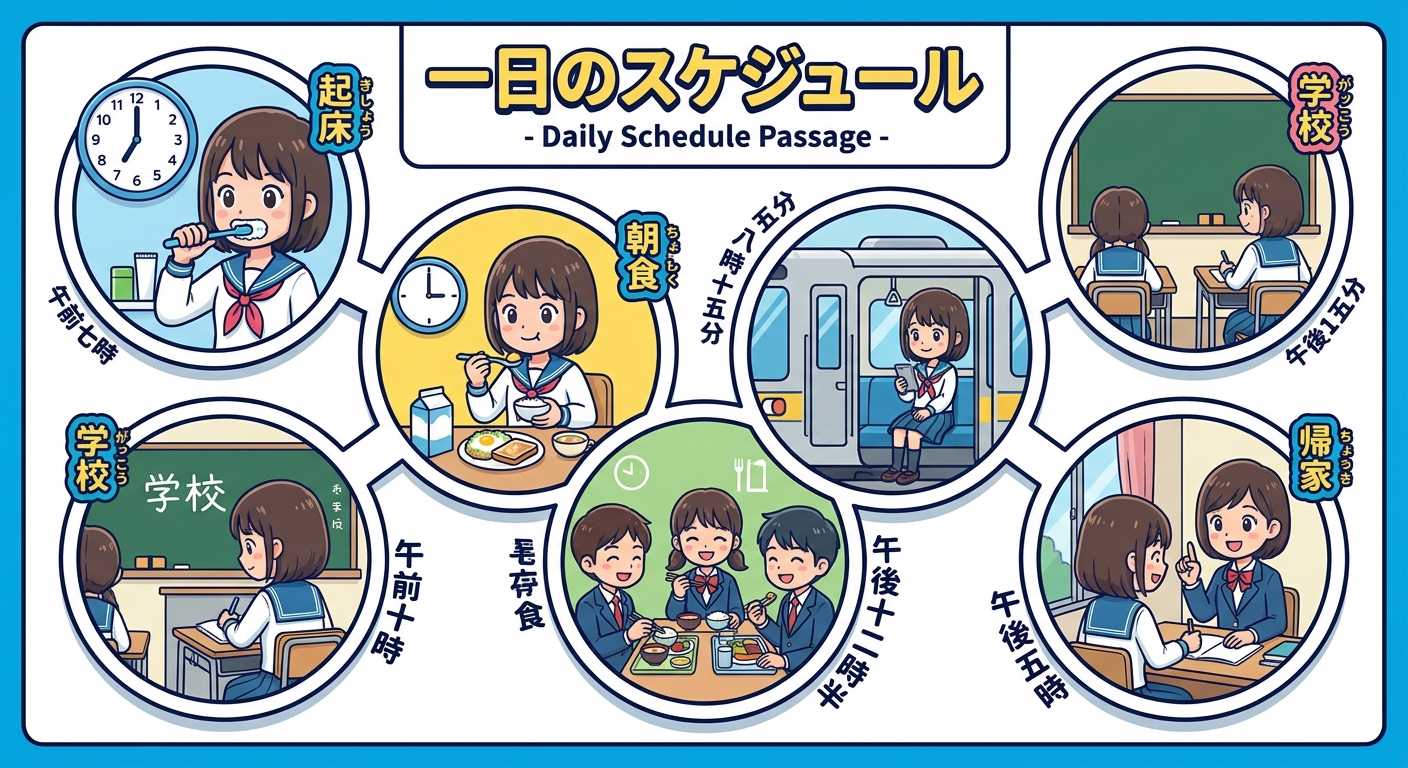
Introduction
Welcome to this N5 lesson focused on reading and understanding a "Daily Schedule Passage." Mastering the ability to describe your daily routine—and understand others'—is a fundamental milestone in Japanese language acquisition. In this lesson, we will explore a short, cohesive narrative detailing a typical day. You will practice identifying key time markers, essential action verbs in the polite present/future tense (~masu), and crucial particles like ni, wo, kara, and made. By analyzing this passage, you will build the reading stamina and vocabulary necessary to discuss your own day-to-day life with confidence.
Lesson Content
Master Your Day: Writing a Daily Schedule in Japanese (JLPT N5)
Welcome to your definitive guide to mastering daily routines in Japanese. Describing your day-to-day activities is a core requirement for the JLPT N5 exam. By the end of this lesson, you will be able to construct a natural, grammatically correct paragraph about your daily schedule.
1. Core Vocabulary & Kanji
To talk about your day, you need time expressions and action verbs. Pay close attention to the kanji stroke order concepts below.
Key Time Vocabulary
- 朝 (あさ - asa): Morning
- 午後 (ごご - gogo): PM / Afternoon
- 午前 (ごぜん - gozen): AM / Morning
- 毎日 (まいにち - mainichi): Every day
- 時 (じ - ji): Hour / O'clock
- 分 (ふん/ぷん - fun/pun): Minute
- 半 (はん - han): Half (e.g., 7時半 = 7:30)
Essential Verbs (Polite ます-Form)
- 起きます (おきます - okimasu): To wake up
- 食べます (たべます - tabemasu): To eat
- 行きます (いきます - ikimasu): To go
- 勉強します (べんきょうします - benkyou shimasu): To study
- 帰ります (かえります - kaerimasu): To return home
- 寝ます (ねます - nemasu): To sleep
Kanji Stroke Order Tip (時):
When writing 時 (Time/Hour), start with the "Sun" radical (日) on the left (4 strokes, left-to-right, top-to-bottom), followed by the "Temple" radical (寺) on the right (6 strokes). Always write left-to-right!
2. Essential Particles for Routines
Particles are the glue of Japanese sentences. For daily schedules, you must master these four:
-
に (ni) - The Time Marker
Marks the specific time an action occurs.- Example: 7時に起きます。(I wake up at 7:00.)
-
を (o/wo) - The Object Marker
Marks the direct object of a verb.- Example: 朝ご飯を食べます。(I eat breakfast.)
-
から (kara) ... まで (made) - From ... Until
Defines the start and end times of an activity.- Example: 9時から5時まで働きます。(I work from 9:00 until 5:00.)
-
へ (e) / に (ni) - The Direction Markers
Points to the destination of movement verbs (行きます, 帰ります). Note that the hiragana へ is pronounced "e" when used as a particle.- Example: うちへ帰ります。(I return home.)
3. The Daily Schedule Passage
Here is a natural N5-level daily schedule. Read through it, paying attention to how the particles connect the times, locations, and actions.
Japanese (with Furigana)
私は毎日、午前6時半に起きます。
朝ご飯を食べます。それから、7時半に家を出ます。
8時から午後4時まで学校で勉強します。
午後5時にうちへ帰ります。
夜、11時に**寝ます。
Romaji
Watashi wa mainichi, gozen roku-ji han ni okimasu.
Asagohan o tabemasu. Sorekara, shichi-ji han ni ie o demasu.
Hachi-ji kara gogo yo-ji made gakkou de benkyou shimasu.
Gogo go-ji ni uchi e kaerimasu.
Yoru, juu-ichi-ji ni nemasu.
English Translation
I wake up at 6:30 AM every day.
I eat breakfast. After that, I leave the house at 7:30.
I study at school from 8:00 AM until 4:00 PM.
I return home at 5:00 PM.
At night, I go to sleep at 11:00.
4. Grammar Breakdown
- それから (sorekara): This is a vital N5 conjunction meaning "after that" or "and then." It helps your passage flow smoothly instead of sounding like a robotic list.
- 学校で (gakkou de): The particle で marks the location of an action. We study (勉強します) at school, so we use で.
- 家を出ます (ie o demasu): To leave a place uses the object particle を. Think of the place as the starting point you are acting upon.
5. Practice Challenge
Test your knowledge! Translate the following sentence into Japanese using the grammar rules you just learned:
"I study Japanese from 7:00 PM to 9:00 PM."
(Hint: "Japanese" is 日本語 - にほんご, and "PM" is 午後 - ごご)
Answer:
午後7時から9時まで日本語を勉強します。
(Gogo nana-ji kara ku-ji made nihongo o benkyou shimasu.)
Exercises
Daily Schedule Passage (Exercises)
Exercises for Daily Schedule Passage
Review the grammar and vocabulary, and try to fill in the blanks or write sentences based on the prompts.
Examples
毎朝七時に起きて、コーヒーを飲みます。
Maiasa shichiji ni okite, kouhii o nomimasu.
I get up at seven every morning and drink coffee.
午前九時から午後五時まで学校で勉強します。
Gozen kuji kara gogo goji made gakkou de benkyou shimasu.
I study at school from 9:00 AM to 5:00 PM.
夜十時にシャワーを浴びて、十一時に寝ます。
Yoru juuji ni shawaa o abite, juuichi-ji ni nemasu.
I take a shower at 10:00 PM and go to bed at 11:00 PM.
Practice Drills
Lesson Materials
Vocabulary (5)
Grammar (3)
Kanji (0)
No kanji characters in this lesson.
Kana (0)
No kana characters in this lesson.