
Short Self-Introduction
Read a beginner-level self-introduction passage (80–120 characters). Practice identifying name, age, nationality, and hobbies from simple text.
🎯 Goal: To confidently deliver a clear, polite, three-to-four sentence self-introduction in Japanese, accurately expressing your name, origin, and occupation using standard N5 grammar and polite formulas.
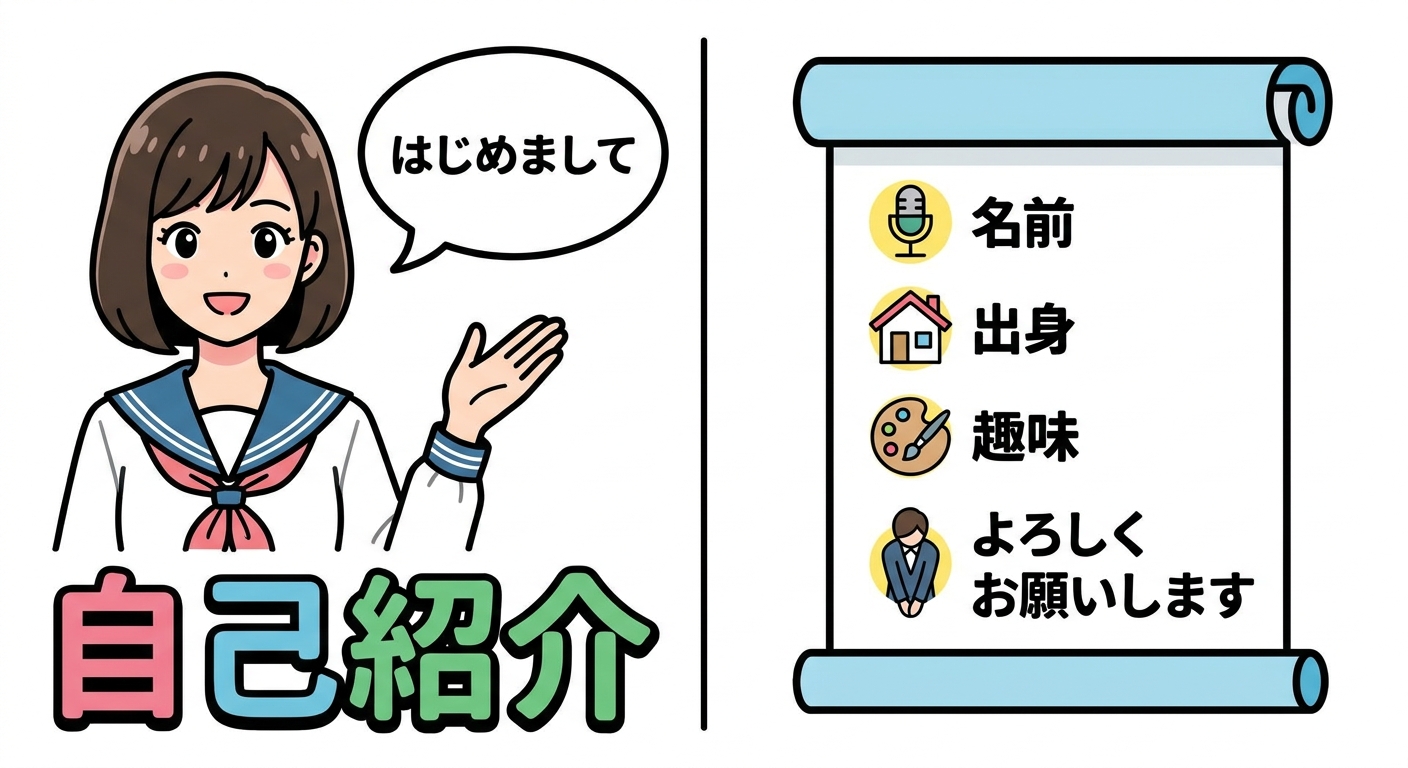
Introduction
First impressions are vital in Japanese culture, and mastering the art of a "Jikoshoukai" (self-introduction) is your first major milestone. In this lesson designed for JLPT N5 learners, you will learn the essential formula to introduce yourself politely and confidently. We will cover key phrases to share your name, nationality, and profession, utilizing basic polite sentence patterns like "~ desu" and the crucial parting phrase "yoroshiku onegai shimasu." By the end of this lesson, you will possess the foundational tools to initiate natural, respectful connections with Japanese speakers in any everyday or professional setting.
Lesson Content
Master the Art of the Japanese Self-Introduction (自己紹介)
In Japan, first impressions are highly valued, and the self-introduction—known as 自己紹介 (じこしょうかい - Jikoshoukai)—is a beautiful cultural ritual of connection.
At the JLPT N5 level, you do not need complex grammar to make a stellar impression. You just need to master a few essential formulas, particles, and cultural nuances. This guide will teach you how to introduce yourself naturally and politely.
1. The Standard N5 Template
Here is a natural, four-line self-introduction that you can use in any polite setting (school, work, or casual meetups):
| Japanese | Romaji | English Translation |
|---|---|---|
| はじめまして。 | Hajimemashite. | Nice to meet you. (Lit: "It is the first time.") |
| [Name] です。 | [Name] desu. | I am [Name]. |
| [Country] から来ました。 | [Country] kara kimashita. | I come from [Country]. |
| よろしくお願いします。 | Yoroshiku onegai shimasu. | Please treat me well. |
2. Grammar & Particle Breakdown
To truly master this introduction, let’s look under the hood at the grammar.
A. The Polite Copula: です (desu)
- Formula:
[Noun] + です - Explanation: Desu functions like the English verb "to be" (am/is/are) in a polite register.
- Example: ジョンです。 (Jon desu.) = "I am John."
- Tutor Tip: Beginners often say Watashi wa John desu (私はジョンです). While grammatically correct, native speakers omit watashi wa (as for me) because it is already obvious you are talking about yourself. Omitting it makes you sound much more natural!
B. The Origin Formula: から来ました (kara kimashita)
- Formula:
[Place] + から + 来ました - Particles & Verbs:
- から (kara): A particle meaning "from."
- 来ました (kimashita): The polite, past-tense form of the verb 来る (kuru - to come). Literally, "came."
- Example: アメリカから来ました。 (Amerika kara kimashita.) = "I came from America."
C. The Magic Phrase: よろしくお願いします (yoroshiku onegai shimasu)
This is one of the most important untranslatable phrases in Japanese. It literally means "Please favor me" or "Please treat me kindly." It signals that you hope to build a positive relationship with the listener. Always use this to close your introduction.
3. Cultural Nuance: The Art of the Bow (お辞儀 - Ojigi)
A Japanese self-introduction is incomplete without physical etiquette.
- Stand straight with your hands at your sides (for men) or clasped gently in front of your lap (for women).
- Say "Hajimemashite" while making eye contact and smiling.
- Deliver your name and origin.
- Say "Yoroshiku onegai shimasu," and as you finish speaking, bow from the waist at a 15-degree angle (called Eshaku).
- Crucial Rule: Do not speak while bowing. Speak first, then bow. This shows ultimate respect.
4. Practice Challenge
Fill in the blanks to create your own Jikoshoukai:
- はじめまして。 (Hajimemashite.)
[ Your Name ]です。 (...desu.)[ Your Country/City ]から来ました。 (...kara kimashita.)- よろしくお願いします。 (Yoroshiku onegai shimasu.)
Example:
はじめまして。マリアです。イギリスから来ました。よろしくお願いします。
(Hajimemashite. Maria desu. Igirisu kara kimashita. Yoroshiku onegai shimasu.)
Congratulations! You are now ready to make your first Japanese friends with confidence and grace. がんばってください (Good luck)!
Exercises
Short Self-Introduction (Exercises)
Exercises for Short Self-Introduction
Review the grammar and vocabulary, and try to fill in the blanks or write sentences based on the prompts.
Examples
はじめまして、ジョンです。
Hajimemashite, Jon desu.
Nice to meet you, I am John.
イギリスから来ました。
Igirisu kara kimashita.
I came from the UK.
よろしくお願いします。
Yoroshiku onegai shimasu.
Please be kind to me.
Practice Drills
Lesson Materials
Vocabulary (5)
Kanji (0)
No kanji characters in this lesson.
Kana (0)
No kana characters in this lesson.