
Travel and Place Kanji
Learn 7 travel and place kanji: 電車道駅店会社町. Connect to vocabulary from the directions and daily life lessons.
🎯 Goal: By the end of this lesson, students will be able to identify, read, and write 15 key JLPT N4 kanji related to travel and places, enabling them to navigate transportation systems, comprehend basic maps, and identify common destinations in Japan.
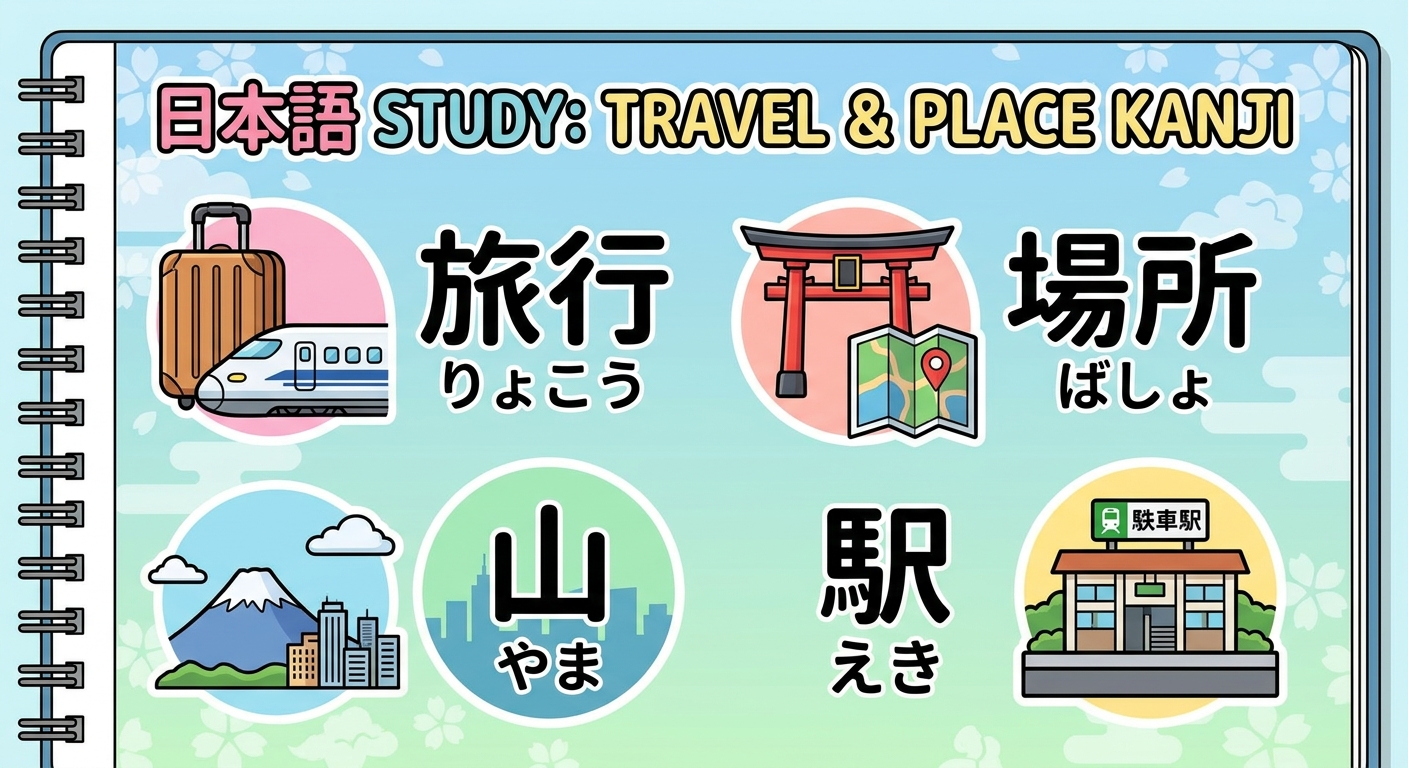
Introduction
Navigating Japan becomes a seamless and enriching experience once you master the essential kanji for travel and places. At the JLPT N4 level, transitioning from basic vocabulary to practical, real-world kanji is crucial for independence. This lesson focuses on the key characters used in transportation, directions, and common destinations. You will learn to recognize and read kanji found on train station signs, maps, and tourist brochures, such as those for 'station' (駅), 'port' (港), and 'direction' (方). By anchoring these characters in travel contexts, you will build the confidence needed to navigate Japanese cities and countryside with ease.
Lesson Content
Master N4 Kanji: Travel and Places (旅行と場所)
Welcome to your definitive guide to mastering N4 Kanji for travel and locations. Whether you are navigating the bustling streets of Tokyo or preparing for the JLPT N4 exam, these four essential kanji will serve as your linguistic compass.
1. 旅 (Travel / Trip)
This kanji represents a banner and people marching together—the perfect image for a journey.
- On'yomi (Chinese Reading): リョ (ryo)
- Kun'yomi (Japanese Reading): たび (tabi)
- Stroke Count: 10
- Stroke Order Tip: Start with the top-left elements (the banner radical) before writing the right-hand side (the people).
Key Vocabulary:
- 旅行 (りょこう - ryokou): Travel / Trip
- Example: 来週、京都へ旅行します。 (I will travel to Kyoto next week.)
- 一人旅 (ひとりたび - hitoritabi): Solo travel
- 旅人 (たびびと - tabibito): Traveler
2. 駅 (Station)
Crucial for train travel in Japan. The left side is the radical for "horse" (馬), reminding us of how people traveled before trains!
- On'yomi: エキ (eki)
- Kun'yomi: None
- Stroke Count: 14
- Stroke Order Tip: Write the complex "horse" radical on the left first, keeping it narrow to leave room for the right side (尺).
Key Vocabulary:
- 駅 (えき - eki): Station
- Example: 新宿駅で会いましょう。 (Let's meet at Shinjuku Station.)
- 駅員 (えきいん - ekiin): Station staff
- 駅弁 (えきべん - ekiben): Station bento box (a must-try for travelers!)
3. 館 (Building / Large Hall)
This kanji denotes a grand building or public facility. Note the left side, which is a modified version of 食 (food/eat), hinting at places that provide lodging or nourishment.
- On'yomi: カン (kan)
- Kun'yomi: None
- Stroke Count: 16
- Stroke Order Tip: Write the left "food" radical first, then the right side (官) from top to bottom.
Key Vocabulary:
- 旅館 (りょかん - ryokan): Traditional Japanese inn
- Example: 温泉のある旅館に泊まりたいです。 (I want to stay at a ryokan with a hot spring.)
- 図書館 (としょかん - toshokan): Library
- 美術館 (びじゅつかん - bijutsukan): Art museum
4. 地 (Earth / Ground / Place)
The left side is the "earth" radical (土), anchoring the meaning to physical ground or location.
- On'yomi: チ (chi) / ジ (ji)
- Kun'yomi: None
- Stroke Count: 6
- Stroke Order Tip: Start with the horizontal stroke of the 土 radical, then its vertical and rising stroke, before moving to the right side (也).
Key Vocabulary:
- 地図 (ちず - chizu): Map
- Example: 地図を見せてください。 (Please show me the map.)
- 地下鉄 (ちかてつ - chikatetsu): Subway (literally: "earth-under-iron")
- 地方 (ちほう - chihou): Region / Countryside
When traveling, pair these kanji with the correct N4 particles:
- Destination (に / へ):
- 駅に行く (Go to the station)
- Location of Action (で):
- 旅館でご飯を食べる (Eat a meal at the ryokan)
Challenge: Can you read this?
Translate the following sentence into Hiragana and English:
駅で地図をもらって、美術館へ行きました。
(Answer: えきでちずをもらって、びじゅつかんへいきました。 / "I got a map at the station and went to the art museum.")
Exercises
Travel and Place Kanji (Exercises)
Exercises for Travel and Place Kanji
Review the grammar and vocabulary, and try to fill in the blanks or write sentences based on the prompts.
Examples
空港へ行くために、東京駅で電車に乗りました。
Kūkō e iku tame ni, Tōkyō-eki de densha ni norimashita.
I boarded a train at Tokyo Station to go to the airport.
スマートフォンの地図で、有名な旅館の場所を調べました。
Sumātofon no chizu de, yūmei na ryokan no basho o shirabemashita.
I looked up the location of the famous Japanese inn on my smartphone's map.
京都は古いお寺がたくさんあるので、旅行に人気の場所です。
Kyōto wa furui otera ga takusan aru node, ryokō ni ninki no basho desu.
Kyoto is a popular place for travel because there are many old temples.
Practice Drills
Lesson Materials
Vocabulary (5)
Grammar (3)
Kanji (3)
Kana (0)
No kana characters in this lesson.