
Daily Life Kanji
Learn 8 high-frequency daily life kanji: 食飲買見聞読書話. Master both on-yomi and kun-yomi readings. Read each in example sentences.
🎯 Goal: By the end of this lesson, students will be able to identify and correctly interpret key N4-level kanji used in daily life, enabling them to navigate public spaces, understand basic product labels, and comprehend common public notices with confidence.
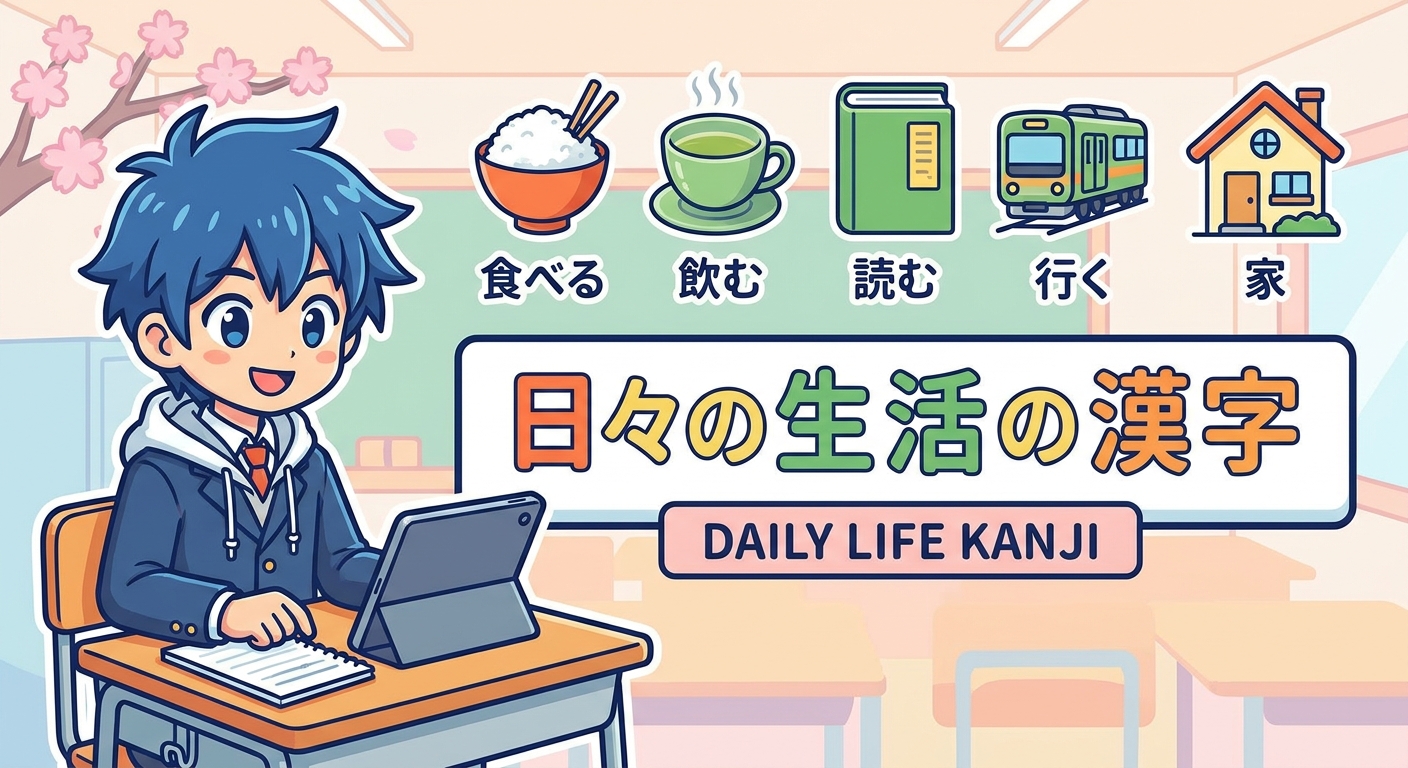
Introduction
Navigating daily life in Japan requires more than just conversational skills; it demands the ability to read and understand the written world around you. This N4 lesson focuses on "Daily Life Kanji," targeting the essential characters you encounter on street signs, public transportation, grocery labels, and restaurant menus. By moving beyond textbook exercises, you will learn to recognize high-frequency kanji that directly impact your autonomy in Japan. Master the visual cues of daily living, build your reading confidence, and transition from a passive observer to an active, independent navigator of Japanese society.
Lesson Content
Master N4 Kanji: Navigating Daily Life (日常の漢字)
Welcome to your N4 Kanji study guide! As you transition from beginner (N5) to intermediate Japanese, the kanji you encounter become much more practical. Today, we will master four essential kanji that you will see every single day in Japan—whether you are doing laundry, buying groceries, catching a train, or entering a shop.
1. 洗 (Wash)
This kanji combines the water radical (氵) on the left with a phonetic component representing "advance" on the right. Think of water advancing to clean something!
- Readings:
- Kunyomi: あら・う (ara-u) — to wash
- Onyomi: セン (sen)
- Key Vocabulary:
- 洗う (adau): To wash
- 洗濯 (sentaku): Laundry
- お手洗い (oterai): Restroom (literally, "hand-washing")
Example Sentence:
毎朝、自分で服を洗います。
Maiasa, jibun de fuku wo araimasu.
Translation: I wash my clothes by myself every morning.
Grammar Note: The particle を (wo) marks "clothes" (fuku) as the direct object of the transitive verb arau.
2. 払 (Pay)
Featuring the hand radical (扌), this kanji represents the physical action of brushing away or, in modern daily life, handing over money to pay.
- Readings:
- Kunyomi: はら・う (hara-u) — to pay / sweep away
- Onyomi: フツ (futsu) (rarely used at N4)
- Key Vocabulary:
- 払う (harau): To pay
- 支払い (shiharai): Payment
Example Sentence:
レジでクレジットカードで払ってください。
Reji de kurejitto kaado de haratte kudasai.
Translation: Please pay by credit card at the cash register.
Grammar Note: The first で (de) indicates the location of the action (at the register), while the second で (de) indicates the means/instrument (by credit card).
3. 急 (Hurry / Urgent)
With the heart radical (心) at the bottom, this kanji depicts a heart that is beating fast because you are in a rush.
- Readings:
- Kunyomi: いそ・ぐ (iso-gu) — to hurry
- Onyomi: キュウ (kyuu)
- Key Vocabulary:
- 急ぐ (isogu): To hurry
- 急行 (kyuukou): Express train
- 急に (kyuu ni): Suddenly
Example Sentence:
電車に遅れそうなので、急いでいます。
Densha ni okuresou na node, isoide imasu.
Translation: I am in a hurry because it looks like I will be late for the train.
Grammar Note: 〜そう (sou) means "looks like/about to." 〜ています (te-imasu) expresses an ongoing state (being in a hurry).
4. 開 (Open)
This kanji features the gate radical (門) enclosing a pair of hands sliding a bolt open.
- Readings:
- Kunyomi: あ・く (a-ku) — to open (intransitive), あ・ける (a-keru) — to open (transitive)
- Onyomi: カイ (kai)
- Key Vocabulary:
- 開ける (akeru): To open (something)
- 開く (aku): (Something) opens
- 開店 (kaiten): Store opening
Example Sentence:
デパートは午前十時に開きます。
Depaato wa gozen juuji ni akimasu.
Translation: The department store opens at 10:00 AM.
Grammar Spotlight: Transitive vs. Intransitive with "開"
At the N4 level, distinguishing transitive verbs (actions you do to an object) from intransitive verbs (actions that happen on their own) is crucial.
- Transitive (他動詞): 開ける (akeru)
- Usage: [Subject] が [Object] を 開ける。
- Example: 窓を開けました。 (I opened the window.)
- Intransitive (自動詞): 開く (aku)
- Usage: [Subject] が 開く。
- Example: 自動ドアが開きました。 (The automatic door opened.)
Quick Practice
Translate the following sentence into Japanese using the kanji learned above:
- "I hurried because the store opens at 9:00."
(Hint: Use "〜から" or "〜ので" for "because".)
Answer:
店は九時に開くので、急ぎました。
(Mise wa kuji ni aku node, isogimashita.)
Exercises
Daily Life Kanji (Exercises)
Exercises for Daily Life Kanji
Review the grammar and vocabulary, and try to fill in the blanks or write sentences based on the prompts.
Examples
食後にこの薬を飲んでください。
Shokugo ni kono kusuri wo nonde kudasai.
Please take this medicine after meals.
毎朝、自転車で駅まで行きます。
Maiasa, jitensha de eki made ikimasu.
I go to the station by bicycle every morning.
毎日、台所で料理を作ります。
Mainichi, daidokoro de ryouri wo tsukurimasu.
I cook food in the kitchen every day.
Practice Drills
Lesson Materials
Vocabulary (5)
Grammar (0)
No grammar rules in this lesson.
Kanji (3)
Kana (0)
No kana characters in this lesson.