
People and Feelings Kanji
Learn 7 kanji about people and inner states: 体病友私彼思知. Use in sentences about health, relationships, and thoughts.
🎯 Goal: To master the reading, writing, and contextual usage of key N4 kanji related to human relationships and emotions, enabling learners to express feelings and describe people accurately in everyday Japanese.
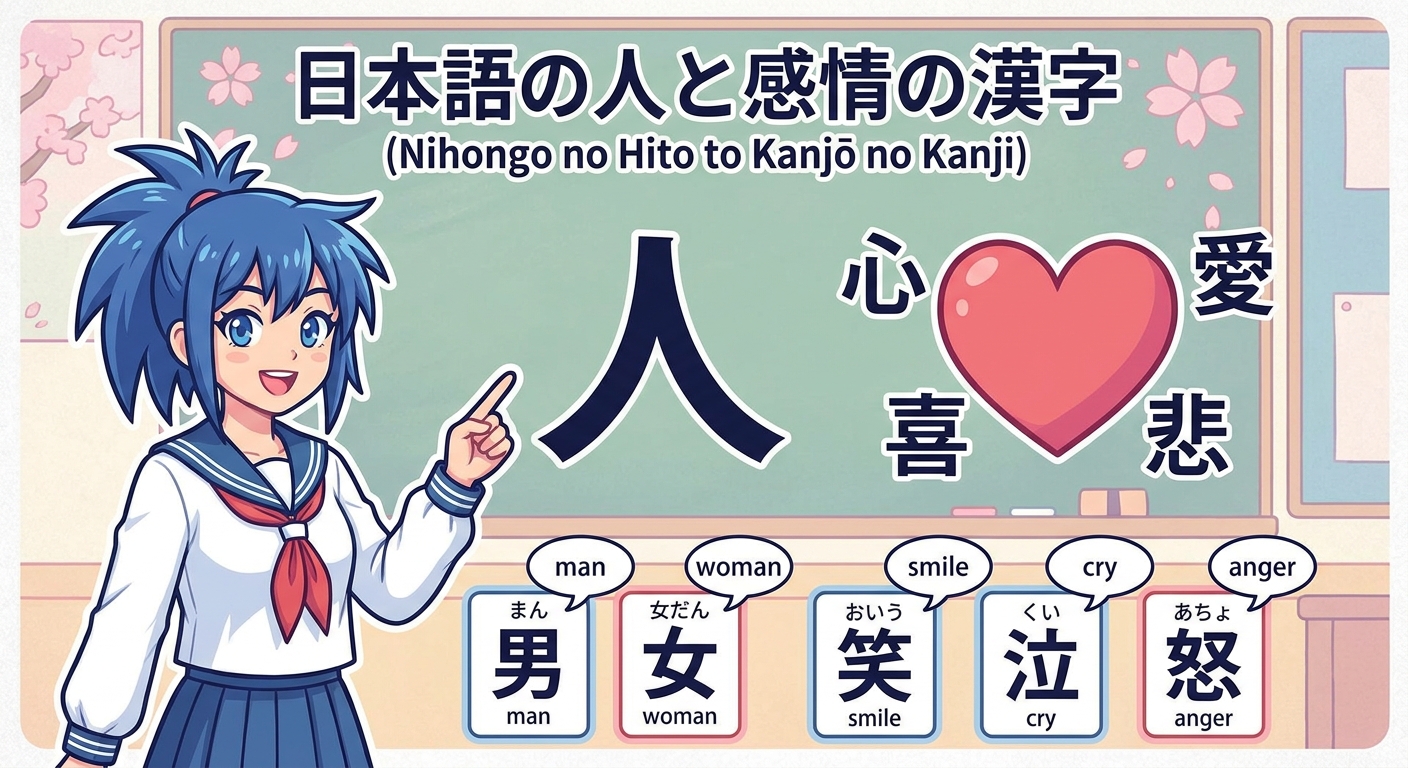
Introduction
Welcome to the "People and Feelings Kanji" lesson! At the JLPT N4 level, expanding your vocabulary to describe human connections and inner emotions is essential for natural communication. In this lesson, we will explore key kanji related to people, relationships, and various emotional states. You will learn characters like 心 (heart/mind), 情 (feeling), and 活 (life/activity), examining how they combine to form common compound words (jukugo) used in daily conversations. By mastering these characters, you will be able to express empathy, describe personalities, and discuss interpersonal dynamics with greater nuance and confidence.
Lesson Content
Master Class: People and Feelings Kanji (JLPT N4)
In Japanese, the landscape of human emotion and connection is beautifully mapped out through Kanji. At the N4 level, you transition from basic nouns to expressing complex inner states and interpersonal relationships.
This guide explores the essential Kanji for feelings and people, focusing on their anatomy, stroke dynamics, and grammatical usage.
1. The Anatomy of Emotion: The "Heart" Radical (心)
Most Kanji representing feelings contain the radical 心 (kokoro - heart/mind). It acts as a semantic marker. When placed at the bottom of a character, it looks like 心. When compressed on the left side, it transforms into 忄 (called Risshinben).
2. Core N4 Kanji Deep Dive
① 思 (Think, Feel)
- Readings: Onyomi: シ (shi) | Kunyomi: おも・う (omo-u)
- Meaning: To think, to feel, to recall.
- Visual Mnemonics: A brain/field (田) over a heart (心). Using both your intellect and emotion to process a thought.
- Stroke Order Concept: 9 strokes. Write the top 田 first (left to right, top to bottom), then write the bottom 心.
Key Vocabulary:
- 思う (omou - to think)
- 思い出 (omoide - memory)
- 意思 (ishi - intention/will)
② 感 (Feel, Sensation)
- Readings: Onyomi: カン (kan)
- Meaning: Feeling, emotion, to be moved by.
- Visual Mnemonics: The top part (咸) means "all together" or "connection." Combined with heart (心), it represents your whole heart reacting to an external stimulus.
- Stroke Order Concept: 13 strokes. Complete the complex top-half frame first, then anchor the character with the bottom 心.
Key Vocabulary:
- 感じる (kanjiru - to feel [an emotion/sensation])
- 感謝 (kansha - gratitude)
- 感動する (kandō suru - to be deeply moved)
③ 情 (Emotion, Condition)
- Readings: Onyomi: ジョウ (jō) | Kunyomi: なさ・け (nasa-ke)
- Meaning: Emotion, sympathy, real circumstances.
- Visual Mnemonics: The left side is the "heart" radical (忄). The right side is 青 (blue/pure). It represents "pure, natural feelings."
- Stroke Order Concept: 11 strokes. Always write the left radical (忄) first: vertical stroke, then the two dots. Then write the right side (青).
Key Vocabulary:
- 感情 (kanjō - emotion/feelings)
- 同情 (dōjō - sympathy)
- 情報 (jōhō - information [lit. "reports on conditions"])
④ 怒 (Anger, Get Mad)
- Readings: Onyomi: ド (do) | Kunyomi: おこ・る (oko-ru)
- Meaning: To get angry.
- Visual Mnemonics: A woman (女) under control/hand (又) forms "slave" (奴), placed over a heart (心). A heart feeling oppressed or controlled bursts into anger.
- Stroke Order Concept: 9 strokes. Write the top 奴 first, then write the bottom 心.
Key Vocabulary:
- 怒る (okoru - to get angry)
- 怒り (ikari - anger [noun])
3. Grammar & Particles in Action
To use these Kanji naturally, you must master their accompanying N4 particles.
Pattern A: Expressing Thoughts and Intentions
Use the quotation particle と (to) with 思う.
- 彼は来ないと思います。
(Kare wa konai to omoimasu.)
I think he won't come.
Pattern B: Direct Objects of Sensation
Use the direct object particle を (wo) with 感じる.
- 強い風を感じました。
(Tsuyoi kaze wo kanjimashita.)
I felt a strong wind.
Pattern C: Directing Anger
Use the target particle に (ni) to indicate who or what you are angry at.
- 先生は彼に怒っています。
(Sensei wa kare ni okotte imasu.)
The teacher is angry at him.
4. Quick Challenge
Translate the following N4 sentence into Japanese using the Kanji learned today:
"I feel gratitude toward my family."
Answer Key:
- 家族に****感謝を****感じます。 (Kazoku ni kansha wo kanjimasu.)
Exercises
People and Feelings Kanji (Exercises)
Exercises for People and Feelings Kanji
Review the grammar and vocabulary, and try to fill in the blanks or write sentences based on the prompts.
Examples
彼女の悲しい話を聞いて、心が痛くなりました。
Kanojo no kanashii hanashi o kiite, kokoro ga itaku narimashita.
Hearing her sad story made my heart ache.
約束を守らなかったので、父はとても怒っています。
Yakusoku o mamoranakatta node, chichi wa totemo okotte imasu.
Because I didn't keep my promise, my father is very angry.
友達が面白い冗談を言ったので、みんなで笑いました。
Tomodachi ga omoshiroi joudan o itta node, minna de waraimashita.
My friend told a funny joke, so we all laughed.
Practice Drills
Lesson Materials
Vocabulary (0)
No vocabulary in this lesson.
Grammar (0)
No grammar rules in this lesson.
Kanji (3)
Kana (0)
No kana characters in this lesson.