
Shopping — Price, Quantity, Comparison
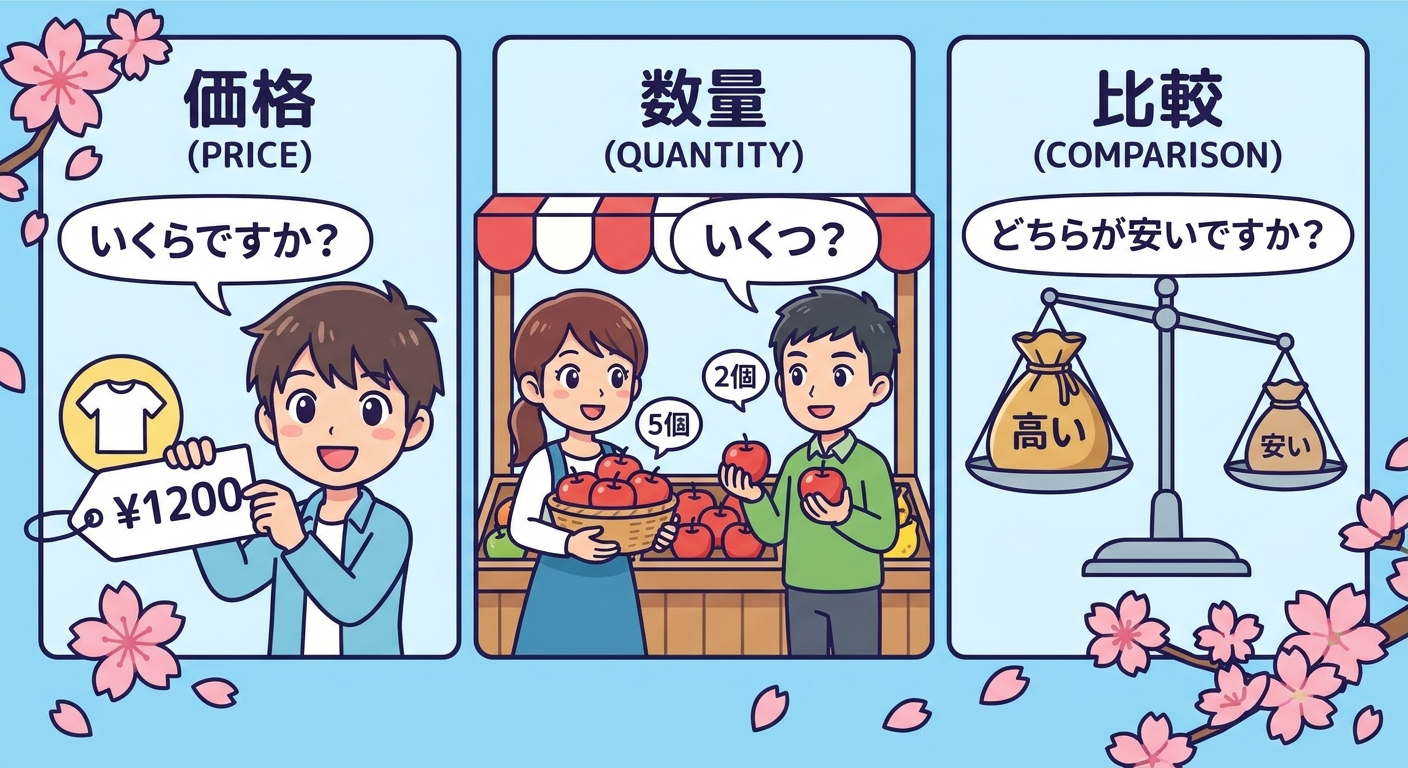
Handle shopping situations: asking prices (いくらですか), talking about quantity (〜つ/個), and comparing items (〜の方が/〜より). Practice in shop roleplay.
🎯 Goal: To confidently navigate Japanese retail environments by accurately asking for prices, specifying item quantities using correct counters, and comparing products using N4 comparative and superlative structures to make informed purchasing decisions.
Introduction
Welcome to this lesson on shopping, a fundamental skill for daily life in Japan. At the JLPT N4 level, navigating stores requires more than just pointing and asking for prices. In this lesson, you will master the essential vocabulary and grammar needed to inquire about prices, specify quantities using appropriate Japanese counters, and make comparisons between different products. You will learn to express preferences using structures like 'A is cheaper than B' or identify the best option among multiple items. By blending practical retail vocabulary with core N4 comparative grammar, you will gain the confidence to shop independently and make informed purchasing decisions in Japanese.
Lesson Content
Master Japanese N4: Shopping — Price, Quantity, & Comparison
Welcome to your definitive N4 guide to mastering shopping transactions in Japanese. Whether you are hunting for bargains in Tokyo or ordering online, this guide will teach you how to discuss prices, specify quantities, and compare products like a native speaker.
1. Talking About Price: Beyond the Basics
To ask for a price, use 〜はいくらですか (How much is...?). At the N4 level, you must also master expressing limitations on your budget using だけ (only - positive) and しか...ない (only - negative implication).
Key Grammar: だけ vs. しか...ない
- だけ (Dake): Simply states a limit. It is followed by a positive verb.
- しか (Shika) ... ない (Nai): Implies that the amount is insufficient or less than expected. It must always pair with a negative verb.
Examples:
- 予算(よさん)は5千円(ごせんえん)だけあります。
Yosan wa gosen-en dake arimasu.
"I have only 5,000 yen (and that is fine/neutral)." - 財布(さいふ)に千円(せんえん)しかありません。
Saifu ni sen-en shika arimasen.
"I have only 1,000 yen (and that is not enough)."
2. Expressing Quantities with Precision
When shopping, place the counter after the particle marking the object, or directly before the verb.
- Structure:
[Noun] + [Particle] + [Quantity] + [Verb] - Example: りんごを三(みっ)つ買(か)いました。 (I bought three apples.)
Essential N4 Shopping Counters:
| Counter | Pronunciation | Used For | Example |
|---|---|---|---|
| 〜個 (ko) | こ | Small, round objects | りんご一個 (1 apple) |
| 〜枚 (mai) | まい | Flat, thin objects | シャツ二枚 (2 shirts) |
| 〜本 (hon/pon/bon) | ほん | Long, cylindrical objects | 傘三本 (3 umbrellas) |
3. Comparing Products (比較 - Hikaku)
As an N4 learner, you must master the three core patterns of comparison:
Pattern A: Comparing Two Items (A is more than B)
$$\text{A は B より [Adjective] です}$$
- Example: この靴(くつ)はあの靴より安(やす)いです。
Kono kutsu wa ano kutsu yori yasui desu.
"These shoes are cheaper than those shoes."
Pattern B: Asking for a Preference (Which of the two...?)
$$\text{A と B と どちらが [Adjective] ですか}$$
$$\text{Response: A のほうが [Adjective] です}$$
- Example:
Q: ビールとワインとどちらが安いですか。
Biiru to wain to dochira ga yasui desu ka?
"Which is cheaper, beer or wine?"
A: ビールのほうが安いです。
Biiru no hō ga yasui desu.
"Beer is cheaper."
Pattern C: Superlatives (The most...)
$$\text{[Group/Range] の中で A が一番(いちばん) [Adjective] です}$$
- Example: この店(みせ)の中で、このカバンが一番高(たか)いです。
Kono mise no naka de, kono kaban ga ichiban takai desu.
"Out of everything in this store, this bag is the most expensive."
4. Practical Dialogue: At the Electronics Store
Apply these rules in a real-world context. Read the dialogue below:
客(きゃく - Customer): すみません、このヘッドホンとあのヘッドホンと、どちらのほうが音(おと)がいいですか。
Sumimasen, kono heddohon to ano heddohon to, dochira no hō ga oto ga ii desu ka?
"Excuse me, between these headphones and those headphones, which one has better sound?"
店員(てんいん - Clerk): こちらのほうが少し高いですが、音は一番いいですよ。
Kochira no hō ga sukoshi takai desu ga, oto wa ichiban ii desu yo.
"This one is a bit more expensive, but the sound is the best."
客: そうですか。今、財布に1万円しかありませんが、足(た)りますか。
Sō desu ka. Ima, saifu ni ichiman-en shika arimasen ga, tarimasu ka?
"I see. I only have 10,000 yen in my wallet right now; is that enough?"
店員: はい、消費税(しょうひぜい)込(こ)みで9千円ですから、足りますよ!
Hai, shōhizei komi de kyūsen-en desu kara, tarimasu yo!
"Yes, it is 9,000 yen including consumption tax, so it's enough!"
Quick Review Challenge
Can you translate this sentence using today's grammar?
"Out of these three shirts, the blue one is the cheapest."
(Answer: この三枚のシャツの中で、青いのが一番安いです。)
Exercises
Shopping — Price, Quantity, Comparison (Exercises)
Exercises for Shopping — Price, Quantity, Comparison
Review the grammar and vocabulary, and try to fill in the blanks or write sentences based on the prompts.
Examples
この赤いかばんのほうが、あの黒いかばんより安いです。
Kono akai kaban no hou ga, ano kuroi kaban yori yasui desu.
This red bag is cheaper than that black bag.
このりんごを3個買ったら、全部でいくらになりますか。
Kono ringo o sanko kattara, zenbu de ikura ni narimasu ka.
If I buy three of these apples, how much will it be in total?
この3つのTシャツの中で、どれが一番人気がありますか。
Kono mittsu no tiishatsu no naka de, dore ga ichiban ninki ga arimasu ka.
Out of these three T-shirts, which one is the most popular?
Practice Drills
Lesson Materials
Vocabulary (5)
Grammar (3)
Kanji (0)
No kanji characters in this lesson.
Kana (0)
No kana characters in this lesson.