
趣味 and Interests
Talk about hobbies and preferences using 趣味は〜です and 〜が好きです/きらいです/得意です. Build natural conversations about leisure activities.
🎯 Goal: To confidently describe your hobbies and leisure activities in detail using N4 grammar, express personal preferences, and actively engage in natural, two-way conversations about interests with Japanese speakers.
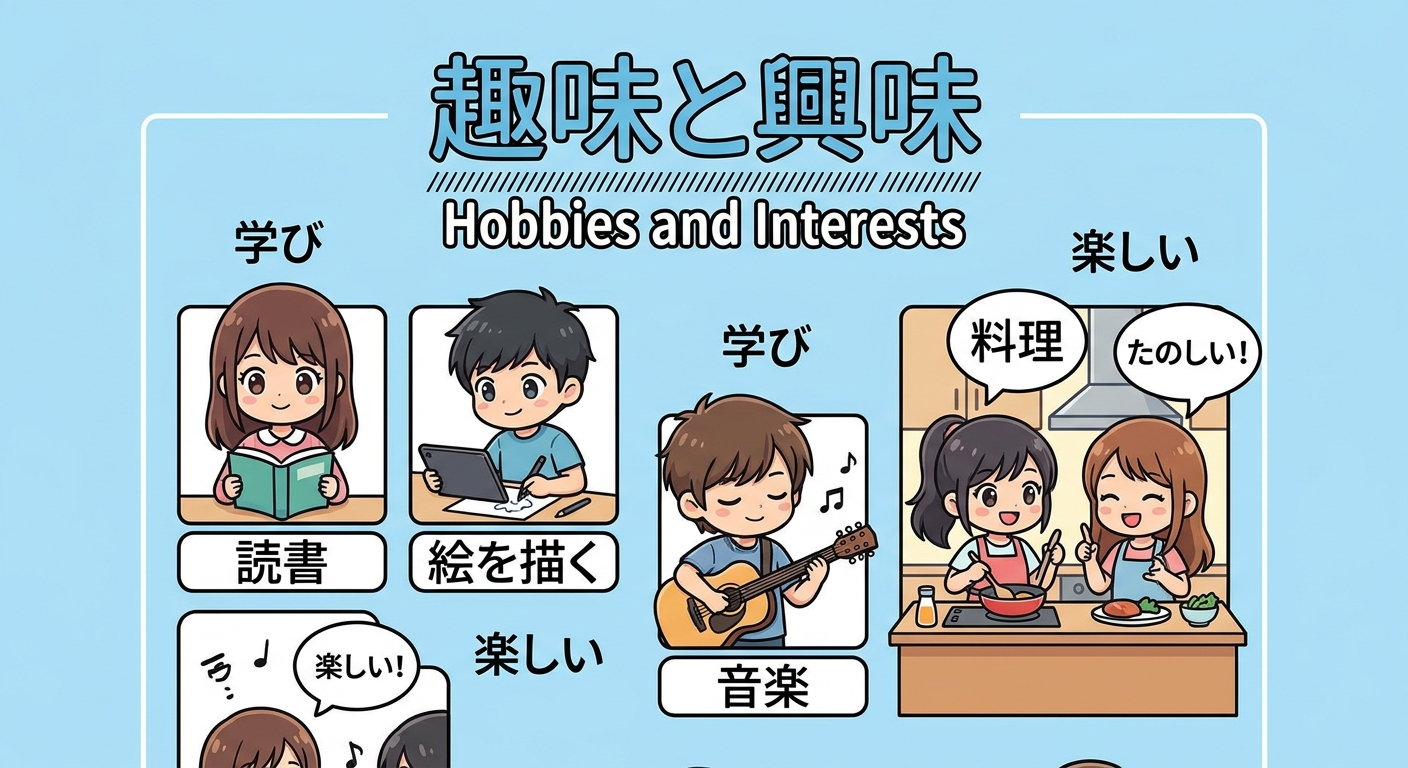
Introduction
Welcome to this lesson on "趣味" (Hobbies) and Interests, designed for JLPT N4 learners. Talking about what we love to do in our free time is one of the best ways to build connections and sustain conversations in Japanese. In this lesson, you will move beyond simple N5 sentence patterns to express your passions with greater detail and nuance. We will explore key N4 grammar structures, such as using nominalizers (~こと and ~の) to describe activities, and expressing frequency or preferences. By the end of this module, you will be able to share your hobbies naturally and ask engaging follow-up questions.
Lesson Content
Elite Japanese Study Guide: Master Talking About Hobbies (趣味)
Level: JLPT N4
Focus: Nominalization, Expressing Preferences, and Listing Activities
Talking about your hobbies (趣味 - しゅみ) is the ultimate icebreaker in Japanese culture. At the N4 level, you transition from simple nouns (e.g., "I like soccer") to complex, dynamic sentences (e.g., "My hobby is taking photos of old temples").
This guide covers the core grammar structures, essential vocabulary, and natural expressions needed to discuss your interests fluently.
1. Essential N4 Hobby Vocabulary
Before diving into grammar, let's upgrade your vocabulary with kanji and expressions common at the N4 level:
| Kanji/Kana | Romaji | English Meaning |
|---|---|---|
| 趣味 (しゅみ) | shumi | Hobby / Interest |
| 読書 (どくしょ) | dokusho | Reading books |
| 山登り (やまのぼり) | yamanobori | Mountain climbing / Hiking |
| 絵を描くこと (えをかくこと) | e o kaku koto | Drawing/Painting pictures |
| 写真を撮ること (しゃしんをとること) | shashin o toru koto | Taking photos |
| 旅行すること (りょこうすること) | ryokō suru koto | Traveling |
2. Grammar Pillar 1: Defining Your Hobby
Structure: [Verb (Dictionary Form)] + こと です
To say "My hobby is [doing something]," you must turn the action verb into a noun. In Japanese, we do this by adding こと (koto) to the dictionary (plain) form of the verb.
$$\text{私の趣味は} + \text{[Verb (Dictionary Form)]} + \text{ことです。}$$
Examples:
- 私の趣味は本を読むことです。
- Watashi no shumi wa hon o yomu koto desu.
- My hobby is reading books.
- 彼の趣味は外国の料理を作ることです。
- Kare no shumi wa gaikoku no ryōri o tsukuru koto desu.
- His hobby is cooking foreign food.
Tutor Tip: Never say "私の趣味は本を読みますです" (Incorrect). You cannot couple a polite verb ending (
ます) directly withです. Always nominalize withこと.
3. Grammar Pillar 2: Expressing Likes & Dislikes
Structure: [Verb (Dictionary Form)] + の が好きです
When expressing likes (好き), dislikes (嫌い), strengths (得意), or weaknesses (苦手), use the nominalizer の (no) instead of こと.
$$\text{[Verb (Dictionary Form)]} + \text{のが [好き / 得意 / 苦手] です。}$$
Examples:
- 私は写真を撮るのが好きです。
- Watashi wa shashin o toru no ga suki desu.
- I like taking photos.
- 妹は歌を歌うのが得意です。
- Imōto wa uta o utau no ga tokui desu.
- My younger sister is good at singing songs.
4. Grammar Pillar 3: Listing Activities Representative of Your Hobbies
Structure: [Verb 1 (Ta-form)] + り、[Verb 2 (Ta-form)] + り します
To show that your hobby involves various activities without listing every single one, use the 〜たり、〜たりします pattern (doing things like A and B).
Example:
- 週末は、映画を見たり、音楽を聞いたりします。
- Shūmatsu wa, eiga o mitari, ongaku o kikitari shimasu.
- On weekends, I do things like watching movies and listening to music.
5. Natural Conversation Practice
Read this natural N4-level exchange between Ken and Anna:
-
Ken: アンナさんの趣味は何ですか。
(Anna-san no shumi wa nan desu ka?)
Anna, what is your hobby? -
Anna: 私の趣味は旅行することです。特に、古いお寺の写真を撮るのが好きです。ケンさんは?
(Watashi no shumi wa ryokō suru koto desu. Tokuni, furui otera no shashin o toru no ga suki desu. Ken-san wa?)
My hobby is traveling. Especially, I like taking photos of old temples. How about you, Ken? -
Ken: いいですね!私は休みに、山に登ったり、美味しいものを食べたりするのが好きです。
(Ii desu ne! Watashi wa yasumi ni, yama ni nobottari, oishii mono o tabetari suru no ga suki desu.)
Sounds nice! On my days off, I like doing things like climbing mountains and eating delicious food.
6. Challenge Exercise
Transform the following raw actions into natural N4 sentences:
-
Hobby: Watch anime (アニメを見る)
- Target: "My hobby is watching anime."
- Answer: 私の趣味はアニメを見ることです。
-
Preference: Play piano (ピアノを弾く)
- Target: "I am bad at playing the piano."
- Answer: 私はピアノを弾くのが苦手です。
Exercises
趣味 and Interests (Exercises)
Exercises for 趣味 and Interests
Review the grammar and vocabulary, and try to fill in the blanks or write sentences based on the prompts.
Examples
私の趣味は、きれいな景色の写真を撮ることです。
Watashi no shumi wa, kirei na keshiki no shashin o toru koto desu.
My hobby is taking photos of beautiful scenery.
日本の文化に興味があるので、茶道を習っています。
Nihon no bunka ni kyoumi ga aru node, sadou o naratte imasu.
I am interested in Japanese culture, so I am learning tea ceremony.
週末は、音楽を聞いたり映画を見たりします。
Shuumatsu wa, ongaku o kiitari eiga o mitari shimasu.
On weekends, I do things like listen to music and watch movies.
Practice Drills
Lesson Materials
Vocabulary (5)
Grammar (3)
Kanji (0)
No kanji characters in this lesson.
Kana (0)
No kana characters in this lesson.