
から / ので — Giving Reasons
Express reasons using から (because, casual) and ので (because, polite/formal). Understand the register difference and when to use each in daily communication.
🎯 Goal: By the end of this lesson, you will be able to confidently differentiate between から and ので, choose the appropriate particle based on politeness and subjectivity, and construct grammatically correct sentences to express reasons in both casual and formal Japanese.
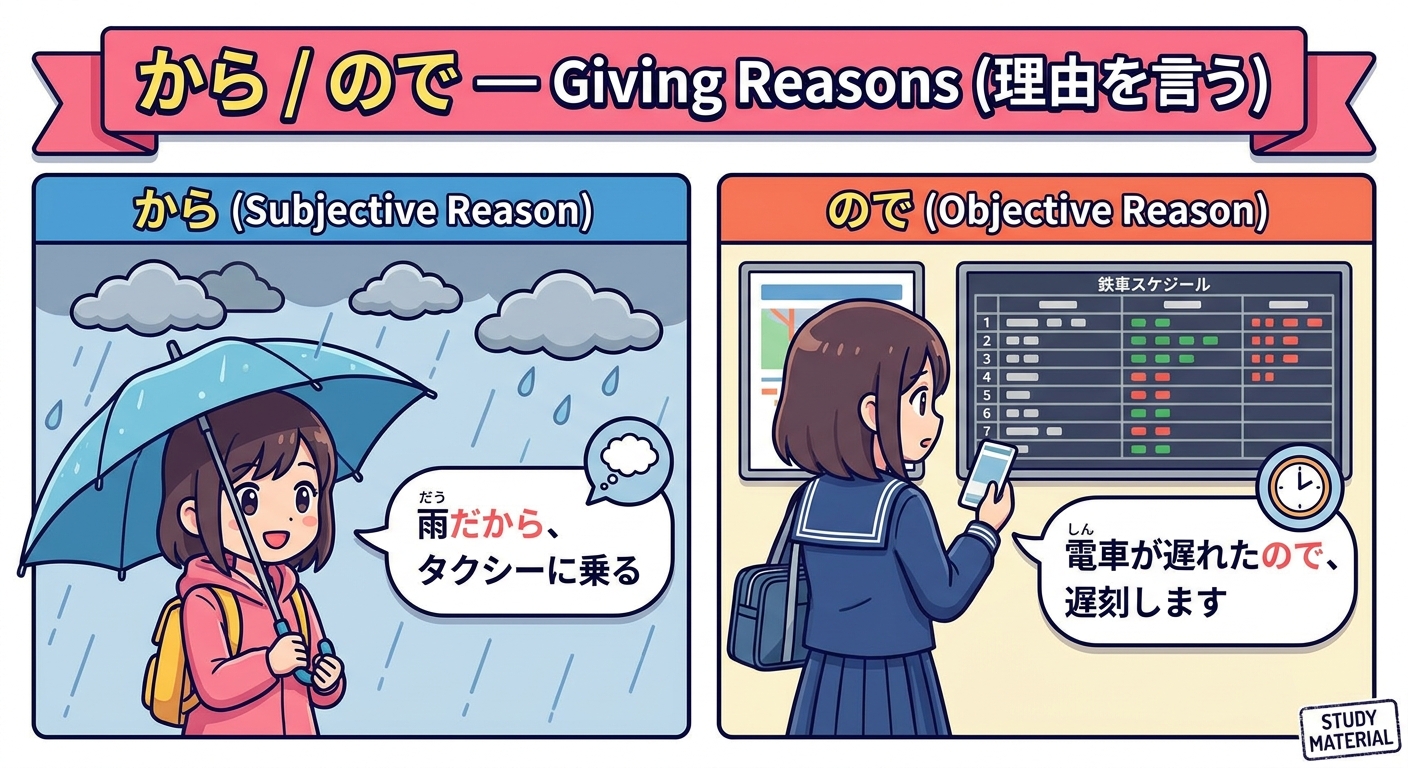
Introduction
In Japanese, explaining why something happened is essential for natural communication. In this lesson, we will explore two fundamental particles used for giving reasons: から (kara) and ので (node). While both translate to 'because' or 'so' in English, they carry distinct nuances that affect how your message is received. から is subjective and emphasizes the speaker's personal opinion, making it great for casual speech or commands. In contrast, ので is objective, polite, and softer, making it ideal for making excuses or speaking in professional settings. Mastering these will elevate your N4 conversational flow.
Lesson Content
Master Japanese Causality: から (Kara) vs. ので (Node)
In Japanese, expressing why something happens is a fundamental communication skill. At the JLPT N4 level, you will encounter two primary particles for giving reasons: から (kara) and ので (node).
While both translate to "because" or "so" in English, they carry completely different nuances. Mixing them up can make you sound accidentally rude or overly dramatic. Let’s master the difference!
1. から (Kara) — The Subjective "Because"
から focuses on the speaker’s personal opinion, feelings, or intent. It is subjective, active, and can sound strong or assertive.
Grammatical Connection
- Verbs / い-Adjectives: Plain/Polite form + から
- Example: 食べるから (taberu kara) / 食べますから (tabemasu kara)
- な-Adjectives / Nouns: Add だ (da) or です (desu) + から
- Example: 雨だから (ame da kara) / 雨ですから (ame desu kara)
Key Nuance & Usage
Use から when you are expressing personal excuses, making suggestions, giving commands, or stating strong beliefs.
- 寒いから、窓を閉めてください。
- Samui kara, mado o shimete kudasai.
- Because I feel cold, please close the window. (Subjective request)
- 危ないから、入るな!
- Abunai kara, hairu na!
- Because it's dangerous, don't enter! (Strong command)
2. ので (Node) — The Objective "Because"
ので is used for objective facts, natural consequences, and polite explanations. It sounds softer, gentler, and more socially diplomatic than から.
Grammatical Connection
- Verbs / い-Adjectives: Plain form + ので
- Example: 行くので (iku node) / 寒いので (samui node)
- な-Adjectives / Nouns: Add な (na) + ので (Crucial N4 Grammar Point!)
- Example: 好きなので (suki na node) / 病気なので (byōki na node)
Key Nuance & Usage
Use ので when explaining a situation politely (especially to superiors), apologizing, or stating a natural cause-and-effect relationship.
- バスが遅れたので、遅刻しました。
- Basu ga okureta node, chikoku shimashita.
- Because the bus was late, I arrived late. (An objective fact; sounds less like a defensive excuse).
- 頭が痛いので、早く帰ってもいいですか。
- Atama ga itai node, hayaku kaette mo ii desu ka.
- Since I have a headache, may I go home early? (Polite request)
Quick Comparison Table
| Feature | から (Kara) | ので (Node) |
|---|---|---|
| Perspective | Subjective (Speaker's view) | Objective (Facts/Reality) |
| Tone | Strong, assertive, direct | Polite, soft, apologetic |
| Noun Connection | Noun + だから | Noun + なので |
| Best Used For | Commands, personal opinions, excuses | Business situations, polite requests, natural causes |
Tutor's Tip: The "Excuse" Test 💡
Imagine you are late for work.
- If you say: 「寝坊したから、遅れました」 (Nebō shita kara, okuremashita), it sounds like: "I overslept, so (deal with it) I'm late." It sounds defensive.
- If you say: 「寝坊したので、遅れました」 (Nebō shita node, okuremashita), it sounds like: "Because of the fact that I overslept, I am late (I apologize)." It sounds much more professional and polite.
Rule of thumb: When apologizing to a teacher or boss, always use ので!
Practice Challenge 📝
Choose the correct particle (から or ので) for each sentence:
- 漢字が難しい( )、毎日練習してください。
(Kanji is difficult, so please practice every day.) - 日曜日( )、デパートは人が多いです。
(Because it is Sunday, the department store is crowded.)
(Answers: 1. から - because it is a command/request | 2. なので - because Sunday is a noun, and this is an objective fact).
Exercises
から / ので — Giving Reasons (Exercises)
Exercises for から / ので — Giving Reasons
Review the grammar and vocabulary, and try to fill in the blanks or write sentences based on the prompts.
Examples
雨が降っているから、タクシーで行きましょう。
Ame ga futte iru kara, takushī de ikimashō.
Since it is raining, let's go by taxi.
頭が痛いので、今日は早く帰ってもいいですか。
Atama ga itai node, kyō wa hayaku kaette mo ii desu ka.
I have a headache, so may I go home early today?
明日は休みなので、遅くまで起きています。
Ashita wa yasumi na node, osoku made okite imasu.
Tomorrow is a day off, so I am staying up late.
Practice Drills
Lesson Materials
Vocabulary (5)
Grammar (3)
Kanji (0)
No kanji characters in this lesson.
Kana (0)
No kana characters in this lesson.