
Directions and Transport
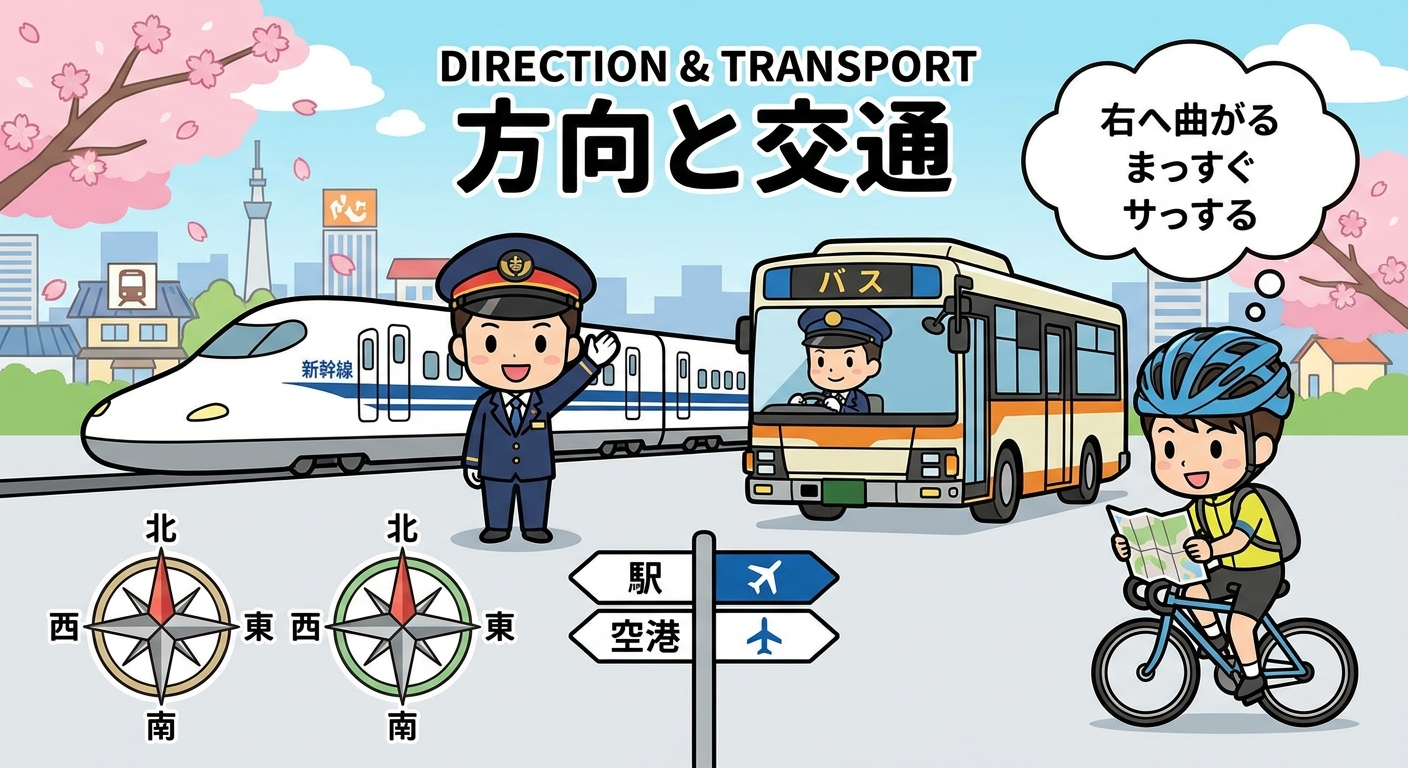
Learn travel vocabulary and direction expressions: まっすぐ, 右, 左, 曲がる. Use 〜て行く/来る to describe routes. Practice explaining how to get somewhere.
🎯 Goal: To confidently ask for, understand, and give detailed directions using landmarks and specific transit methods, while effectively utilizing N4 grammar patterns like conditional ~to and sequential ~te kara in real-world travel scenarios.
Introduction
Navigating Japan's world-class transportation system and asking for directions are essential skills for any language learner. In this N4 lesson, we transition from basic survival phrases to more natural, detailed expressions. You will learn how to ask for and give complex directions using landmarks, understand common transit announcements, and utilize essential grammar points such as ~te kara (after doing) and ~to (if/when) to describe routes. By mastering these structures, you will gain the confidence to navigate Japanese cities independently, comprehend transit staff instructions, and assist others in Japanese.
Lesson Content
Elite Japanese Study Guide: Directions and Transport (JLPT N4)
Navigating Japan’s world-class transit system and picturesque streets is a core milestone of the JLPT N4 level. This guide refines your ability to give and receive directions, use transit particles accurately, and sound natural to native speakers.
1. Essential Vocabulary (語彙)
Mastering these spatial and transit terms is crucial before applying grammar rules.
| Kanji | Furigana | English | Nuance Note |
|---|---|---|---|
| 角 | かど | Corner | Specifically an outer corner of a street. |
| 交差点 | こうさてん | Intersection | Where two or more roads cross. |
| 信号 | しんごう | Traffic Light | Often used as landmarks for turning. |
| 突き当たり | つきあたり | End of the street | A dead end or T-junction. |
| 〜線 | 〜せん | ...Line | Used for train lines (e.g., 山手線 Yamanote-sen). |
| 乗り換え | のりかえ | Transfer | Changing trains, buses, or flights. |
2. Key Grammar Patterns
Rule A: The Movement Particle を (Navigating Space)
In English, we walk through a park or turn at a corner. In Japanese, the particle を marks the space or route through, along, or out of which movement occurs.
$$\text{[Location/Obstacle]} + \mathbf{\text{を}} + \text{[Movement Verb (曲がる, 渡る, 通る)]}$$
- 角を右に曲がってください。
- Kado o migi ni magatte kudasai.
- Please turn right at the corner.
- この道をまっすぐ行ってください。
- Kono michi o massugu itte kudasai.
- Please go straight along this street.
Rule B: Giving Directions with the 〜と Conditional
To explain what a traveler will find after taking a specific action, use the と conditional (Dictionary Form + と). This indicates a natural, inevitable consequence: "If you do X, Y will naturally appear."
$$\text{[Verb (Dictionary Form)]} + \mathbf{\text{と}} + \text{[Result/State]}$$
- 橋を渡ると、左に交番があります。
- Hashi o wataru to, hidari ni kouban ga arimasu.
- If you cross the bridge, there will be a police box on your left.
- まっすぐ行くと、突き当たりにコンビニが見えます。
- Massugu iku to, tsukiatari ni konbini ga miemasu.
- If you go straight, you will see a convenience store at the end of the street.
Rule C: Boarding, Exiting, and Transferring
Using the correct particles with transport verbs is a common trap on the JLPT N4 exam. Memorize these pairings:
- Get on:
[Vehicle] に乗る (にのる)$\rightarrow$にmarks the target of entry. - Get off:
[Vehicle] を降りる (をおりる)$\rightarrow$をmarks the point of departure. - Transfer:
[Station] で [A] から [B] に乗り換える
- 東京駅で地下鉄に乗り換えてください。
- Tōkyō-eki de chikate tsu ni norikaete kudasai.
- Please transfer to the subway at Tokyo Station.
3. Real-World Dialogue (会話)
Read this natural conversation between a tourist (A) and a local (B) to see these rules in action.
- A: すみません、美術館へはどう行けばいいですか。
- Sumimasen, bijutsukan e wa dō ikeba ii desu ka?
- Excuse me, how can I get to the art museum?
- B: ああ、美術館ですね。この道をまっすぐ行くと、大きな交差点があります。
- Ā, bijutsukan desu ne. Kono michi o massugu iku to, ōkina kōsaten ga arimasu.
- Ah, the art museum. If you go straight down this street, there is a large intersection.
- A: はい、交差点ですね。
- Hai, kōsaten desu ne.
- Yes, the intersection.
- B: その交差点を右に曲がって、2分ほど歩くと右側にありますよ。
- Sono kōsaten o migi ni magatte, nifun hodo aruku to migigawa ni arimasu yo.
- Turn right at that intersection, and if you walk for about two minutes, it will be on your right side.
4. Pro-Tip for N4 Success
When asked for directions in listening exams, map out the sequence mentally using 〜てから (after doing...).
- Example: 電車を降りてから、北口を出てください。 (After getting off the train, exit through the North Gate.)
Exercises
Directions and Transport (Exercises)
Exercises for Directions and Transport
Review the grammar and vocabulary, and try to fill in the blanks or write sentences based on the prompts.
Examples
次の角を右に曲がると、左側に地下鉄の駅があります。
Tsugi no kado o migi ni magaru to, hidarigawa ni chikatetsu no eki ga arimasu.
If you turn right at the next corner, the subway station will be on your left.
新宿駅でJR線から地下鉄に乗り換えなければなりません。
Shinjuku eki de jēāru-sen kara chikatetsu ni norikaenakereba narimasen.
You must transfer from the JR line to the subway at Shinjuku Station.
空港へ行くには、どのバスに乗ったらいいですか。
Kūkō e iku ni wa, dono basu ni nottara ii desu ka.
Which bus should I take to go to the airport?
Practice Drills
Lesson Materials
Vocabulary (5)
Grammar (3)
Kanji (0)
No kanji characters in this lesson.
Kana (0)
No kana characters in this lesson.