
Body and Health Vocabulary
Learn body parts and health vocabulary: 頭, 熱, 気分が悪い, 病院, 薬. Explain simple health problems politely to a doctor or pharmacist.
🎯 Goal: By the end of this lesson, you will be able to identify key vocabulary for body parts and common ailments, express physical symptoms using appropriate N4 grammatical structures and verbs, and confidently communicate your physical condition in daily conversations or medical situations.
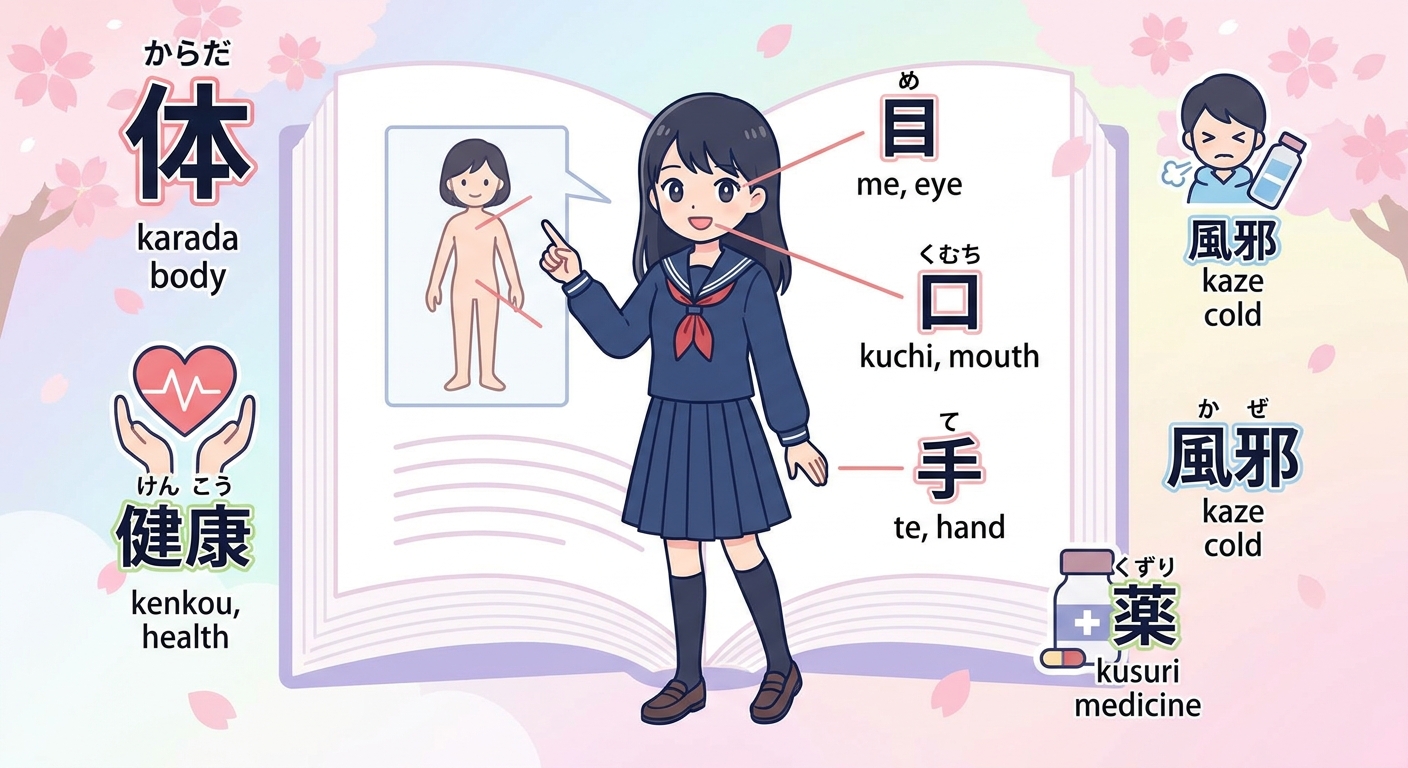
Introduction
Welcome to your JLPT N4 lesson on Body and Health Vocabulary. Navigating daily life in Japan or discussing your well-being requires a solid foundation in health-related terminology. In this lesson, you will expand your vocabulary beyond basic body parts to include common symptoms, illnesses, and essential verbs used in healthcare settings. You will learn how to accurately describe how you feel, explain physical symptoms to a doctor, and understand basic medical advice. Mastering these terms will not only prepare you for the N4 exam but also empower you to confidently manage your health and well-being in Japanese.
Lesson Content
Master Japanese N4: Body & Health (体と健康)
When living or traveling in Japan, being able to describe how you feel and point out parts of your body is essential. This guide covers the vital N4-level vocabulary and grammar structures you need to navigate health situations with confidence.
1. Core Vocabulary: Parts of the Body (体の部位)
Let’s start with the essential N4 body parts. Pay close attention to the kanji and their readings.
| Kanji | Hiragana | English | Tutor's Note |
|---|---|---|---|
| 頭 | あたま | Head | Used in "headache" (頭痛 - ずつう) |
| 首 | くび | Neck | 手首 (てくび) is wrist; 足首 (あしくび) is ankle. |
| 喉 | のど | Throat | Crucial for cold/flu symptoms. |
| 肩 | かた | Shoulder | 肩がこる means to have stiff shoulders. |
| 胸 | むね | Chest / Breast | Used for chest pain or deep breathing. |
| お腹 | おなか | Stomach / Belly | Polite form of 腹 (はら). |
| 腰 | こし | Lower Back / Hips | A common pain point in Japan! |
| 足 / 脚 | あし | Foot / Leg | 足 is foot; 脚 is the entire leg. |
2. Expressing Symptoms (症状の表現)
To tell a doctor or colleague how you are feeling, you need these key verbs and nouns:
- 風邪をひく (kaze o hiku) – To catch a cold
- 熱がある (netsu ga aru) – To have a fever
- 咳が出る (seki ga deru) – To cough (literally: "cough comes out")
- 怪我をする (kega o suru) – To get injured
- 気分が悪い (kibun ga warui) – To feel unwell / nauseous
3. Essential N4 Grammar Patterns
Pattern A: Expressing Pain
To say something hurts, use the particle が with the $i$-adjective 痛い (いたい).
$$\text{[Body Part]} + \mathbf{が} + \text{痛いです}$$
- 頭が痛いです。 (Atama ga itai desu.)
- "My head hurts." (I have a headache.)
- 昨日から、のどが痛いです。 (Kinō kara, nodo ga itai desu.)
- "My throat has been hurting since yesterday."
Pattern B: Explaining Symptoms with 〜んです
At the clinic, use the explanatory 〜んです (n desu) to describe your condition. This adds a nuance of explanation, making it sound natural to native speakers.
- 熱が38度あるんです。 (Netsu ga san-jū-hachi do aru n desu.)
- "The thing is, I have a 38-degree fever."
- 咳が止まらないんです。 (Seki ga tomaranai n desu.)
- "The cough just won't stop."
4. Practice Dialogue: At the Clinic (病院で)
Read this natural N4-level conversation between a doctor (医者 - いしゃ) and a patient (患者 - かんじゃ).
- 医者: 今日はどうしましたか。
(Kyō wa dō shimashita ka?)
"What seems to be the problem today?" - 患者: 昨日からお腹が痛いんです。
(Kinō kara onaka ga itai n desu.)
"My stomach has been hurting since yesterday." - 医者: 熱はありますか。
(Netsu wa arimasu ka?)
"Do you have a fever?" - 患者: はい、微熱(びねつ)があります。吐き気(はきけ)もするんです。
(Hai, binetsu ga arimasu. Hakike mo suru n desu.)
"Yes, I have a slight fever. I also feel nauseous." - 医者: 分かりました。横になって、お腹を触りますね。
(Wakarimashita. Yoko ni natte, onaka o sawarimasu ne.)
"I understand. Please lie down, and I will examine your stomach."
Quick Quiz!
Translate the following sentence into Japanese using the grammar learned above:
"My lower back hurts, so I cannot play tennis today."
(Answer: 今日は腰が痛いので、テニスができません。)
Exercises
Body and Health Vocabulary (Exercises)
Exercises for Body and Health Vocabulary
Review the grammar and vocabulary, and try to fill in the blanks or write sentences based on the prompts.
Examples
風邪をひいたので、今日は薬を飲んで早く寝ます。
Kaze o hiita node, kyō wa kusuri o nonde hayaku nemasu.
Since I caught a cold, I will take medicine and go to bed early today.
昨日から熱があるので、今日は会社を休みました。
Kinō kara netsu ga aru node, kyō wa kaisha o yasumimashita.
I have had a fever since yesterday, so I took today off from work.
毎日果物や野菜を食べることは、体にいいです。
Mainichi kudamono ya yasai o taberu koto wa, karada ni ii desu.
Eating fruits and vegetables every day is good for your health.
Practice Drills
Lesson Materials
Vocabulary (5)
Grammar (3)
Kanji (0)
No kanji characters in this lesson.
Kana (0)
No kana characters in this lesson.