
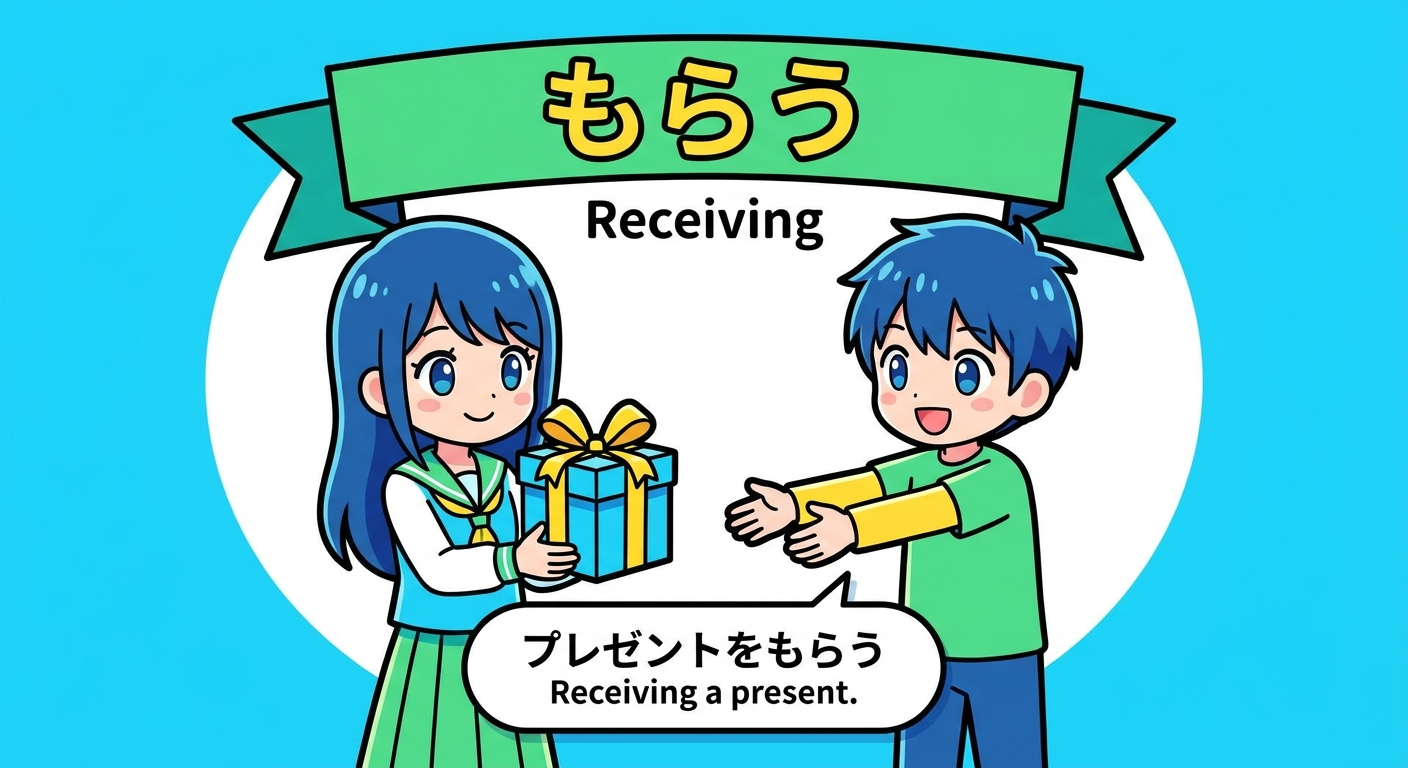
もらう — Receiving
Learn もらう (receive/get from someone). Practice [person] に/から もらいます patterns. Contrast with くれる from the receiver's perspective.
🎯 Goal: By the end of this lesson, students will be able to confidently use the verb もらう (morau) to express receiving items from others, identify the correct particle markers (に or から) for the giver, and understand the social dynamics of gratitude embedded in Japanese giving-and-receiving grammar.
Introduction
In Japanese culture, expressing gratitude and acknowledging the direction of giving and receiving is essential for polite communication. In this N4 lesson, we explore the verb もらう (morau), which means "to receive." Unlike English, where "receive" is relatively simple, Japanese verbs of giving and receiving carry social weight, indicating relationships and gratitude. You will learn how to use もらう to describe receiving physical objects, and lay the groundwork for the auxiliary verb pattern 〜てもらう (to have someone do something). Mastering this concept is key to natural, culturally respectful Japanese communication.
Lesson Content
Mastering もらう (Morau): The Art of Receiving in Japanese
In Japanese culture, receiving a gift or a favor is never just a transaction—it is an exchange of warmth and gratitude. At the N4 level, mastering the verb もらう (貰う) is essential for expressing this gratitude.
In this guide, we will break down how to use もらう for physical objects and how to combine it with verbs (〜てもらう) to express appreciation for favors.
1. Receiving Physical Objects: [Receiver] は [Giver] に/から [Object] を もらう
When you receive a tangible item, use the basic verb もらう (dictionary form) or もらいます (polite form).
The Grammar Structure
$$\text{[Receiver] は/が} + \text{[Giver] に/から} + \text{[Object] を} + \text{もらう / もらいました}$$
- The Receiver (は/が): Usually "I" (わたし), but can be anyone. If it is "I", it is often omitted.
- The Giver (に/から): The person who gave the item. You can use either particle, but から (from) is preferred when receiving from an institution, school, or company.
- The Object (を): The item received.
Examples
- 私は友達に誕生日プレゼントをもらいました。
- Watashi wa tomodachi ni tanjōbi purezento o moraimashita.
- I received a birthday present from my friend.
- 妹は先生から本をもらった。
- Imōto wa sensei kara hon o moratta.
- My little sister received a book from the teacher.
2. Receiving Actions (Favors): 〜てもらう
In Japanese, when someone does you a favor, simply saying "they did X" can sound cold. Instead, we use the Te-form + もらう construction. This translates to "to have someone do something for me" and carries a strong nuance of gratitude.
The Grammar Structure
$$\text{[Receiver] は} + \text{[Giver] に} + \text{[Verb て-form]} + \text{もらう}$$
⚠️ Key Rule: The giver of the action is always marked by the particle に in this construction.
Examples
- 私は田中さんに英語を教えてもらいました。
- Watashi wa Tanaka-san ni Eigo o oshiete moraimashita.
- I had Mr. Tanaka teach me English. (Literal: I received the favor of teaching English from Mr. Tanaka.)
- 私はお母さんにシャツを洗ってもらった。
- Watashi wa okāsan ni shatsu o aratte moratta.
- I had my mother wash my shirt.
3. Crucial N4 Distinctions: もらう vs. くれる
A common mistake for N4 learners is confusing もらう (to receive) with くれる (to give me).
| Feature | もらう (To Receive) | くれる (To Give [to me]) |
|---|---|---|
| Subject (は/が) | The Receiver (usually "I") | The Giver (someone else) |
| Perspective | "I received from them." | "They kindly gave to me." |
| Example | 私は彼に本をもらった。 | 彼が私に本をくれた。 |
Use もらう when you want to keep the spotlight on the receiver (yourself).
Quick Check: Test Your Knowledge!
Translate the following sentences into Japanese using もらう or 〜てもらう:
- I received a letter from my father.
- I had my friend help me with my homework.
Answers
- 私は父に/から手紙をもらいました。 (Watashi wa chichi ni/kara tegami o moraimashita.)
- 私は友達に宿題を手伝ってもらいました。 (Watashi wa tomodachi ni shukudai o tetsudatte moraimashita.)
Exercises
もらう — Receiving (Exercises)
Exercises for もらう — Receiving
Review the grammar and vocabulary, and try to fill in the blanks or write sentences based on the prompts.
Examples
誕生日に友達からプレゼントをもらいました。
Tanjōbi ni tomodachi kara purezento o moraimashita.
I received a present from my friend on my birthday.
田中さんに日本語を教えてもらいました。
Tanaka-san ni Nihongo o oshiete moraimashita.
I had Mr. Tanaka teach me Japanese.
友達に駅まで車で送ってもらいました。
Tomodachi ni eki made kuruma de okutte moraimashita.
I had my friend drive me to the station.
Practice Drills
Lesson Materials
Vocabulary (5)
Grammar (3)
Kanji (0)
No kanji characters in this lesson.
Kana (0)
No kana characters in this lesson.