
てあげる / てくれる / てもらう
Extend giving/receiving to actions: doing a favor for someone (てあげる), someone doing a favor for you (てくれる), having someone do something for you (てもらう). Build natural social conversation.
🎯 Goal: To confidently identify and use te ageru, te kureru, and te morau to describe the giving and receiving of favors, choosing the correct form based on the speaker's relationship and perspective in everyday social interactions.
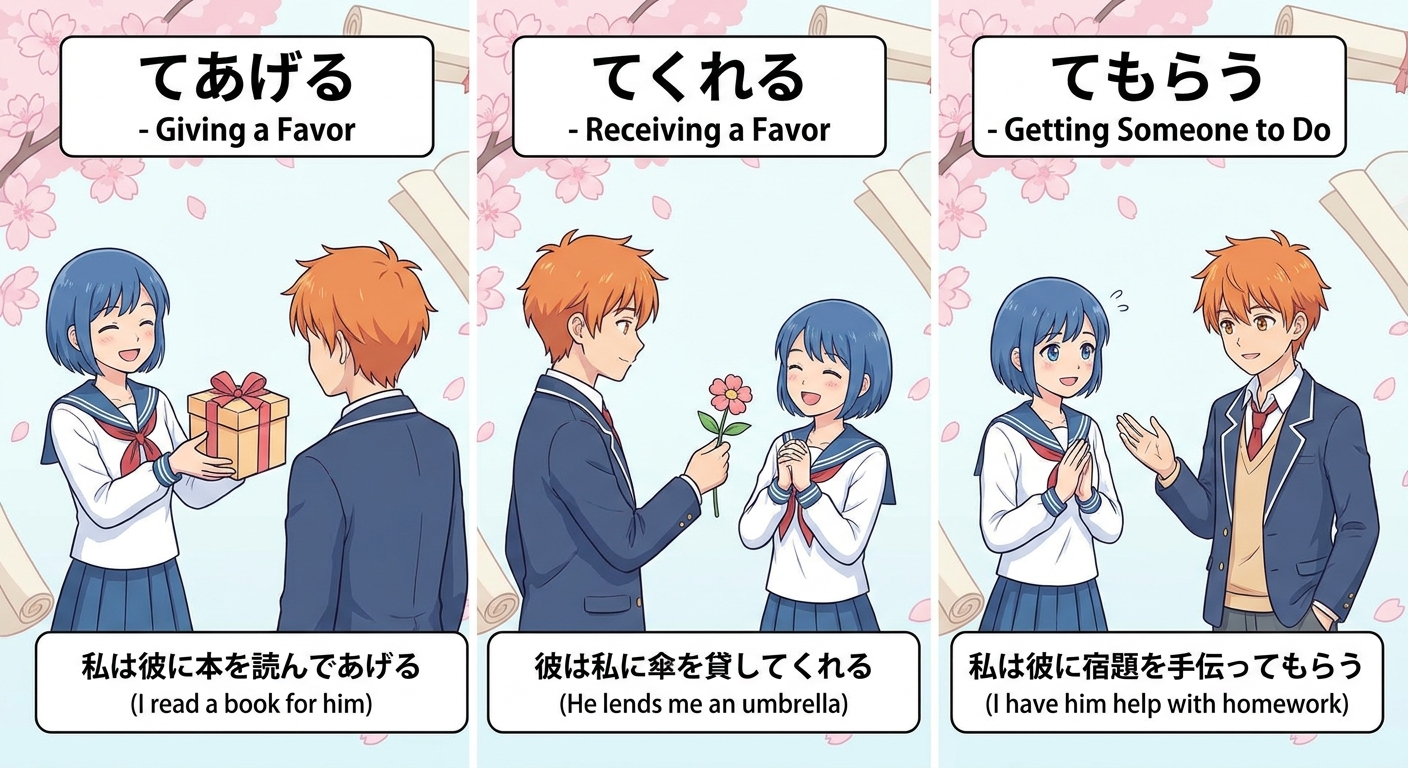
Introduction
In Japanese culture, expressing gratitude and acknowledging mutual support is vital to smooth communication. This lesson introduces the benefactive auxiliary verbs: te ageru, te kureru, and te morau. These grammar patterns allow you to describe actions not just as simple events, but as favors given or received. Mastering these structures is a major milestone in your JLPT N4 journey, as they shift your Japanese from grammatically correct to culturally natural. You will learn how to navigate these verbs based on who performs the action and who benefits, helping you build warmer, more polite connections with Japanese speakers.
Lesson Content
Master Japanese Benefactives: 〜てあげる, 〜てくれる, and 〜てもらう (JLPT N4)
In Japanese culture, gratitude, social harmony, and relationships are embedded directly into the grammar. When someone does a favor for someone else, you cannot simply use a standard verb. You must use benefactive verbs (授受動詞 - juju dōshi) to show who performed the action and who benefited from it.
Let's demystify the three pillars of N4 benefactive grammar: 〜てあげる, 〜てくれる, and 〜てもらう.
The Big Picture: Direction of Favors
| Grammar Pattern | Meaning | Direction of Favor | Focus |
|---|---|---|---|
| 〜てあげる | "I do something for you/others" | Outward (Me $\rightarrow$ You/Others) | The Giver's action |
| 〜てくれる | "Someone does something for me" | Inward (Others $\rightarrow$ Me) | The Giver's kindness |
| 〜てもらう | "I receive/get someone to do something" | Inward (Me $\leftarrow$ Others) | The Receiver's gratitude/initiative |
1. 〜てあげる (Doing a favor for someone)
Use this when you (or someone in your in-group) do a favor for someone else.
Sentence Structure:
$$\text{[Giver] は/が + [Receiver] に + [Verb て-form] あげる}$$
Example:
- 私は友達に英語を教えてあげました。
- Watashi wa tomodachi ni eigo o oshiete agemashita.
- I taught English to my friend (as a favor).
⚠️ Cultural Warning: Avoid using
〜てあげるdirectly to superiors or people you don't know well. It can sound patronizing, as if you are bragging about doing them a favor. Instead, use polite alternatives or simply the standard polite verb form (お〜しますor just〜ます).
2. 〜てくれる (Someone doing a favor for you)
Use this when someone else does a favor for you (or your family/in-group). The subject of the sentence is always the person who did the favor.
Sentence Structure:
$$\text{[Giver] が + [Receiver (Me)] に + [Verb て-form] くれる}$$
Example:
- 鈴木さんが(私に)傘を貸してくれました。
- Suzuki-san ga (watashi ni) kasa o kashite kuremashita.
- Suzuki-san lent me an umbrella. (How kind of him!)
💡 Tip: Because
くれるinherently means the action is directed toward "me," you can almost always omit私に(to me).
3. 〜てもらう (Receiving a favor / Having someone do something)
Use this when you receive a favor from someone. Unlike 〜てくれる, the subject of this sentence is the receiver (usually you). It often implies that you asked or initiated the action.
Sentence Structure:
$$\text{[Receiver (Me)] は + [Giver] に/から + [Verb て-form] もらう}$$
Example:
- 私は山田さんに漢字を教えてもらいました。
- Watashi wa Yamada-san ni kanji o oshiete moraimashita.
- I had Yamada-san teach me Kanji. (I received the favor of him teaching me.)
The Nuance Battle: 〜てくれる vs. 〜てもらう
Students often ask: "What is the difference between these two?"
- 〜てくれる focuses on the giver's spontaneous kindness.
- Example: 友達が宿題を手伝ってくれた。 (My friend helped me with my homework—they initiated it out of kindness.)
- 〜てもらう focuses on the receiver's gratitude or request.
- Example: 友達に宿題を手伝ってもらった。 (I got my friend to help me with my homework—I likely asked them for help.)
Quick Practice Challenge
Translate the following sentences into Japanese using the correct benefactive pattern. (Answers below!)
- My older brother bought a book for me.
- I lent a pen to Tanaka-san.
- I got the teacher to check my essay.
Answers:
- 兄が(私に)本を買ってくれました。 (Ani ga hon o katte kuremashita.)
- 私は田中さんにペンを貸してあげました。 (Watashi wa Tanaka-san ni pen o kashite agemashita.)
- 私は先生に作文を直してもらいました。 (Watashi wa sensei ni sakubun o naoshite moraimashita.)
Exercises
てあげる / てくれる / てもらう (Exercises)
Exercises for てあげる / てくれる / てもらう
Review the grammar and vocabulary, and try to fill in the blanks or write sentences based on the prompts.
Examples
私は友達に傘を貸してあげました。
Watashi wa tomodachi ni kasa o kashite agemashita.
I lent my friend an umbrella.
先生が私に日本語を教えてくれました。
Sensei ga watashi ni nihongo o oshiete kuremashita.
The teacher kindly taught me Japanese.
私は兄に宿題を手伝ってもらいました。
Watashi wa ani ni shukudai o tetsudatte moraimashita.
I had my older brother help me with my homework.
Practice Drills
Lesson Materials
Vocabulary (5)
Kanji (0)
No kanji characters in this lesson.
Kana (0)
No kana characters in this lesson.