
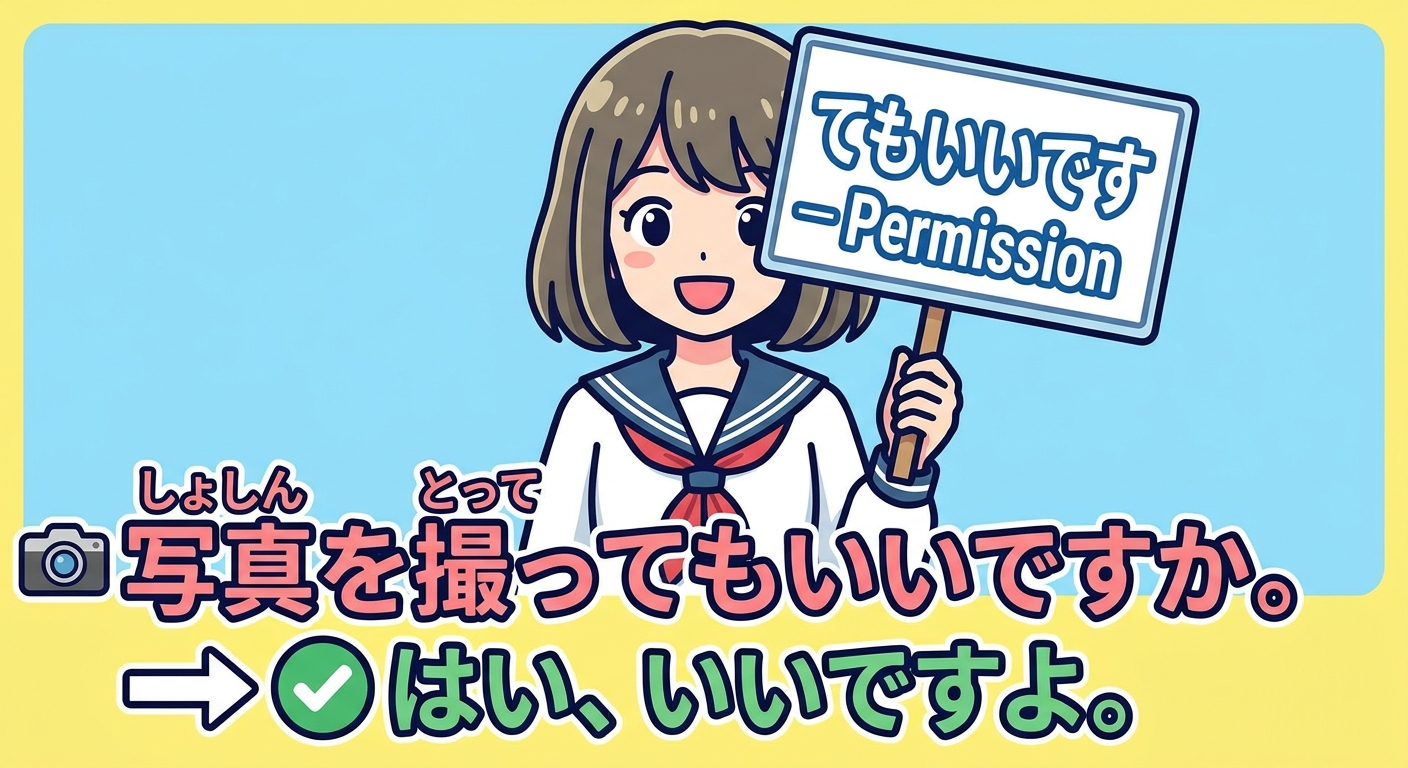
てもいいです — Permission
Learn to ask and grant permission using [て form] + もいいですか. Learn the negative 〜てはいけません. Practice in school, work, and public contexts.
🎯 Goal: To confidently use the "~てもいい" structure to ask for permission, grant permission to others, and understand polite responses in everyday Japanese contexts.
Introduction
Welcome to this lesson on mastering "てもいいです" (~te mo ii desu), a fundamental grammar point for N4 learners used to ask for and grant permission in Japanese. Whether you want to ask if you can take a photo, borrow a pen, or leave early, this versatile structure is essential for polite daily communication. Building upon your knowledge of the te-form of verbs, this lesson will guide you through conjugating verbs smoothly, understanding the nuance of asking questions with "てもいいですか," and responding appropriately. By mastering this form, you will navigate social and professional situations in Japan with confidence and politeness.
Lesson Content
Master Japanese Permission: How to Use 〜てもいいです (JLPT N4)
In Japanese culture, navigating social boundaries and showing respect is key. When you want to ask for permission ("May I...?") or grant it ("You may..."), the standard, polite formula to use is 〜てもいいです (~te mo ii desu).
This guide will break down how to conjugate, use, and master this essential JLPT N4 grammar point.
1. The Grammar Formula
To construct this phrase, you only need two ingredients: the Te-form of a verb and もいいです (mo ii desu).
$$\text{Verb [Te-form]} + \text{もいいです}$$
| Verb Group | Dictionary Form | Te-Form | Granting Permission (You may...) | Asking Permission (May I...?) |
|---|---|---|---|---|
| Group 1 (U) | 行く (iku - to go) | 行って (itte) | 行ってもいいです | 行ってもいいですか。 |
| Group 2 (Ru) | 食べる (taberu - to eat) | 食べて (tabete) | 食べてもいいです | 食べてもいいですか。 |
| Group 3 (Irregular) | する (suru - to do) | して (shite) | してもいいです | してもいいですか。 |
Literal Meaning
- 〜て (Te-form): Connective particle.
- も (mo): "Also" or "even if."
- いいです (ii desu): "It is good/okay."
- Literal translation: "Even if I do [verb], it is okay."
2. Asking for Permission: 〜てもいいですか
To ask if you are allowed to do something, simply add the question particle か (ka) to the end.
- 写真を撮ってもいいですか。
- Shashin o tottemo ii desu ka?
- May I take a picture?
- ここに入ってもいいですか。
- Koko ni haittemo ii desu ka?
- May I come in here?
- 窓を閉めてもいいですか。
- Mado o shimetemo ii desu ka?
- May I close the window?
3. Granting Permission: 〜てもいいです(よ)
When giving someone permission, you use the plain statement. Native speakers almost always add the soft sentence-ending particle よ (yo) to make the permission sound warm and reassuring.
- A: このペンを使ってもいいですか。 (May I use this pen?)
- B: ええ、使ってもいいですよ。 (Yes, you may use it.)
💡 Tutor Tip: If you want to say "You don't have to [do something]," you can use the negative variation: 〜なくてもいいです (nakutemo ii desu).
Example: 急がなくてもいいですよ。 (You don't have to hurry.)
4. Casual vs. Polite Nuances
In casual speech with friends or family, you can drop も (mo), です (desu), and か (ka). Your voice pitch rises at the end of a question.
| Level | Asking Permission | Granting Permission |
|---|---|---|
| Polite | 帰ってもいいですか。 (Kaittemo ii desu ka?) | 帰ってもいいですよ。 (Kaittemo ii desu yo.) |
| Casual | 帰っていい? (Kaitte ii?) | 帰っていいよ。 (Kaitte ii yo.) |
5. Quick Practice Challenge
Translate the following sentences into Japanese using 〜てもいいです. (Answers below)
- May I drink this water? (Polite)
- You may watch TV. (Casual)
- May I sit here? (Polite)
Answers
- この水を飲んでもいいですか。 (Kono mizu o nondemo ii desu ka?)
- テレビを見ていいよ。 (Terebi o mite ii yo.)
- ここに座ってもいいですか。 (Koko ni suattemo ii desu ka?)
Exercises
てもいいです — Permission (Exercises)
Exercises for てもいいです — Permission
Review the grammar and vocabulary, and try to fill in the blanks or write sentences based on the prompts.
Examples
ここで写真を撮ってもいいですよ。
Koko de shashin o tottemo ii desu yo.
You may take photos here.
窓を開けてもいいですか。
Mado o akete mo ii desu ka.
May I open the window?
この辞書を使ってもいいですか。
Kono jisho o tsukatte mo ii desu ka.
May I use this dictionary?
Practice Drills
Lesson Materials
Vocabulary (5)
Grammar (3)
Kanji (0)
No kanji characters in this lesson.
Kana (0)
No kana characters in this lesson.