
あげる / くれる — Giving
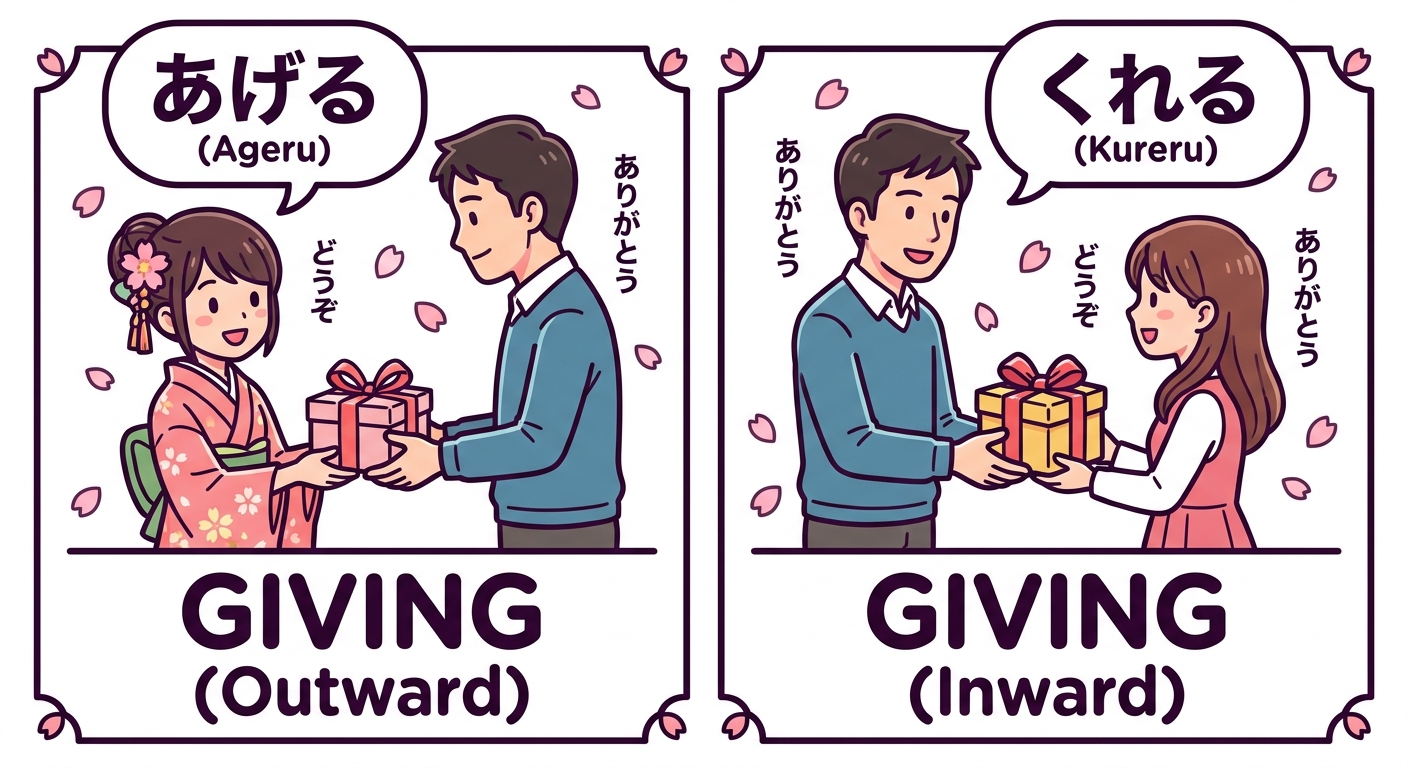
Learn the two giving verbs from the speaker's perspective: あげる (I/we give outward) and くれる (someone gives to me/in-group). Master the directional logic of Japanese giving verbs.
🎯 Goal: By the end of this lesson, you will be able to accurately distinguish between and use ageru and kureru to describe giving actions, correctly identifying the giver and receiver using the appropriate particles (wa/ga and ni).
Introduction
In Japanese culture, expressing gratitude and acknowledging the direction of an action are essential for polite communication. This lesson introduces the fundamental verbs of giving: ageru (あげる) and kureru (くれる). While both translate to "to give" in English, they are used based on the perspective of the speaker. You will learn how to choose the correct verb by identifying who is giving to whom, focusing on the crucial concept of the "in-group" versus the "out-group." Mastering these verbs is a vital stepping stone toward natural Japanese communication and understanding intermediate-level benefit-giving expressions.
Lesson Content
Master the Vector of Giving: あげる vs. くれる (JLPT N4)
In English, the verb "to give" is simple: I give you a book; you give me a book.
In Japanese, however, "giving" is all about perspective and direction. To choose the correct verb, you must determine who is standing at the center of the giving circle.
At the N4 level, mastering あげる (ageru) and くれる (kureru) is crucial for sounding natural and polite. Let’s break down these two essential verbs.
1. あげる (Ageru) – Giving Outward
Use あげる when the flow of the gift moves outward from you, or between two other people.
The Vector:
- Me $\rightarrow$ You/Other
- Other A $\rightarrow$ Other B
Grammar Formula:
$$\text{[Giver] は/が} + \text{[Receiver] に} + \text{[Object] を} + \mathbf{あげる}$$
Examples:
- 私は友達に本をあげました。
- Watashi wa tomodachi ni hon o agemashita.
- I gave my friend a book. (Outward from me)
- 田中さんはマリアさんに花をあげました。
- Tanaka-san wa Maria-san ni hana o agemashita.
- Tanaka-san gave flowers to Maria. (Between two other people)
2. くれる (Kureru) – Giving Inward
Use くれる when someone gives something inward to you, or to a member of your close "in-group" (like your family).
The Vector:
- Other $\rightarrow$ Me / My In-Group
Grammar Formula:
$$\text{[Giver] は/が} + \text{[Me/Family] に} + \text{[Object] を} + \mathbf{くれる}$$
(Note: Because くれる inherently means the receiver is "me," 私に (ni watashi) is very often omitted.)
Examples:
- 友達が(私に)プレゼントをくれました。
- Tomodachi ga (watashi ni) purezento o kuremashita.
- My friend gave me a present. (Inward to me)
- 鈴木さんが妹にお菓子をくれました。
- Suzuki-san ga imōto ni okashi o kuremashita.
- Suzuki-san gave my younger sister sweets. (Inward to my family member)
3. Doing Favors: ~てあげる and ~てくれる
At the N4 level, these verbs also attach to the Te-form of verbs to show giving and receiving actions (favors).
| Form | Meaning | Example |
|---|---|---|
| ~てあげる | To do a favor for someone else | 私は彼に英語を教えてあげました。<br>(I taught him English—as a favor.) |
| ~てくれる | Someone does a favor for me | 彼女は車で送ってくれました。<br>(She gave me a ride—and I appreciate it.) |
Grammar Tip: Be careful with ~てあげる directly to superiors, as it can sometimes sound slightly patronizing ("I am doing this nice thing for you").
Summary Cheat Sheet
| Verb | Direction | Giver | Receiver |
|---|---|---|---|
| あげる | Outward | Me / Person A | Person B |
| くれる | Inward | Person A | Me / My Family |
Quick Challenge!
Fill in the blanks with the correct form of あげる or くれる (use past tense: あげました or くれました):
- 弟(Little brother)は 私に 辞書(dictionary)を ______________。
- 私は 先生に 手紙(letter)を ______________。
Answers:
- くれました (Inward to me)
- あげました (Outward from me to someone else)
Exercises
あげる / くれる — Giving (Exercises)
Exercises for あげる / くれる — Giving
Review the grammar and vocabulary, and try to fill in the blanks or write sentences based on the prompts.
Examples
私は誕生日に友達にプレゼントをあげました。
Watashi wa tanjoubi ni tomodachi ni purezento o agemashita.
I gave a present to my friend on their birthday.
田中さんが私に美味しいお菓子をくれました。
Tanaka-san ga watashi ni oishii okashi o kuremashita.
Mr. Tanaka gave me some delicious sweets.
妹に新しい辞書をあげました。
Imouto ni atarashii jisho o agemashita.
I gave my younger sister a new dictionary.
Practice Drills
Lesson Materials
Vocabulary (5)
Kanji (0)
No kanji characters in this lesson.
Kana (0)
No kana characters in this lesson.