
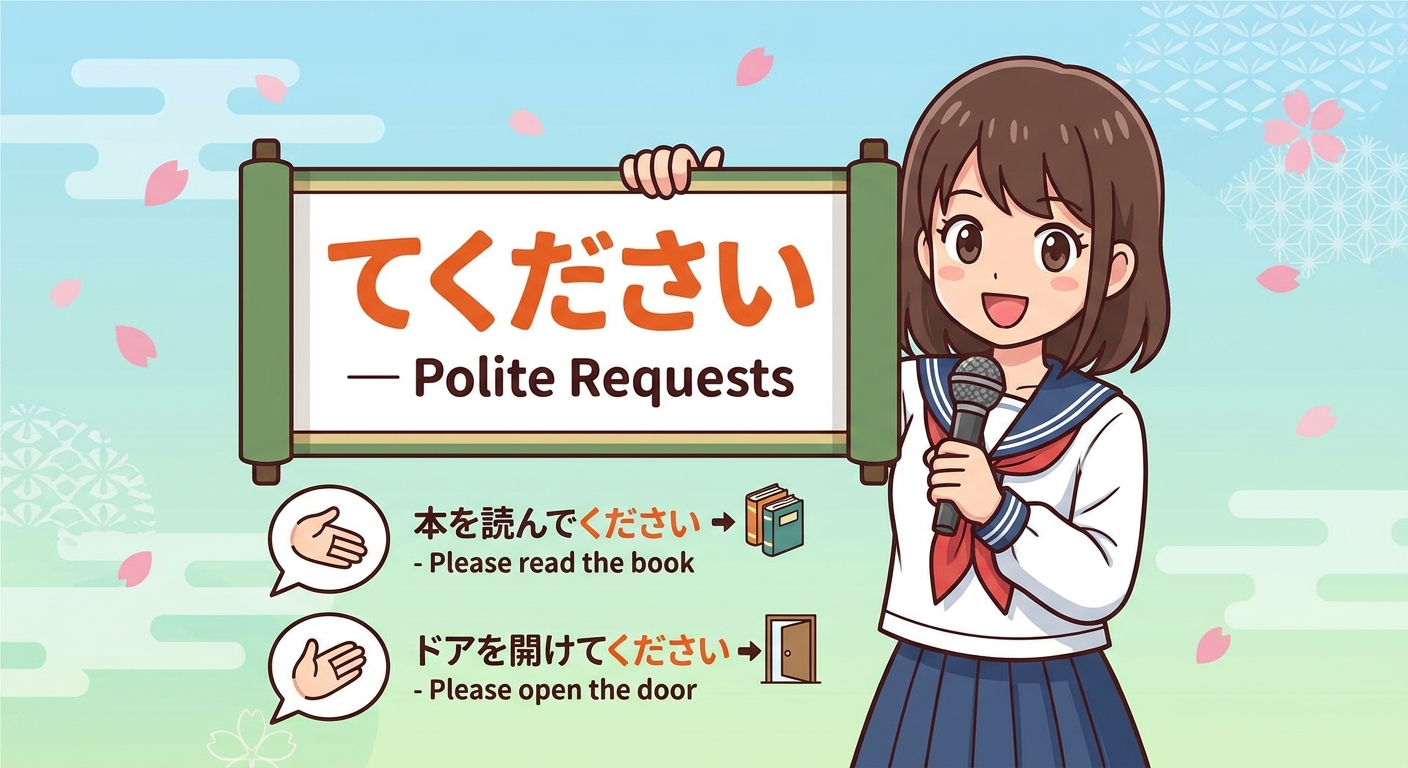
てください — Polite Requests
Use the て form + ください to make polite requests. Learn the difference between commands (てください) and suggestions (ましょう). Practice in classroom and daily situations.
🎯 Goal: By the end of this lesson, you will be able to confidently conjugate verbs into the Te-form and apply the 〜てください pattern to make polite requests, ask for help, and give clear instructions in everyday Japanese.
Introduction
In Japanese communication, expressing requests politely and naturally is essential for smooth daily interactions. In this lesson, we introduce the fundamental N4 grammar pattern 〜てください (te-kudasai). Building upon your knowledge of Te-form verb conjugation, this structure enables you to ask for assistance, give directions, and make polite requests in both casual and semi-formal contexts. Master how to transition from direct imperatives to socially appropriate, cooperative phrasing. By understanding the nuances of 〜てください, you will gain the confidence to navigate everyday situations in Japan, from ordering at restaurants to asking for help on the streets.
Lesson Content
Master the Art of Polite Requests: 〜てください (Te-kudasai)
In Japanese, getting what you need while maintaining social harmony is an essential skill. At the JLPT N4 level, your primary tool for making polite requests, giving instructions, or offering kind invitations is the 〜てください (~te kudasai) construction.
This guide will break down how to conjugate, use, and refine this pattern like a native speaker.
1. The Grammar Formula
To build this structure, you only need to conjugate your verb into the て-form (Te-form) and add ください (kudasai), which means "please."
$$\text{Verb (Te-form)} + \text{ください}$$
Quick Te-form Conjugation Refresher
Before you can make requests, you must master the Te-form. Here is a quick cheat sheet:
| Verb Group | Dictionary Form | Te-form | Request Form | English Translation |
|---|---|---|---|---|
| Group 1 (U-Verbs) | 待つ (matsu) <br> 書く (kaku) | 待って (matte) <br> 書いて (kaite) | 待ってください <br> 書いてください | Please wait. <br> Please write. |
| Group 2 (Ru-Verbs) | 食べる (taberu) | 食べて (tabete) | 食べてください | Please eat. |
| Group 3 (Irregular) | する (suru) <br> 来る (kuru) | して (shite) <br> 来て (kite) | してください <br> 来てください | Please do. <br> Please come. |
2. Real-World Examples
Let’s look at how this grammar functions in everyday Japanese conversations.
Example 1: Asking for Assistance
- 日本語で話してください。
- Nihongo de hanashite kudasai.
- Translation: Please speak in Japanese.
- Breakdown: 話す (hanasu / to speak) $\rightarrow$ 話して (hanashite) + ください.
Example 2: Giving Directions
- ここに名前と住所を書いてください。
- Koko ni namae to jūsho o kaite kudasai.
- Translation: Please write your name and address here.
- Breakdown: 書く (kaku / to write) $\rightarrow$ 書いて (kaite) + ください.
Example 3: Offering Hospitality
- 温かいお茶をどうぞ。ゆっくり飲んでください。
- Atatakai ocha o dōzo. Yukkuri nonde kudasai.
- Translation: Here is some warm green tea. Please take your time and drink it.
- Breakdown: 飲む (nomu / to drink) $\rightarrow$ 飲んで (nonde) + ください.
3. The Negative Request: 〜ないでください
To ask someone not to do something, use the negative plain form (Nai-form) of the verb, replace the final i with de, and add kudasai.
$$\text{Verb (Nai-form)} + \text{でください}$$
- 写真を撮らないでください。
- Shashin o toranaide kudasai.
- Translation: Please do not take photos.
4. Cultural Nuance: Is it *too* direct?
While 〜てください is polite, it is still technically a soft command.
- With friends: Drop
くださいentirely and just use the Te-form (e.g., Matte! / "Wait!"). - With superiors (bosses, teachers, clients): Avoid using
〜てくださいfor favors, as it can sound slightly bossy. Instead, elevate your politeness to 〜ていただけませんか (~te itadakemasen ka / "Could you please do... for me?").- Example: 教えてください (Please teach me) $\rightarrow$ 教えていただけませんか (Would you be so kind as to teach me?).
5. Quick Challenge!
Translate the following sentences into Japanese using the grammar you learned today. (Answers below!)
- Please open the window. (To open = 開ける / akeru)
- Please do not forget your umbrella. (To forget = 忘れる / wasureru; Umbrella = 傘 / kasa)
Answers:
- 窓を開けてください。 (Mado o akete kudasai.)
- 傘を忘れないでください。 (Kasa o wasurenaide kudasai.)
Exercises
てください — Polite Requests (Exercises)
Exercises for てください — Polite Requests
Review the grammar and vocabulary, and try to fill in the blanks or write sentences based on the prompts.
Examples
ここに名前を書いてください。
Koko ni namae o kaite kudasai.
Please write your name here.
暑いので、窓を開けてください。
Atsui node, mado o akete kudasai.
Please open the window because it is hot.
メニューを見せてください。
Menyū o misete kudasai.
Please show me the menu.
Practice Drills
Lesson Materials
Vocabulary (5)
Grammar (3)
Kanji (0)
No kanji characters in this lesson.
Kana (0)
No kana characters in this lesson.