
て Form — Connecting Actions
Learn the て form for connecting multiple actions sequentially. Master the て form alternation rules. Use 〜て to express doing A then B.
🎯 Goal: By the end of this lesson, you will be able to confidently conjugate Group 1, 2, and 3 verbs into their て form and use them to link multiple actions in a single, cohesive sentence to describe daily routines and sequential events naturally.
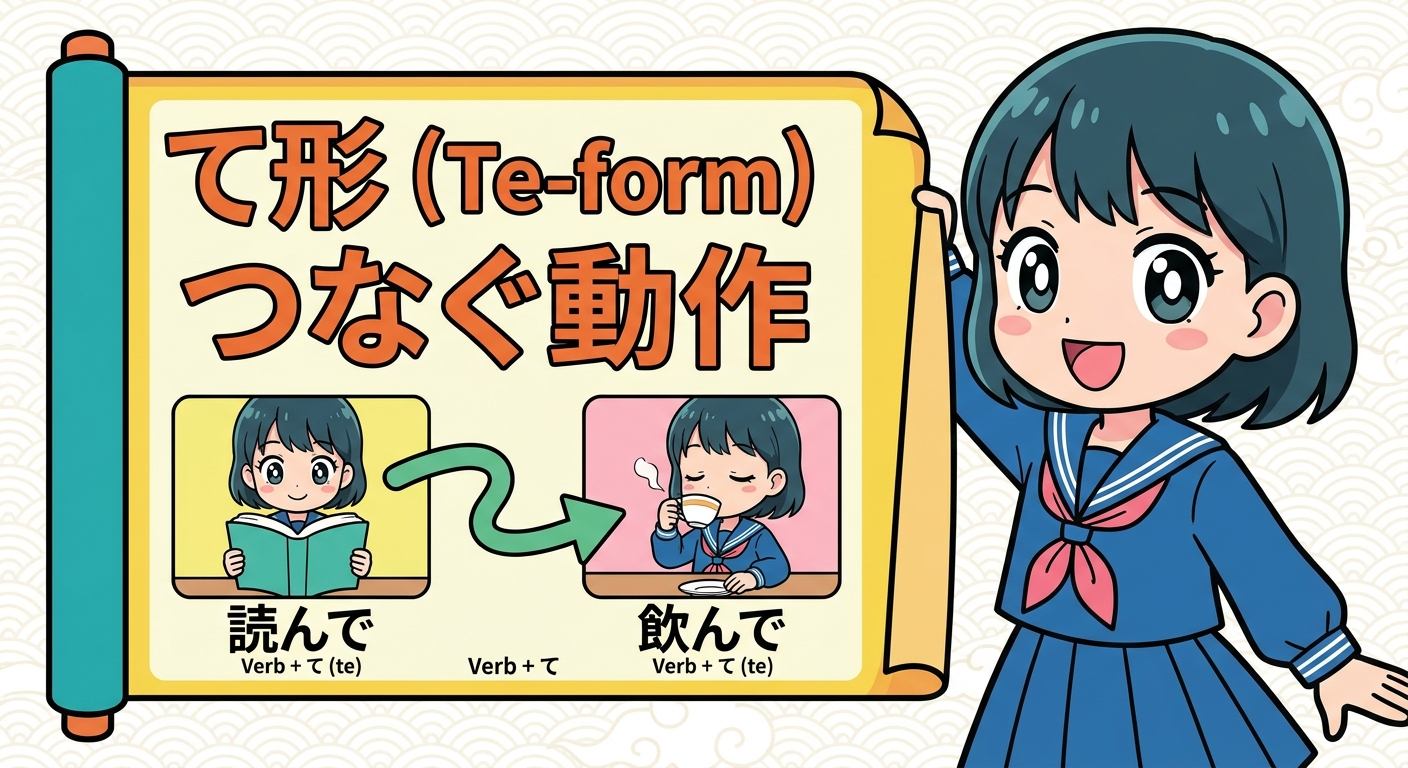
Introduction
Welcome to your gateway to fluent Japanese communication! At the JLPT N4 level, moving beyond short, isolated sentences is key to sounding natural. The て (te) form is one of the most versatile and essential grammar structures in Japanese, serving as the ultimate linguistic glue. In this lesson, you will master how to use the て form to connect multiple actions in chronological order, describe a sequence of events, and express cause-and-effect relationships. By unlocking this structure, you will transition from speaking in simple fragments to expressing complex, fluid thoughts effortlessly in daily conversations.
Lesson Content
Master the て (Te) Form: Connecting Actions Like a Native (JLPT N4)
In basic Japanese, you learned how to express single actions. But to speak naturally, you need to chain actions together. In English, we use the word "and" to connect verbs (e.g., "I ate lunch and watched a movie").
In Japanese, you cannot use the particle と (to) to connect verbs. Instead, we use the versatile て (te) form.
1. The Core Grammar Rule
To chain multiple actions chronologically, conjugate all preceding verbs into their て form, and conjugate only the final verb to show the tense (polite/casual, past/non-past).
$$\text{[Action 1 (て form)]} \rightarrow \text{[Action 2 (て form)]} \rightarrow \text{[Final Action (Tense Marker)]}$$
The "Tense Anchor" Rule
The final verb acts as the anchor for the entire sentence. Even if all actions happened in the past, Action 1 and Action 2 remain in the neutral て form.
2. Real-World Examples
Let’s look at how this works in practice.
Example 1: Present/Habitual Actions
朝起きて、コーヒーを飲んで、学校に行きます。
Asa okite, kōhī o nonde, gakkō ni ikimasu.
(I wake up, drink coffee, and go to school.)
- 起きて (okite): て form of 起きる (to wake up)
- 飲んで (nonde): て form of 飲む (to drink)
- 行きます (ikimasu): Polite present/future form of 行く (to go)
Example 2: Past Actions
昨日、図書館に行って、本を借りて、家に帰りました。
Kinō, toshokan ni itte, hon o karite, ie ni kaerimashita.
(Yesterday, I went to the library, borrowed a book, and went home.)
- 行って (itte) and 借りて (karite) remain in the て form, while the final verb 帰りました (kaerimashita) sets the entire sentence into the polite past tense.
3. Elite Tutor Nuances: て Form vs. 〜たり 〜たり
A common mistake at the N4 level is confusing the て form with the 〜たり 〜たり (tari/tari) form.
- Use the て form when the actions happen in a strict, chronological sequence (First A, then B, then C).
- Use 〜たり 〜たり when you are listing representative, non-sequential examples of what you did ("I did things like A and B, among other things").
| Sentence | Meaning | Nuance |
|---|---|---|
| 本を読んで、寝ました。 | I read a book and (then) went to sleep. | I read the book immediately before sleeping. |
| 本を読んだり、寝たりしました。 | I did things like reading and sleeping. | I did these activities randomly throughout the day. |
4. Quick Challenge
Translate the following English sentence into Japanese using the て form.
"I met my friend, watched a movie, and ate dinner."
(Vocabulary: 会う au / 見る miru / 晩ご飯を食べる bangohan o taberu)
Answer & Breakdown:
友達に会って、映画を見て、晩ご飯を食べました。
Tomodachi ni atte, eiga o mite, bangohan o tabemashita.
- 会う (au) $\rightarrow$ 会って (atte)
- 見る (miru) $\rightarrow$ 見て (mite)
- 食べる (taberu) $\rightarrow$ 食べました (tabemashita - Past Polite)
Pro-Tip: Remember that meeting a friend requires the particle に (友達に会う), not を!
Exercises
て Form — Connecting Actions (Exercises)
Exercises for て Form — Connecting Actions
Review the grammar and vocabulary, and try to fill in the blanks or write sentences based on the prompts.
Examples
朝起きて、朝ご飯を食べて、学校に行きます。
Asa okite, asagohan o tabete, gakkō ni ikimasu.
I get up in the morning, eat breakfast, and go to school.
昨日は友達に会って、映画を見ました。
Kinō wa tomodachi ni atte, eiga o mimashita.
Yesterday, I met my friend and watched a movie.
あの角を曲がって、まっすぐ行ってください。
Ano kado o magatte, massugu itte kudasai.
Please turn at that corner and go straight.