
た Form — Plain Past
Learn the plain past tense た form for all verb groups. Practice the alternation rules (く→いた, ぐ→いだ, etc.) and use it to form 〜たことがある and 〜たあとで.
🎯 Goal: By the end of this lesson, you will be able to confidently conjugate Group 1, 2, and 3 verbs into their plain past (た) form, use them to speak casually about past events, and apply them correctly in foundational N4 sentence structures.
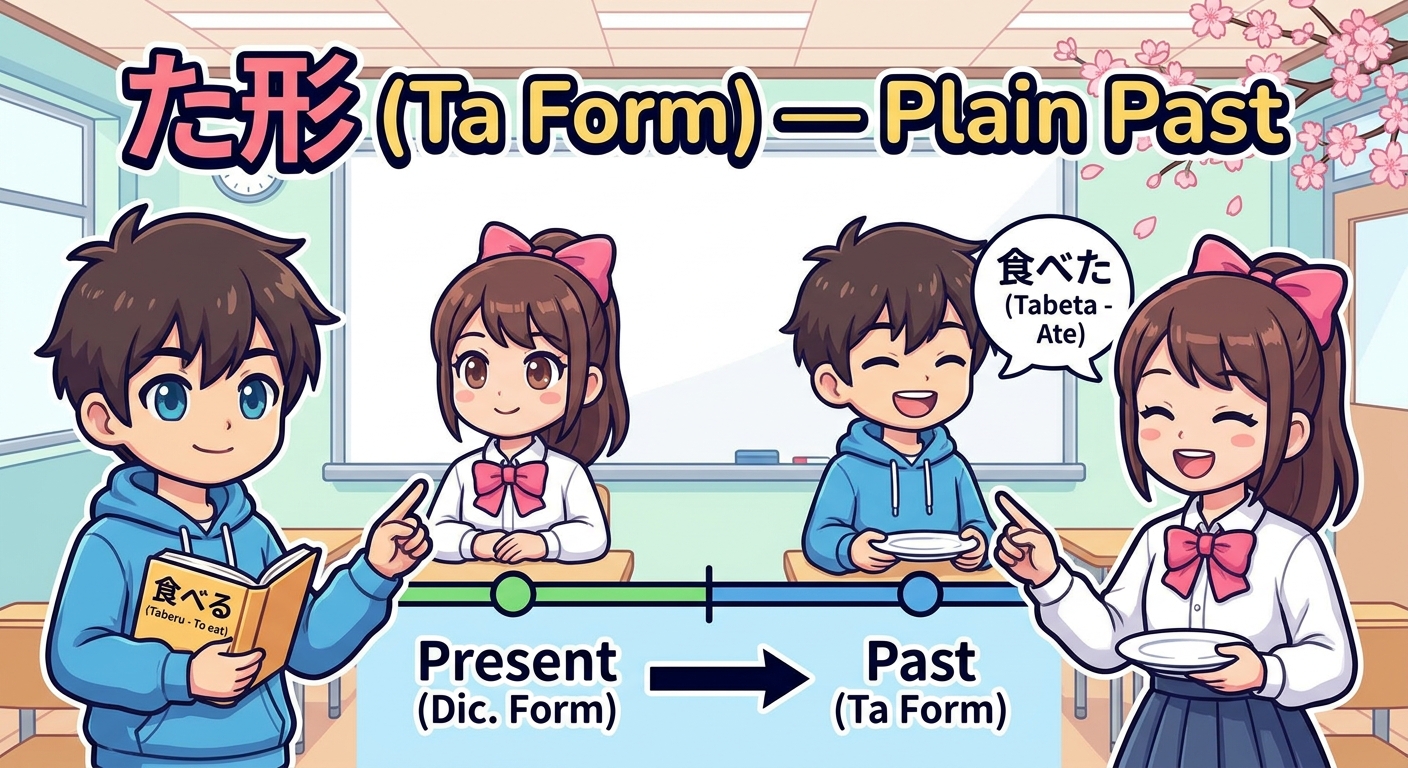
Introduction
Welcome to your guide on the た Form, the cornerstone of informal past-tense Japanese. While you may already be familiar with the polite past tense (~mashita), mastering the plain past (~ta) form is essential for natural, casual conversations with friends and family. Beyond daily chat, the ta form is a crucial building block for many essential N4 grammar patterns, including expressing past experiences and giving advice. In this lesson, you will learn the conjugation rules for Group 1, 2, and 3 verbs, and discover how to transition smoothly from polite to casual past-tense Japanese.
Lesson Content
Master the た (Ta) Form: Plain Past Tense
Welcome to your definitive guide to the た (Ta) Form.
At the JLPT N4 level, mastering the た form is a major milestone. Not only is it the plain (casual) past tense equivalent of the polite 〜ました (-mashita), but it also serves as the structural foundation for crucial N4 grammar patterns.
The best secret to learning the た form? If you know the て (Te) form, you already know the た form! The conjugation rules are identical—simply replace te with ta, and de with da.
1. Conjugation Rules: From Dictionary to た Form
Let’s break down how to conjugate verbs into the た form by their verb groups.
Group 1: U-Verbs (Godan)
For Group 1 verbs, look at the dictionary form's final syllable and apply these changes:
| Dictionary Ending | Sound Change | Dictionary Example | た Form | English |
|---|---|---|---|---|
| う、つ、る | った (tta) | 会う (au) / 待つ (matsu) | 会った / 待った | Met / Waited |
| む、ぶ、ぬ | んだ (nda) | 読む (yomu) / 遊ぶ (asobu) | 読んだ / 遊んだ | Read / Played |
| く | いた (ita) | 書く (kaku) | 書いた | Wrote |
| ぐ | いだ (ida) | 泳ぐ (oyogu) | 泳いだ | Swam |
| す | した (shita) | 話す (hanasu) | 話した | Spoke |
⚠️ The Golden Exception:
The verb 行く (iku - to go) conjugating to 行った (itta - went), not いいた (iita).
Group 2: Ru-Verbs (Ichidan)
Group 2 verbs are incredibly simple. Drop the final る (ru) and add た (ta).
- 食べる (taberu - to eat) $\rightarrow$ 食べた (tabeta - ate)
- 見る (miru - to see) $\rightarrow$ 見た (mita - saw)
Group 3: Irregular Verbs
There are only two irregular verbs in Japanese. Memorize these directly:
- する (suru - to do) $\rightarrow$ した (shita - did)
- 来る (kuru - to come) $\rightarrow$ 来た (きた / kita - came)
2. Essential N4 Grammar Patterns Using た Form
Once you have conjugated your verb, you can unlock these powerful N4 sentence structures.
Pattern A: Casual Past Tense (Informal Speech)
Use the plain た form at the end of a sentence when speaking with friends, family, or peers.
- 昨日、友達に会った。
- Kinō, tomodachi ni atta.
- Yesterday, I met a friend. (Casual)
Pattern B: Expressing Past Experience (〜たことがある)
Use this pattern to say you have done something in your life.
$$\text{Verb (た Form)} + \text{ことがある}$$
- 日本に行ったことがある。
- Nihon ni itta koto ga aru.
- I have been to Japan before.
Pattern C: Giving Advice (〜たほうがいい)
When recommending a specific course of action, use the た form. It translates to "You should..." or "It is better to..."
$$\text{Verb (た Form)} + \text{ほうがいい}$$
- 早く寝たほうがいいですよ。
- Hayaku neta hō ga ii desu yo.
- You should go to sleep early.
Pattern D: Listing Representative Actions (〜たり、〜たりする)
Use this to list a few key activities out of many. The final suru determines the tense of the entire sentence.
$$\text{Verb}_1\text{ (た-ri)} + \text{Verb}_2\text{ (た-ri) する}$$
- 週末は、本を読んだり、映画を見たりした。
- Shūmatsu wa, hon o yondari, eiga o mitari shita.
- On the weekend, I did things like reading books and watching movies.
Quick Practice Challenge
Transform these dictionary-form verbs into their た form:
- 買う (kau - to buy) $\rightarrow$ ________
- 始める (hajimeru - to begin) $\rightarrow$ ________
- 運転する (unten suru - to drive) $\rightarrow$ ________
Answers: 1. 買った (katta), 2. 始めた (hajimeta), 3. 運転した (unten shita)
Exercises
た Form — Plain Past (Exercises)
Exercises for た Form — Plain Past
Review the grammar and vocabulary, and try to fill in the blanks or write sentences based on the prompts.
Examples
昨日、友達に手紙を書いた。
Kinou, tomodachi ni tegami o kaita.
Yesterday, I wrote a letter to my friend.
昨日の夜、美味しい日本料理を食べた。
Kinou no yoru, oishii nihon ryouri o tabeta.
Last night, I ate delicious Japanese food.
日曜日に部屋の掃除をした。
Nichiyoubi ni heya no souji o shita.
I cleaned my room on Sunday.
Practice Drills
Lesson Materials
Grammar (3)
Kanji (0)
No kanji characters in this lesson.
Kana (0)
No kana characters in this lesson.