
ない Form — Plain Negative
Learn the ない form (plain negative) for all verb groups. Use it in casual speech and in grammar patterns like 〜ないでください and 〜なければなりません.
🎯 Goal: By the end of this lesson, you will be able to confidently conjugate Group 1, Group 2, and irregular verbs into the nai (plain negative) form, and utilize them accurately in casual speech and foundational N4 grammatical structures.
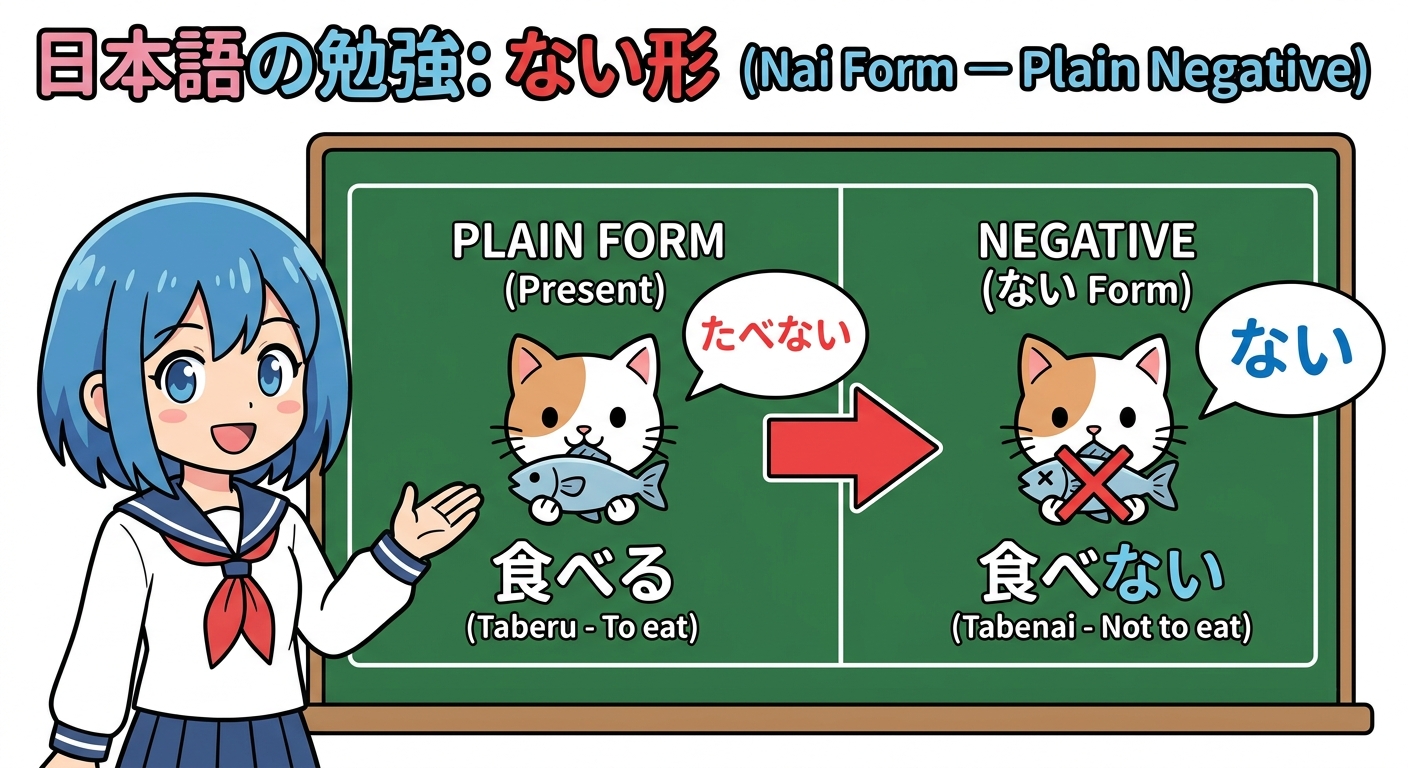
Introduction
Welcome to the study of the nai form, the cornerstone of plain negative Japanese. At the N4 level, transitioning from polite (-masen) to plain (-nai) form is crucial for natural, casual conversations with friends and peers. More importantly, mastering this form is the key to unlocking essential intermediate grammar patterns, such as expressing obligation (nakereba narimasen) or making requests (naide kudasai). In this lesson, we will demystify the conjugation rules for Group 1, Group 2, and irregular verbs, and practice applying them in everyday contexts. Let's take your Japanese fluency to the next level.
Lesson Content
Master the ない (Nai) Form: Plain Negative Verbs (JLPT N4)
Welcome to your definitive guide to the ない (Nai) form. If you want to speak casual Japanese, express obligations, or give polite prohibitions, mastering this form is non-negotiable.
In polite Japanese, you use 〜ません (-masen) to negate verbs. In casual speech, and as a building block for advanced grammar, we use the Plain Negative (ない) form.
1. How to Conjugate Verbs into the ない Form
To conjugate correctly, you must first identify which of the three verb groups your verb belongs to.
Group 1: Godan Verbs (U-Verbs)
Rule: Change the final dictionary hiragana character from the 〜u row to its corresponding character in the 〜a row, then add ない.
- Crucial Exception: If the verb ends in a hiragana う (u), change it to わ (wa), not あ (a).
| Dictionary Form | Class | Sound Change | ない Form | English |
|---|---|---|---|---|
| 話す (hanasu) | Speak | す $\rightarrow$ さ | 話さない (hanasanai) | Not speak |
| 書く (kaku) | Write | く $\rightarrow$ か | 書かない (kakanai) | Not write |
| 待つ (matsu) | Wait | つ $\rightarrow$ た | 待たない (matanai) | Not wait |
| 会う (au) | Meet | う $\rightarrow$ わ | 会わない (awanai) | Not meet |
Group 2: Ichidan Verbs (Ru-Verbs)
Rule: Simply drop the final る (ru) and add ない.
| Dictionary Form | ない Form | English |
|---|---|---|
| 食べる (taberu) | 食べない (tabenai) | Not eat |
| 見る (miru) | 見ない (minai) | Not see/watch |
Group 3: Irregular Verbs & Special Cases
There are only two irregular verbs, plus one highly important exception you must memorize.
- する (to do) $\rightarrow$ しない (shinai)
- 来る (くる - to come) $\rightarrow$ 来ない (こない - konai) (Note the pronunciation change from "ku" to "ko"!)
- ある (to exist/have) $\rightarrow$ ない (nai) (Do not say "aranai")
2. Essential N4 Grammar Patterns Using the ない Form
The ない form is the foundation for several vital N4 grammar structures. Here are the three most common:
Pattern A: 〜ないでください (Please don't...)
Used to politely request that someone refrain from doing something.
- Form: Verb [ない Form] + でください
- Example:
- 写真を撮らないでください。
- Shashin o toranaide kudasai.
- Please do not take photos.
Pattern B: 〜なければなりません (Must / Have to)
Used to express obligation. To form this, drop the final い from the ない form and add ければなりません.
- Form: Verb [な] + ければなりません
- Example:
- 薬を飲まなければなりません。
- Kusuri o nomanakereba narimasen.
- I must take my medicine.
Pattern C: 〜なくてもいいです (Don't have to...)
Used to grant permission not to do something. Drop the final い from the ない form and add くてもいいです.
- Form: Verb [な] + くてもいいです
- Example:
- 靴を脱がなくてもいいです。
- Kutsu o nuganakute mo ii desu.
- You don't have to take off your shoes.
Quick Challenge!
Can you translate this sentence into Japanese using what you learned?
"Please do not write in the textbook."
(Hint: Textbook is 教科書 - kyōkasho; to write is 書く - kaku)
Answer: 教科書に書かないでください。(Kyōkasho ni kakanaide kudasai.)
Exercises
ない Form — Plain Negative (Exercises)
Exercises for ない Form — Plain Negative
Review the grammar and vocabulary, and try to fill in the blanks or write sentences based on the prompts.
Examples
図書館では大きな声で話さないでください。
Toshokan de wa ōkina koe de hanasanaide kudasai.
Please do not speak in a loud voice in the library.
毎日漢字を練習しなければなりません。
Mainichi kanji o renshū shinakereba narimasen.
I have to practice kanji every day.
お腹がいっぱいだから、もう何も食べない。
Onaka ga ippai dakara, mō nani mo tabenai.
I'm full, so I won't eat anything else.
Practice Drills
Lesson Materials
Grammar (3)
Kanji (0)
No kanji characters in this lesson.
Kana (0)
No kana characters in this lesson.