
Dictionary Form Basics
Learn the plain/casual dictionary form for all verb groups. Contrast with ます form and understand when each is used — casual speech, subordinate clauses, and plain-style writing.
🎯 Goal: By the end of this lesson, you will be able to confidently identify and conjugate Group 1, 2, and 3 Japanese verbs from their polite masu-form into their dictionary form, and understand how to apply them in basic casual sentences and essential N4 grammar patterns.
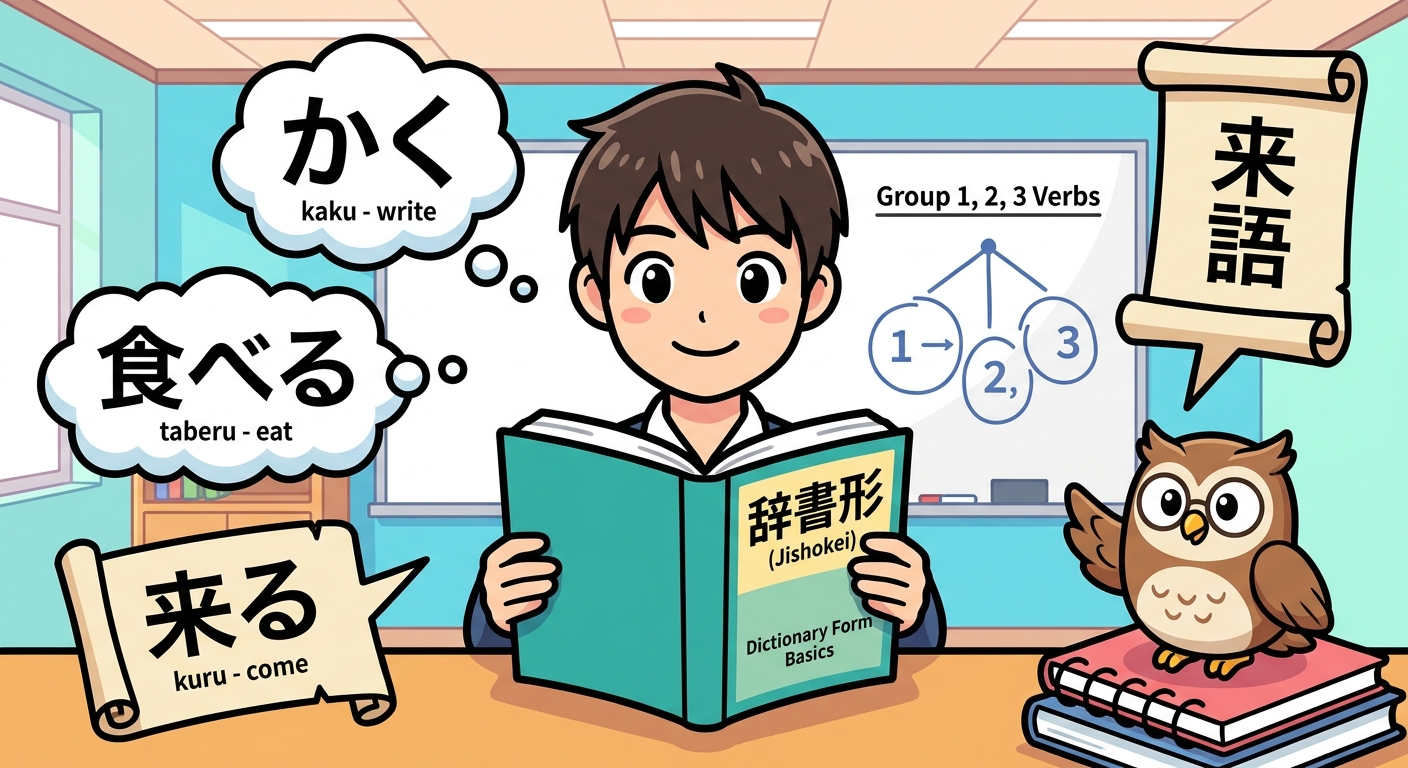
Introduction
Welcome to the "Dictionary Form Basics" lesson. At the N4 level, transitioning from polite masu-form to the plain, or dictionary form (jishokei), is a crucial milestone. This form is not only the standard way verbs are listed in dictionaries, but it also serves as the foundation for casual conversations and numerous essential grammar structures, such as expressing plans, rules, and sequences. In this lesson, we will demystify the conjugation rules for Group 1 (U-verbs), Group 2 (Ru-verbs), and the irregular Group 3 verbs, giving you the confidence to unlock more advanced Japanese sentence patterns.
Lesson Content
Master the Japanese Dictionary Form (辞書形): The Gateway to N4 Grammar
Welcome to your comprehensive guide to the Dictionary Form (辞書形 - jishokei).
At the N5 level, you likely relied on the polite 〜ます (-masu) form. However, transitioning to N4 requires mastering the Dictionary Form. It is not only the casual, plain present-positive form used with close friends, but it also serves as the essential building block for advanced grammar patterns.
1. How to Conjugate: From 〜ます to Dictionary Form
To conjugate verbs accurately, you must first identify which of the three verb groups your verb belongs to.
Group 1: U-Verbs (Godan)
For Group 1 verbs, change the ~i sound vowel immediately preceding 〜ます to its corresponding ~u sound.
| Polite Form | Pre-masu Vowel | Dictionary Form | Meaning |
|---|---|---|---|
| 会います (aimasu) | い (i) $\rightarrow$ う (u) | 会う (au) | to meet |
| 書きます (kakimasu) | き (ki) $\rightarrow$ く (ku) | 書く (kaku) | to write |
| 話します (hanashimasu) | し (shi) $\rightarrow$ す (su) | 話す (hanasu) | to speak |
| 待ちます (machimasu) | ち (chi) $\rightarrow$ つ (tsu) | 待つ (matsu) | to wait |
Group 2: Ru-Verbs (Ichidan)
These verbs usually have an ~e or ~i sound before 〜ます. Conjugation is simple: drop 〜ます and add 〜る (-ru).
| Polite Form | Drop 〜ます | Dictionary Form | Meaning |
|---|---|---|---|
| 食べます (tabemasu) | 食べ- | 食べる (taberu) | to eat |
| 見ます (mimasu) | 見- | 見る (miru) | to see/watch |
| 開けます (akemasu) | 開け- | 開ける (akeru) | to open |
Group 3: Irregular Verbs
There are only two verbs in this group. You must memorize them:
| Polite Form | Dictionary Form | Meaning |
|---|---|---|
| します (shimasu) | する (suru) | to do |
| 来ます (kimasu) | 来る (kuru) | to come |
2. Essential N4 Grammar Patterns
Once you master the dictionary form, you can immediately unlock crucial N4 grammar structures. Here are two of the most common:
Pattern A: Expressing Ability (〜ことができる)
- Structure:
[Verb in Dictionary Form] + ことができる(to be able to do [verb])
Example 1:
- 日本語を話すことができます。
- Nihongo o hanasu koto ga dekimasu.
- I can speak Japanese. (Literally: "The thing of speaking Japanese is possible.")
Pattern B: Sequencing Actions (〜前に)
- Structure:
[Verb in Dictionary Form] + 前に(before doing [verb]) - Note: The verb before
前にis always in the dictionary form, even if the main sentence is in the past tense.
Example 2:
- ご飯を食べる前に、手を洗います。
- Gohan o taberu mae ni, te o araimasu.
- Before eating a meal, I wash my hands.
Example 3:
- 日本へ行く前に、切符を買いました。
- Nihon e iku mae ni, kippu o kaimashita.
- Before I went to Japan, I bought a ticket.
Quick Practice Challenge
Transform the following polite sentences into their plain (casual) dictionary form:
- 毎日日本語を勉強します。
$\rightarrow$ 毎日日本語を勉強する。 (I study Japanese every day.) - 音楽を聞きます。
$\rightarrow$ 音楽を聞く。 (I listen to music.) - 明日、友達が来ます。
$\rightarrow$ 明日、友達が来る。 (My friend is coming tomorrow.)
Keep practicing this transition until it becomes second nature, and you will have conquered one of the most vital milestones of the JLPT N4 level!
Exercises
Dictionary Form Basics (Exercises)
Exercises for Dictionary Form Basics
Review the grammar and vocabulary, and try to fill in the blanks or write sentences based on the prompts.
Examples
私は日本語の新聞を読むことができます。
Watashi wa nihongo no shinbun o yomu koto ga dekimasu.
I can read Japanese newspapers.
ご飯を食べる前に、手を洗います。
Gohan o taberu mae ni, te o araimasu.
Before eating a meal, I wash my hands.
来年、日本に留学するつもりです。
Rainen, nihon ni ryuugaku suru tsumori desu.
I intend to study abroad in Japan next year.