
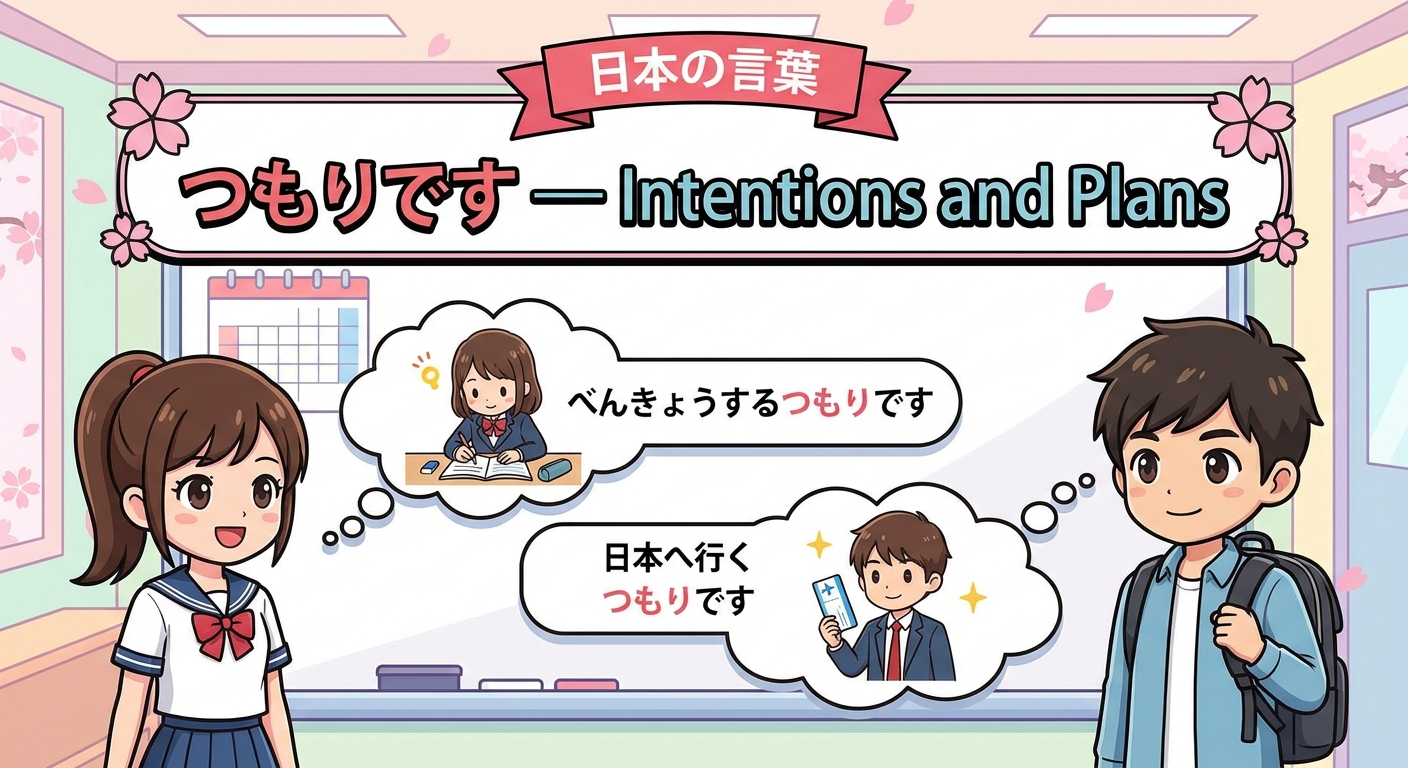
つもりです — Intentions and Plans
Express intentions using [dictionary form] + つもりです and [ない form] + つもりです. Contrast with 〜と思っています for more uncertain plans.
🎯 Goal: By the end of this lesson, you will be able to correctly conjugate verbs into the "つもりです" form (both positive and negative) and use them to express your personal plans, career goals, and upcoming travel arrangements in natural Japanese conversations.
Introduction
Welcome to this lesson on expressing your future plans and intentions using the grammar pattern "つもりです" (tsumori desu). As an upper-beginner (N4) learner, moving beyond simple future actions to expressing personal determination and planned decisions is a crucial step toward natural Japanese conversation. By combining the dictionary form or the negative "nai-form" of a verb with "つもりです", you can confidently share what you intend to do—or not do—in the future. This lesson will guide you through the structural rules, nuance differences from other future expressions, and practical everyday scenarios to help you speak about your goals with ease.
Lesson Content
Master JLPT N4: Expressing Intentions with 〜つもりです
Welcome to your definitive guide to mastering one of the most essential grammar points in the JLPT N4 syllabus: 〜つもりです (tsumori desu).
If you want to talk about your future plans, dreams, or personal resolutions with confidence, this is the structure you need. In Japanese, how you express the future depends heavily on your level of certainty and resolve. Today, we will unpack how to use 〜つもりです to express your firm intentions.
1. Core Meaning & Nuance
つもり (積もり) literally translates to "conviction," "intention," or "plan." When combined with です, it expresses a decision you have already made in your mind.
- English equivalent: "I intend to..." / "I plan to..." / "I am going to..."
- Certainty Level: High (approx. 70-80%). It is stronger than a passing thought (
〜ようと思っています), but less official than a scheduled event (〜予定です).
2. Grammar Construction
Forming sentences with つもりです is highly systematic. You only need the plain (casual) form of the verb.
A. Affirmative: "I intend to do [Action]"
[Verb Dictionary Form] + つもりです
- 買う (to buy) $\rightarrow$ 買うつもりです (I intend to buy)
- 行く (to go) $\rightarrow$ 行くつもりです (I intend to go)
B. Negative: "I intend NOT to do [Action]"
There are two ways to form the negative.
- The Standard Negative (Most Common):
[Verb ない-Form] + つもりです
- 吸わない (not smoke) $\rightarrow$ 吸わないつもりです (I intend not to smoke)
- The Strong Negative (No Intention At All):
[Verb Dictionary Form] + つもりはありません
- 会う (to meet) $\rightarrow$ 会うつもりはありません (I have absolutely no intention of meeting [them])
3. Real-World Examples
Let’s look at these structures in natural, N4-level context.
Example 1: Future Plans
- Japanese: 来年、日本に留学するつもりです。
- Kana: らいねん、にほんにりゅうがくするつもりです。
- Romaji: Rainen, Nihon ni ryūgaku suru tsumori desu.
- English: I intend to study abroad in Japan next year.
Example 2: Lifestyle Resolutions (Negative)
- Japanese: 健康のために、甘いものは食べないつもりです。
- Kana: けんこうのために、あまいものはたべないつもりです。
- Romaji: Kenkō no tame ni, amai mono wa tabenai tsumori desu.
- English: For my health, I intend not to eat sweet things.
Example 3: Strong Refusal
- Japanese: 彼には二度と連絡するつもりはありません。
- Kana: かれにはにどとれんらくするつもりはありません。
- Romaji: Kare ni wa nido to renraku suru tsumori wa arimasen.
- English: I have no intention of contacting him ever again.
4. Crucial Grammar Nuances (Tutor Tips)
⚠️ The Third-Person Rule
つもりです reflects the internal state of the speaker. Therefore, you cannot use it directly for other people without modifying it.
- ❌ Incorrect: 田中さんは旅行に行くつもりです。 (Sounds like you are telepathically reading Tanaka's mind).
- Correct Alternatives:
- 田中さんは旅行に行くそうです (I heard Tanaka plans to go...).
- 田中さんは旅行に行くらしいです (It seems Tanaka intends to go...).
⚠️ Politeness Warning
Do not use つもりですか to ask a superior or boss about their plans. It can sound interrogative or presumptuous (e.g., "Do you actually intend to do that?"). Instead, use the polite 予定ですか (yotei desu ka).
5. Quick Check: Quiz
Test your understanding! Translate the following English sentence into Japanese using つもりです.
<details> <summary><strong>Click to reveal the correct answer!</strong></summary>"I plan to study Japanese for two hours tonight."
(Vocabulary help: Tonight = 今夜 konya / Two hours = 二時間 ni-jikan)
Answer:
今夜、二時間日本語を勉強するつもりです。
(Konya, ni-jikan nihongo o benkyō suru tsumori desu.)
Exercises
つもりです — Intentions and Plans (Exercises)
Exercises for つもりです — Intentions and Plans
Review the grammar and vocabulary, and try to fill in the blanks or write sentences based on the prompts.
Examples
来年、日本に留学するつもりです。
Rainen, Nihon ni ryuugaku suru tsumori desu.
I intend to study abroad in Japan next year.
今夜はお酒を飲まないつもりです。
Konya wa osake wo nomanai tsumori desu.
I do not intend to drink alcohol tonight.
週末に新しい車を買うつもりです。
Shuumatsu ni atarashii kuruma wo kau tsumori desu.
I plan to buy a new car this weekend.
Practice Drills
Lesson Materials
Vocabulary (5)
Grammar (3)
Kanji (0)
No kanji characters in this lesson.
Kana (0)
No kana characters in this lesson.