
前に / 後で — Action Order
Express action sequence using [dictionary form] + 前に (before) and [た form] + 後で (after). Build complex time-ordered sentences.
🎯 Goal: To master the construction and usage of '前に' and '後で' with verbs and nouns, enabling you to accurately describe the sequence of daily activities, make plans, and give chronological instructions in natural Japanese.
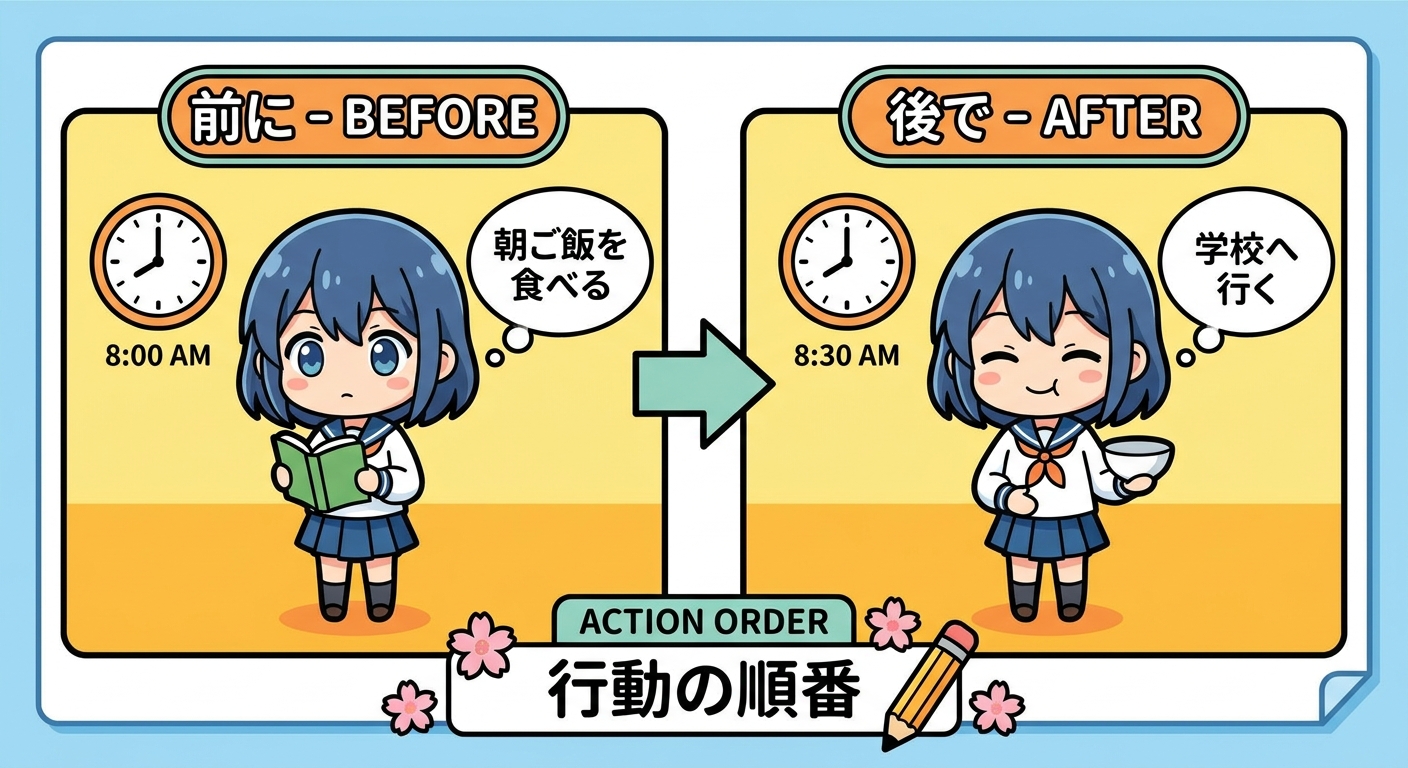
Introduction
Expressing the sequence of events is crucial for daily communication, scheduling, and storytelling in Japanese. This lesson introduces the essential N4 grammar points '前に' (before) and '後で' (after). You will learn how to connect verbs and nouns to clearly describe what happens first and what follows. Mastering the specific verb conjugations required for each—the dictionary form for '前に' and the past tense 'た-form' for '後で'—is key to using these structures accurately. By the end of this lesson, you will be able to smoothly sequence your daily activities, discuss schedules, and give clear instructions.
Lesson Content
Master Class: Sequencing Actions with 前に (mae ni) and 後で (ato de)
Welcome to your definitive guide to mastering action order in Japanese! At the JLPT N4 level, moving beyond simple sentences requires the ability to connect events chronologically. Today, we will master 前に (before) and 後で (after).
By the end of this guide, you will understand the strict grammatical rules governing these patterns and how to avoid the most common pitfalls made by English speakers.
1. Doing "A" Before "B": 〜前に (mae ni)
To express that you do an action before another action, use 前に.
The Golden Rules of Connection:
- Verbs: Use the Dictionary Form (Plain Non-Past) + 前に.
- Nouns: Use Noun + の + 前に.
[Action A: Dictionary Verb / Noun + の] + 前に、[Action B]
"Before doing A, I do B."
⚠️ The Golden Rule of Tense:
The verb directly preceding 前に must always be in the dictionary form, regardless of whether the overall sentence is in the present, future, or past tense. The tense of the entire sentence is determined solely by the final verb.
Examples:
-
Verb Connection:
日本へ行く前に、日本語を勉強します。
Nihon e iku mae ni, nihongo o benkyou shimasu.
Before going to Japan, I will study Japanese. -
Past Tense Example (Notice "iku" does not change):
日本へ行く前に、日本語を勉強しました。
Nihon e iku mae ni, nihongo o benkyou shimashita.
Before going to Japan, I studied Japanese. -
Noun Connection:
食事の前に、手を洗ってください。
Shokuji no mae ni, te o aratte kudasai.
Before the meal, please wash your hands.
2. Doing "B" After "A": 〜後で (ato de)
To express that you do an action after completing another action, use 後で.
The Golden Rules of Connection:
- Verbs: Use the た-Form (Plain Past) + 後で.
- Nouns: Use Noun + の + 後で.
[Action A: た-Form Verb / Noun + の] + 後で、[Action B]
"After doing A, I do B."
⚠️ The Golden Rule of Tense:
The verb preceding 後で must always be in the た-form (past tense). This is because Action A must be completed before Action B can begin. Just like with 前に, the final verb determines the overall tense of the sentence.
Examples:
-
Verb Connection:
宿題をした後で、ゲームをします。
Shukudai o shita ato de, geemu o shimasu.
After doing my homework, I will play video games. -
Noun Connection:
仕事の後で、飲みに行きましょう!
Shigoto no ato de, nomi ni ikimashou!
After work, let's go out for a drink!
Quick Reference Summary
| Pattern | Grammar Rule | Example | English Translation |
|---|---|---|---|
| 前に (Before) | Verb (Dict. Form) + 前に | 寝る前に本を読む。 | Before sleeping, I read a book. |
| Noun + の前に | テストの前に復習する。 | Before the test, I review. | |
| 後で (After) | Verb (た-Form) + 後で | 食べた後で薬を飲む。 | After eating, I take medicine. |
| Noun + の後で | 授業の後で質問する。 | After class, I will ask questions. |
Challenge Yourself! (Practice Quiz)
Translate the following sentences into Japanese using the correct forms. (Answers below)
- Before buying this car, I talked with my family. (Car = 車 kuruma, To buy = 買う kau, Family = 家族 kazoku)
- After watching the movie, I went to bed. (Movie = 映画 eiga, To watch = 見る miru, To go to bed = 寝る neru)
Answers:
- この車を買う前に、家族と話しました。
- 映画を見た後で、寝ました。
Exercises
前に / 後で — Action Order (Exercises)
Exercises for 前に / 後で — Action Order
Review the grammar and vocabulary, and try to fill in the blanks or write sentences based on the prompts.
Examples
日本へ行く前に、日本語を勉強します。
nihon e iku mae ni, nihongo o benkyō shimasu.
Before going to Japan, I will study Japanese.
宿題をした後で、テレビを見ます。
shukudai o shita ato de, terebi o mimasu.
After doing my homework, I will watch TV.
仕事の後で、友達と食事をします。
shigoto no ato de, tomodachi to shokuji o shimasu.
After work, I will have a meal with my friend.