
なければなりません — Obligation
Express must/have to using 〜なければなりません (plain form: なきゃ/なければ). Use in school, work, and daily life contexts.
Lesson Content
Master Japanese Obligation: How to Use 〜なければなりません (N4)
In Japanese, expressing necessity or obligation—saying "must" or "have to"—is a vital milestone in your N4 journey. The standard polite formula for this is 〜なければなりません (nakereba narimasen).
While it may look intimidatingly long at first glance, it is highly systematic. Let’s break it down step-by-step so you can use it with confidence.
1. The Anatomy of the Grammar
To understand this pattern, it helps to look at its literal meaning. It is actually a double negative:
$$\text{Negative Conditional (If not...)} + \text{Negative Verb (It won't go/do)}$$
- なければ (nakereba): "If [you] do not..." (The conditional form of the negative ~nai).
- なりません (narimasen): "It will not do / It is unacceptable."
Combined, it literally means: "If you do not do [action], it will not do." In natural English, this translates directly to: "You must do..." or "I have to..."
2. How to Conjugate
To build this form, follow this simple three-step rule:
- Conjugate your verb into the plain negative (nai-form).
- Drop the final 〜い (i).
- Attach 〜ければなりません (kereba narimasen).
Conjugation Examples:
| Verb Type | Dictionary Form | Plain Negative (Nai-form) | Drop i + Add kereba narimasen | English Translation |
|---|---|---|---|---|
| Group 1 (U) | 行く (iku / to go) | 行かない (ikanai) | 行かなければなりません (ikanakereba...) | I must go. |
| Group 2 (Ru) | 食べる (taberu / to eat) | 食べない (tabenai) | 食べなければなりません (tabenakereba...) | I must eat. |
| Group 3 (Irreg.) | する (suru / to do) | しない (shinai) | しなければなりません (shinakeba...) | I must do. |
| Group 3 (Irreg.) | 来る (kuru / to come) | 来ない (konai) | 来なければなりません (konakereba...) | I must come. |
3. Real-World Examples
Here is how you will see and hear this grammar used in daily polite Japanese:
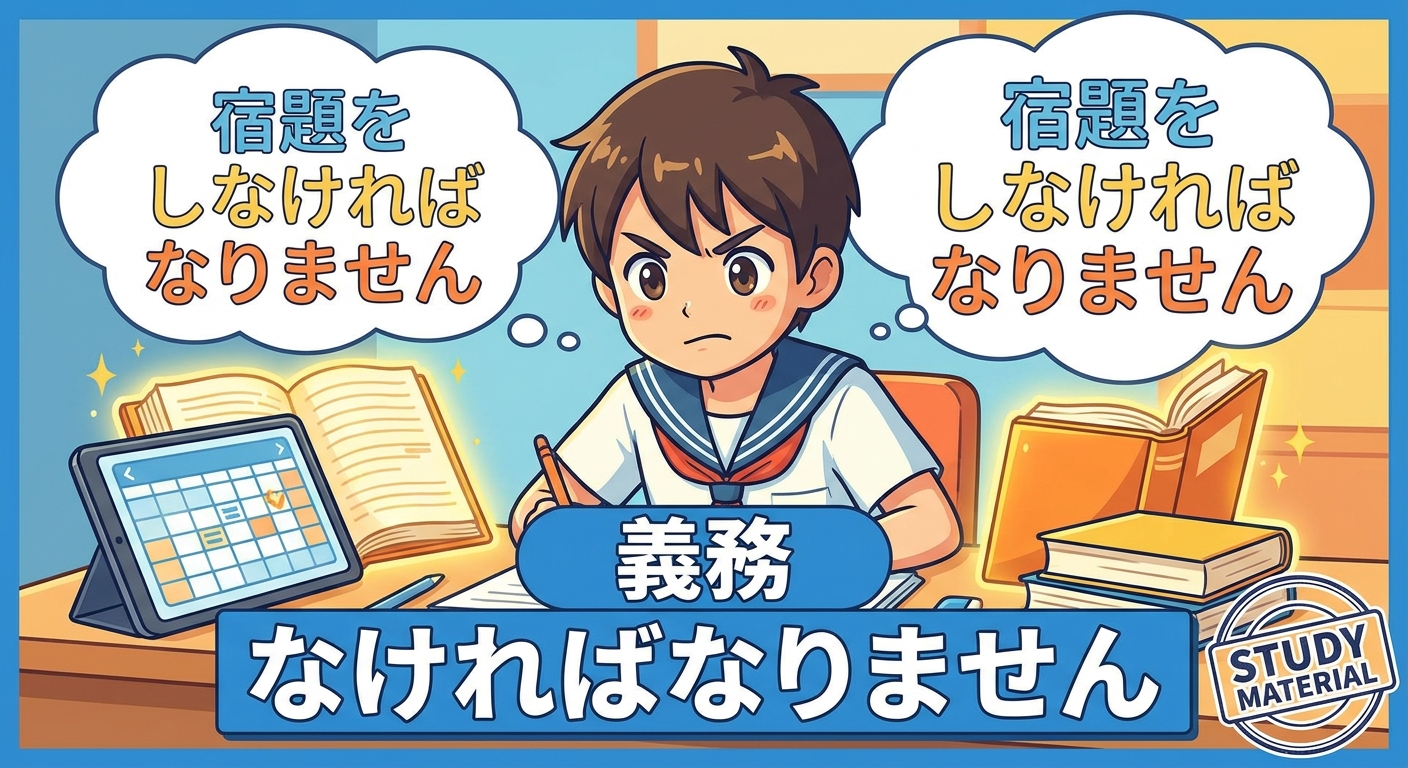
- 宿題をしなければなりません。
- Shukudai o shinakereba narimasen.
- Translation: I must do my homework.
- 明日、早く起きなければなりません。
- Ashita, hayaku okinakereba narimasen.
- Translation: I have to wake up early tomorrow.
- 毎日、薬を飲まなければなりません。
- Mainichi, kusuri o nomanakereba narimasen.
- Translation: I must take my medicine every day.
4. Casual and Written Shortcuts (Bonus N4+ Insight)
In casual speech, Japanese speakers rarely use the full, formal 〜なければなりません because it is a mouthful. Here are the common variations you will encounter:
- 〜なければならない (nakereba naranai): The plain/written form. Used in essays, newspapers, or when speaking seriously to yourself.
- 〜なきゃいけない (nakya ikenai): Conversational and semi-casual.
- 〜なきゃ (nakya): Very casual. You simply drop the end of the sentence.
- Example: 行かなきゃ! (Ikanakya!) — "I gotta go!"
Quick Practice Challenge
Try to translate this sentence into Japanese using the polite form:
"I must speak Japanese." (To speak = 話します / はなします)
(Answer: 日本語を話さなければなりません。 / Nihongo o hanasanakereba narimasen.)
Mastery Tip: Practice saying "nakereba narimasen" as a single, rhythmic sound unit. Once your tongue gets used to the rhythm, you will be able to conjugate any verb on the fly!
Exercises
なければなりません — Obligation (Exercises)
Exercises for なければなりません — Obligation
Review the grammar and vocabulary, and try to fill in the blanks or write sentences based on the prompts.
Examples
毎日薬を飲まなければなりません。
Mainichi kusuri o nomanakereba narimasen.
I have to take medicine every day.
今夜は宿題をしなければなりません。
Konya wa shukudai o shinakereba narimasen.
I must do my homework tonight.
明日は試験があるので、早く起きなければなりません。
Ashita wa shiken ga aru node, hayaku okinakereba narimasen.
Since there is an exam tomorrow, I must wake up early.
Practice Drills
Lesson Materials
Vocabulary (5)
Grammar (3)
Kanji (0)
No kanji characters in this lesson.
Kana (0)
No kana characters in this lesson.