
たことがあります — Past Experience
Express past life experience using [た form] + ことがあります. Distinguish from simple past tense. Practice interview-style conversation about experiences.
🎯 Goal: By the end of this lesson, you will be able to conjugate verbs into the past-plain form (Ta-form) to accurately construct the "〜たことがあります" pattern, enabling you to ask and answer questions about personal life experiences in natural Japanese.
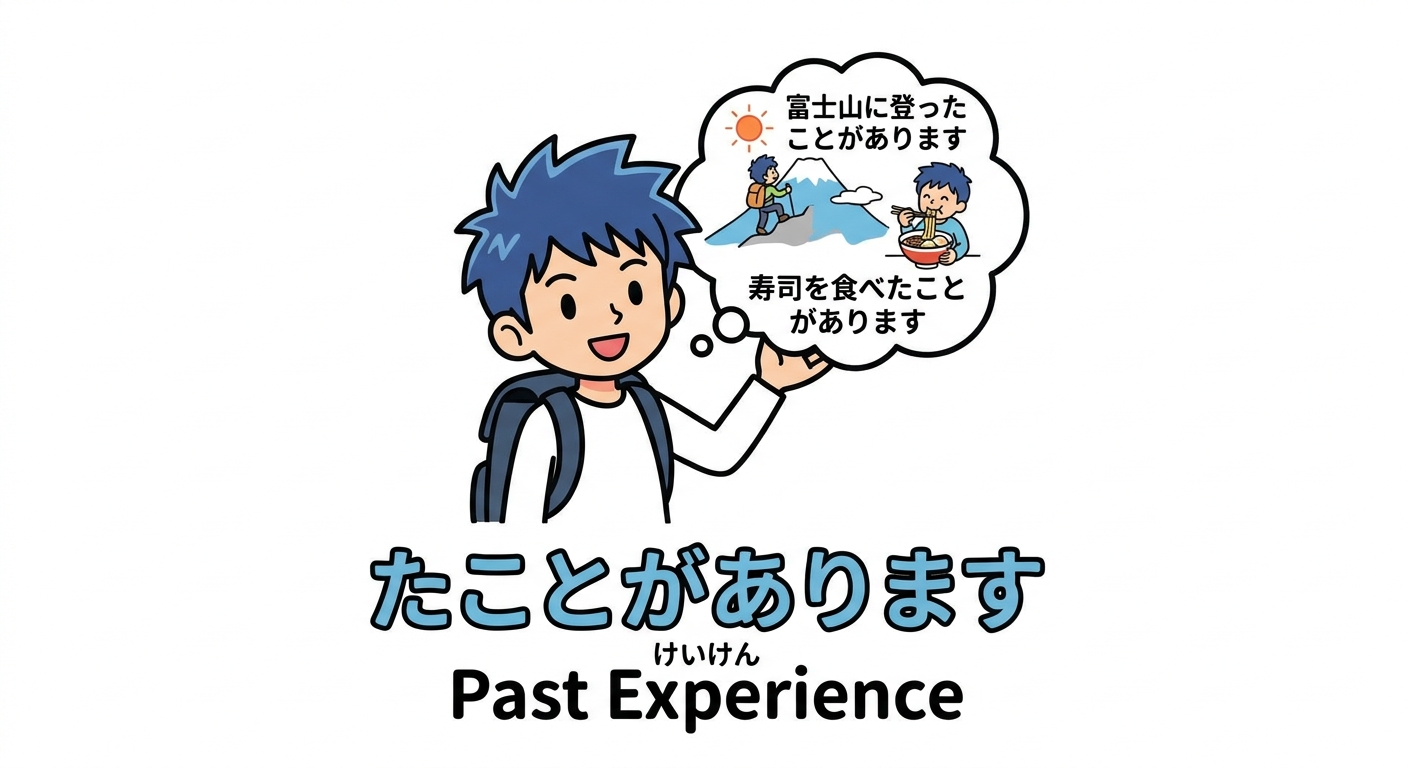
Introduction
Have you ever climbed Mount Fuji, tried authentic sushi, or watched a traditional Kabuki play? Sharing these unique life experiences is a wonderful way to connect with others. In Japanese, we express these past experiences using the essential N4 grammar pattern "〜たことがあります" (ta koto ga arimasu). Unlike the simple past tense, which refers to a specific past event, this pattern highlights the fact that you have had a particular experience at least once in your lifetime. Mastering this structure will allow you to share your personal stories, ask others about their adventures, and engage in deeper, more meaningful conversations.
Lesson Content
Elite Japanese Lesson: Mastering Past Experience with 〜たことがあります (JLPT N4)
Welcome to your definitive guide to expressing life experiences in Japanese. Today, we will master the grammatical structure 〜たことがあります (have had the experience of doing...).
By the end of this guide, you will be able to confidently share your life adventures, ask others about their unique experiences, and avoid common beginner pitfalls.
1. The Core Formula
To express that you have done something at least once in your life, use this construction:
$$\text{Verb (Plain Past / } \bf{Ta}\text{-form)} + \bf{ことがあります}$$
Anatomical Breakdown:
- Verb (た-form): Represents the past action.
- こと (Koto): A nominalizer that turns the verb phrase into a noun clause (meaning "the act/matter of...").
- が (Ga): The subject marker particle.
- あります (Arimasu): The verb of existence for inanimate objects ("there is" / "exists").
Literal Translation: "The concept/experience of having done [Verb] exists."
2. Conjugation Guide
To use this grammar, you must master the Ta-form (plain past). Here is a quick refresher across the three verb groups:
| Group | Dictionary Form | Ta-Form (Past) | Expressing Experience |
|---|---|---|---|
| Group 1 (U-Verbs) | 行く (iku / to go) | 行った (itta) | 行ったことがあります |
| Group 2 (Ru-Verbs) | 食べる (taberu / to eat) | 食べた (tabeta) | 食べたことがあります |
| Group 3 (Irregular) | する (suru / to do) | した (shita) | したことがあります |
Affirmative, Negative, and Question Forms
- Affirmative (I have...): たことがあります (ta koto ga arimasu)
- Negative (I have never...): たことがありません (ta koto ga arimasen)
- Question (Have you ever...?): たことがありますか (ta koto ga arimasu ka)
3. The Crucial Nuance: 〜た vs. 〜たことがあります
Do not confuse the simple past tense (〜た) with the experience form (〜たことがあります).
- 日本に行きました。 (Nihon ni ikimashita.)
- Simple Past: "I went to Japan." (Focuses on a specific past event, e.g., last month).
- 日本に行ったことがあります。 (Nihon ni itta koto ga arimasu.)
- Experience: "I have been to Japan." (Focuses on this being a life experience, regardless of when it happened).
⚠️ Grammar Rule: Do not use this pattern for routine daily activities. For example, do not say "I have eaten breakfast today" using this form. Use it for notable, non-routine life experiences.
4. Real-World Examples
Study these examples to see how particles and context integrate with this grammar.
Example 1: Affirmative Experience
- Japanese: 富士山(ふじさん)に登(のぼ)ったことがあります。
- Romaji: Fujisan ni nobotta koto ga arimasu.
- English: I have climbed Mount Fuji before.
- Note: The particle に indicates the target of the climb.
Example 2: Negative Experience (Never)
- Japanese: 納豆(なっとう)を食べたことがありません。
- Romaji: Nattō o tabeta koto ga arimasen.
- English: I have never eaten natto.
Example 3: Asking a Question
- Japanese: 着物(きもの)を着(き)たことがありますか。
- Romaji: Kimono o kita koto ga arimasu ka.
- English: Have you ever worn a kimono?
5. Quick Check: Test Your Knowledge
Transform the following sentences into the experience form. (Answers below)
- 歌舞伎(かぶき)を見ます (I watch Kabuki) $\rightarrow$ Change to: "I have watched Kabuki before."
- 日本酒(にほんしゅ)を飲みません (I do not drink sake) $\rightarrow$ Change to: "I have never drunk sake."
Answers:
- 歌舞伎(かぶき)を見たことがあります。 (Kabuki o mita koto ga arimasu.)
- 日本酒(にほんしゅ)を飲んだことがありません。 (Nihonshu o nonda koto ga arimasen.)
Congratulations! You have mastered the grammar of life experiences. Try writing down three of your own life experiences in Japanese today to lock in this knowledge!
Exercises
たことがあります — Past Experience (Exercises)
Exercises for たことがあります — Past Experience
Review the grammar and vocabulary, and try to fill in the blanks or write sentences based on the prompts.
Examples
日本に一度行ったことがあります。
Nihon ni ichido itta koto ga arimasu.
I have been to Japan once.
富士山に登ったことがあります。
Fujisan ni nobotta koto ga arimasu.
I have climbed Mt. Fuji.
歌舞伎を見たことがありません。
Kabuki o mita koto ga arimasen.
I have never seen Kabuki.
Practice Drills
Lesson Materials
Grammar (3)
Kanji (0)
No kanji characters in this lesson.
Kana (0)
No kana characters in this lesson.