
ばよかった / てしまう — Regret and Completion
Express regret using 〜ばよかった (should have done). Express unintended completion or regret using 〜てしまう/ちゃう. Practice with natural conversational contexts.
🎯 Goal: By the end of this lesson, you will be able to confidently express personal regret using "〜ばよかった" and describe completed or accidental actions using "〜てしまう" in both casual and polite contexts, enhancing your ability to share personal anecdotes and emotions naturally.
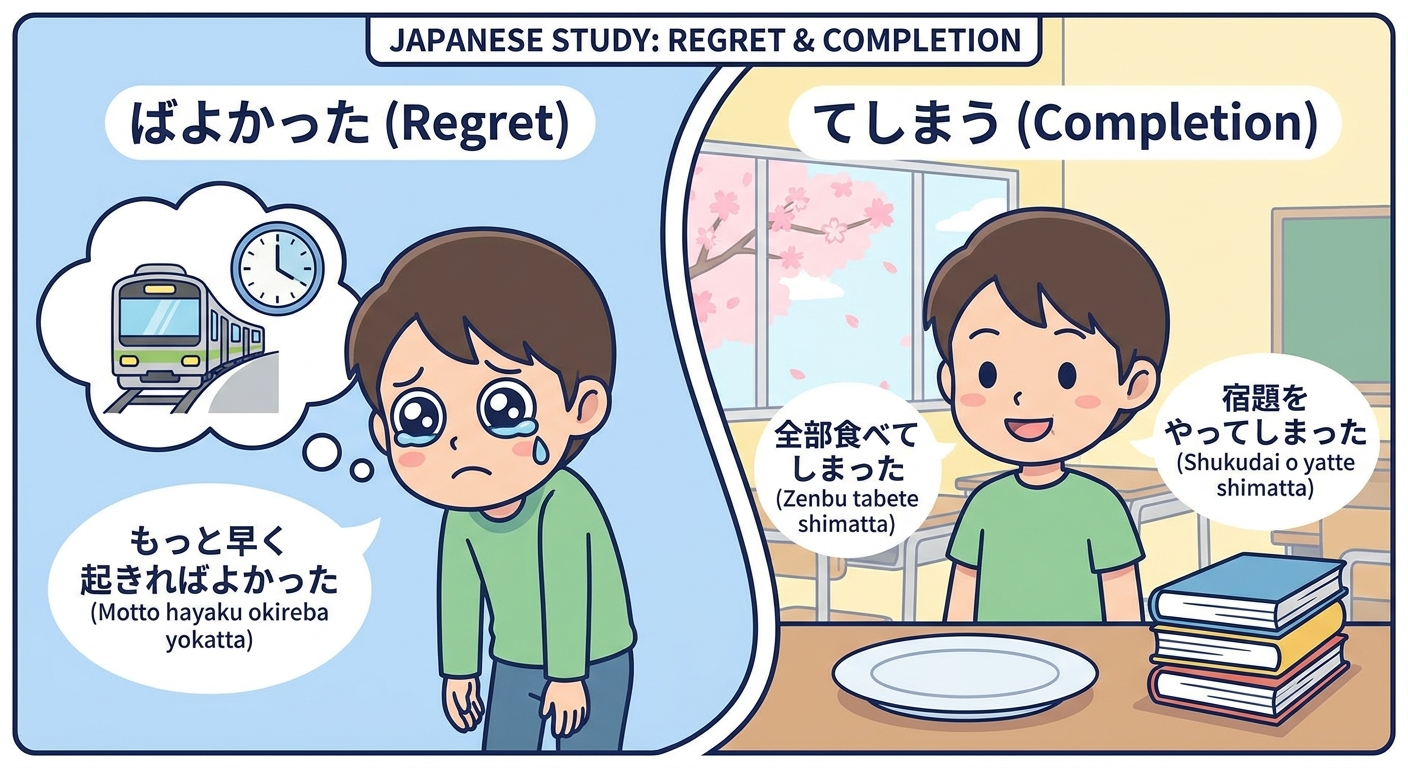
Introduction
Welcome to this N3 lesson, where we explore the expressive nuances of regret and completion in Japanese. As an intermediate learner, moving beyond simple factual statements to expressing personal feelings about past events is crucial for fluent communication. In this lesson, we will master two essential grammar patterns: "〜ばよかった" (I should have done...) to express hypothetical regret about past decisions, and "〜てしまう" (to do completely / accidentally) to convey unintentional actions or a sense of finality. Together, these structures will allow you to describe past mistakes, express relief, and share your genuine feelings in natural, everyday Japanese conversations.
Lesson Content
Master N3 Grammar: Regret & Completion (〜ばよかった & 〜てしまう)
In Japanese, expressing emotion is just as important as conveying facts. At the JLPT N3 level, you move beyond simple statements to express complex feelings like nostalgia, relief, and—crucially—regret.
Today, we will master two essential grammar patterns that native speakers use daily to express regret, accident, and completion: 〜ばよかった and 〜てしまう.
1. 〜ばよかった (I should have... / I wish I had...)
This pattern is used to express regret about a past action. You are looking back at a decision and wishing you had done the opposite.
Conjugation Formula
| Type | Affirmative ("I should have...") | Negative ("I shouldn't have...") |
|---|---|---|
| Verbs | Conditional (ば-form) + よかった | Negative (なければ) + よかった |
- Group 1 (U): 書く $\rightarrow$ 書けばよかった / 書かなければよかった
- Group 2 (Ru): 食べる $\rightarrow$ 食べればよかった / 食べなければよかった
- Group 3 (Irregular): する $\rightarrow$ すればよかった / しなければよかった
Sentence Examples
- もっと勉強(べんきょう)すればよかった。
- Motto benkyō sureba yokatta.
- Translation: I should have studied more. (Regret about inaction)
- あんな辛(から)いものを食べなければよかった。
- Anna karai mono o tabenakereba yokatta.
- Translation: I shouldn't have eaten such spicy food. (Regret about action)
2. 〜てしまう (To do completely / Regrettable accident)
This versatile grammar point has two primary nuances depending on the context: Completion and Regret.
Conjugation Formula
- Verb (て-form) + しまう
💡 Spoken/Casual Japanese Shortcuts:
- てしまう $\rightarrow$ 〜ちゃう (e.g., 食べちゃう)
- でしまう $\rightarrow$ 〜じゃう (e.g., 飲んじゃう)
Nuance A: Completion ("To finish completely")
This indicates that an action has been carried out thoroughly to the very end.
- 宿題(しゅくだい)をもうやってしまいました。
- Shukudai o mō yatte shimaimashita.
- Translation: I have already completely finished my homework.
Nuance B: Regret / Accident ("Oops, I did it unintentionally")
This indicates that something bad happened accidentally, or that you did something you regret.
- 電車(でんしゃ)の中に傘(かさ)を忘(わす)れてしまいました。
- Densha no naka ni kasa o wasurete shimaimashita.
- Translation: I accidentally left my umbrella on the train.
The Synergy: Combining Both Concepts
In natural conversation, these two grammar points often work together to create a narrative of a mistake and the resulting regret.
[Accidental Event (〜てしまった)] ──> [Resulting Regret (〜ばよかった)]
Example:
- 財布(さいふ)を落(お)としてしまった。もっと気(き)をつければよかった。
- Saifu o otoshite shimatta. Motto ki o tsukereba yokatta.
- Translation: I ended up losing my wallet. I should have been more careful.
Quick Practice Challenge
Translate the following sentences into Japanese using today's grammar. (Answers below)
- I accidentally ate my sister's cake. (Casual)
- I should have bought that jacket yesterday.
Answers:
- 妹(いもうと)のケーキを食べちゃった。
- 昨日(きのう)あのジャケットを買(か)えばよかった。
Exercises
ばよかった / てしまう — Regret and Completion (Exercises)
Exercises for ばよかった / てしまう — Regret and Completion
Review the grammar and vocabulary, and try to fill in the blanks or write sentences based on the prompts.
Examples
昨日の夜、もっと早く寝ればよかったです。
Kinou no yoru, motto hayaku nereba yokatta desu.
I should have gone to bed earlier last night.
お気に入りのコップを落として割ってしまいました。
Okiiniiri no koppu wo otoshite watte shimaimashita.
I accidentally dropped and broke my favorite cup.
ダイエット中なのに、ケーキを全部食べてしまった。
Daiettochuu na noni, keeki wo zenbu tabete shimatta.
Even though I'm on a diet, I ended up eating the whole cake.
Practice Drills
Lesson Materials
Vocabulary (5)
Kanji (0)
No kanji characters in this lesson.
Kana (0)
No kana characters in this lesson.