
ことにしている / ようにしている — Habits
Talk about personal habits (decisions you make regularly) using ことにしている and sustained effort using ようにしている. Describe study and health routines.
🎯 Goal: By the end of this lesson, you will be able to confidently distinguish between 〜ことにしている and 〜ようにしている, and use them to express your personal rules, lifestyle choices, and daily efforts in natural Japanese speech and writing.
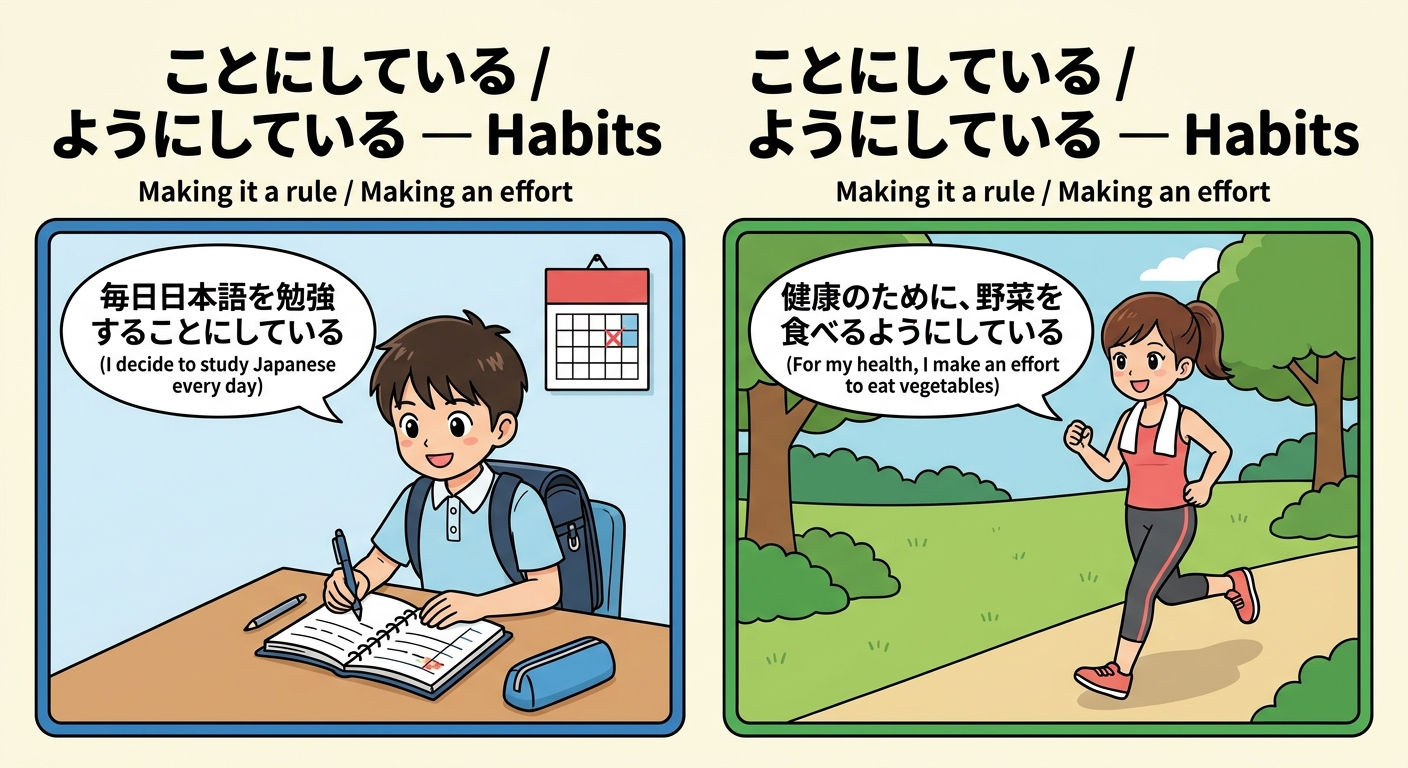
Introduction
Welcome to this N3 grammar lesson, where we will explore how to talk about your personal habits and daily routines using 〜ことにしている and 〜ようにしている. While both expressions describe actions you repeatedly perform, they carry distinct nuances. 〜ことにしている expresses a firm, conscious decision or personal rule you have set for yourself, such as 'I make it a rule to exercise daily.' On the other hand, 〜ようにしている emphasizes the ongoing effort or attempt to establish a habit, translating to 'I make an effort to...'. Mastering these structures will allow you to describe your lifestyle with precision and natural flow.
Lesson Content
Master N3 Grammar: Expressing Habits with ことにしている vs ようにしている
In Japanese, talking about your habits goes far beyond simply using the present tense. To sound natural and precise, you must express how you approach these habits.
Today, we will master two essential JLPT N3 grammar points: 〜ことにしている and 〜ようにしている. While both translate roughly to "I make a habit of..." in English, they carry distinct nuances of strict commitment versus conscious effort.
1. 〜ことにしている (The Self-Imposed Rule)
Form
- Verb (Dictionary Form) + ことにしている
- Verb (ない-Form) + ことにしている
The Meaning & Nuance
Use 〜ことにしている when you have made a firm, conscious decision to make something a personal rule. It implies a strong, self-imposed policy that you adhere to strictly.
- English translation: "I make it a rule to..." / "I have decided to (as a habit)..."
Examples in Action
-
毎日(まいにち)、寝(ね)る前(まえ)に日記(にっき)を書(か)くことにしている。
- Romaji: Mainichi, neru mae ni nikki o kaku koto ni shite iru.
- English: I make it a rule to write in my diary every night before going to bed.
- Nuance: This is a non-negotiable part of my nightly routine.
-
健康(けんこう)のために、夜(よる)遅(おそ)くには何(なに)も食(た)べないことにしている。
- Romaji: Kenkō no tame ni, yoru osoku ni wa nani mo tabenai koto ni shite iru.
- English: For my health, I make it a rule not to eat anything late at night.
- Nuance: I have set a strict boundary for myself.
2. 〜ようにしている (The Conscious Effort)
Form
- Verb (Dictionary Form) + ようにしている
- Verb (ない-Form) + ようにしている
The Meaning & Nuance
Use 〜ようにしている when you are making an effort to establish a habit. It focuses on the attempt and mindfulness behind the action. This grammar point is softer and acknowledges that while you try your best, you might occasionally fail.
- English translation: "I try to..." / "I make an effort to..."
Examples in Action
-
毎日(まいにち)、野菜(やさい)をたくさん食(た)べるようにしている。
- Romaji: Mainichi, yasai o takusan taberu yō ni shite iru.
- English: I try to eat a lot of vegetables every day.
- Nuance: I am actively making an effort to eat healthier, though I might miss a day.
-
エレベーターを使(つか)わずに、階段(かいだん)を使(つか)うようにしている。
- Romaji: Erebētā o tsukawazu ni, kaidan o tsukau yō ni shite iru.
- English: I try to use the stairs instead of the elevator.
- Nuance: I am keeping this goal in mind and acting on it whenever possible.
The Nuance Showdown: Side-by-Side Comparison
To truly understand the difference, look at how the meaning shifts with the same verb:
| Sentence | Nuance | English Translation |
|---|---|---|
| タバコを吸わないことにしている。 | Strict Rule: I have made a firm decision. I do not smoke, period. | "I make it a rule not to smoke." |
| タバコを吸わないようにしている。 | Ongoing Effort: I am trying my best to quit or avoid smoking. | "I am trying not to smoke." |
- Rule of Thumb: If it is a strict, black-and-white policy, use
ことにしている. If it requires continuous effort, willpower, or has room for flexibility, useようにしている.
Quick Practice!
Choose the correct form based on the context:
-
I want to save money, so I am trying not to buy expensive coffee every day.
- Hint: Focuses on effort.
- Answer: 買わないようにしている (kawanai yō ni shite iru)
-
I have a strict personal policy: I never work on Sundays.
- Hint: Focuses on a firm rule.
- Answer: 働かないことにしている (hatarakanai koto ni shite iru)
By mastering these two expressions, you can now describe your daily routines and lifestyle choices with the nuance and sophistication of a native Japanese speaker. Keep practicing, and try writing down your own daily habits using both forms today!
Exercises
ことにしている / ようにしている — Habits (Exercises)
Exercises for ことにしている / ようにしている — Habits
Review the grammar and vocabulary, and try to fill in the blanks or write sentences based on the prompts.
Examples
健康のために、毎日野菜をたくさん食べることにしています。
Kenkō no tame ni, mainichi yasai o takusan taberu koto ni shite imasu.
I make it a rule to eat a lot of vegetables every day for my health.
寝る前は、できるだけスマホを見ないようにしています。
Neru mae wa, dekiru dake sumaho o minai yō ni shite imasu.
I try to avoid looking at my smartphone as much as possible before going to bed.
日本語が上手になりたいので、毎日日記を書くようにしています。
Nihongo ga jōzu ni naritai node, mainichi nikki o kaku yō ni shite imasu.
I want to get better at Japanese, so I try to make an effort to write a diary every day.
Practice Drills
Lesson Materials
Vocabulary (5)
Kanji (0)
No kanji characters in this lesson.
Kana (0)
No kana characters in this lesson.