
づらい / にくい / やすい — Ease and Difficulty
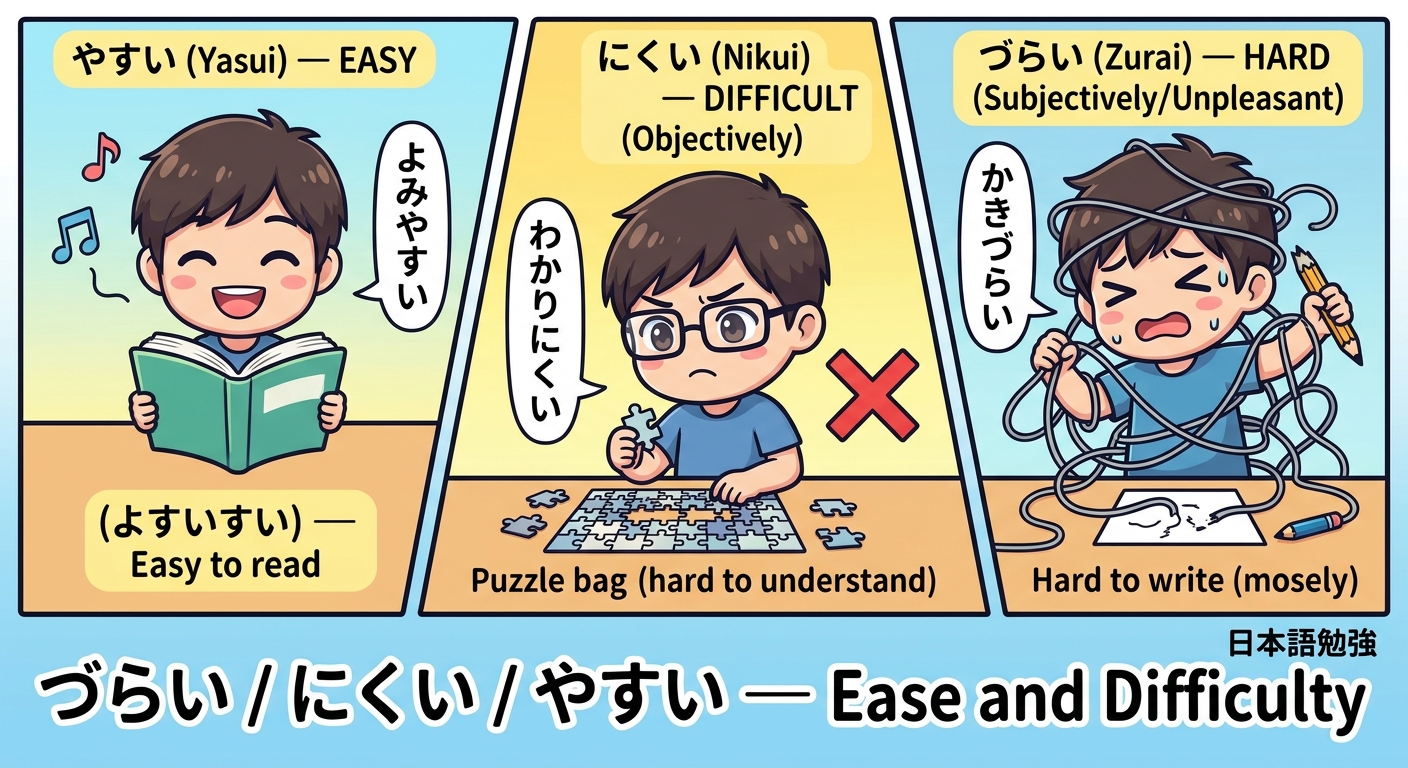
Express how easy or difficult actions are using 〜やすい (easy to), 〜にくい/づらい (hard to). Understand the subtle difference between にくい (physical difficulty) and づらい (psychological difficulty).
🎯 Goal: By the end of this lesson, you will be able to confidently attach 〜やすい, 〜にくい, and 〜づらい to verb stems to describe ease and difficulty, accurately distinguishing between objective difficulty (にくい) and subjective or psychological discomfort (づらい) in both spoken and written Japanese.
Introduction
In Japanese, expressing the ease or difficulty of an action goes beyond simple adjectives. At the JLPT N3 level, mastering the suffixes 〜やすい (easy to), 〜にくい (hard to), and 〜づらい (difficult/painful to) is essential for expressing subtle nuances. While 〜やすい and 〜にくい describe objective ease or difficulty based on external factors, 〜づらい introduces a subjective, often emotional or physical, barrier to performing an action. This lesson will guide you through the grammatical structures, key differences, and practical contexts of these suffixes, enabling you to describe your experiences and observations with native-like precision and sensitivity.
Lesson Content
Master N3 Grammar: Expressing Ease and Difficulty (〜やすい, 〜にくい, 〜づらい)
In Japanese, you can transform a verb to express how easy, difficult, or emotionally challenging an action is by attaching a simple suffix. Today, we will master three essential JLPT N3 suffixes: 〜やすい (yasui), 〜にくい (nikui), and 〜づらい (zurai).
1. The Core Grammar Construction
All three suffixes attach to the Verb ます-stem (pre-masu form).
Once attached, the entire compound verb morphs into an い-adjective (i-adjective) and conjugates accordingly (e.g., 〜やすくない, 〜にくかった).
$$\text{Verb (Stem Form)} + \begin{cases} \textbf{やすい} & \text{(Easy to do)} \ \textbf{にくい} & \text{(Difficult to do - Objective)} \ \textbf{づらい} & \text{(Painful/Awkward to do - Subjective)} \end{cases}$$
2. Deep Dive & Nuances
① 〜やすい (Easy to do / Prone to)
This suffix indicates that an action is physically easy to perform, or that something has a natural tendency to occur.
- Example 1 (Ease):
- このペンは書きやすいです。
- Kono pen wa kaki-yasui desu.
- This pen is easy to write with.
- Example 2 (Tendency):
- 白い服は汚れやすい。
- Shiroi fuku wa yogore-yasui.
- White clothes get dirty easily (are prone to getting dirty).
② 〜にくい (Hard to do — Objective Difficulty)
Use 〜にくい when external factors, physical obstacles, or the inherent nature of an object make an action difficult. It is objective and logical.
- Example:
- この漢字は複雑で覚えにくい。
- Kono kanji wa fukuzatsu de oboe-nikui.
- This kanji is complex and hard to memorize. (Objective fact: complexity makes it hard).
③ 〜づらい (Hard to do — Subjective/Emotional Difficulty)
Derived from the adjective 辛い (つらい - painful/bitter), 〜づらい (voiced from tsurai to zurai) expresses psychological resistance, emotional pain, or physical discomfort. You want to do the action, but doing so causes you distress or awkwardness.
- Example:
- 相手の連絡先は聞きづらい。
- Aite no renrakusaki wa kiki-zurai.
- It is awkward/hard to ask for the other person's contact information. (Psychological barrier).
3. The Ultimate Showdown: 〜にくい vs 〜づらい
While often interchangeable in casual speech, the distinction is crucial for natural Japanese:
| Feature | 〜にくい (Nikui) | 〜づらい (Zurai) |
|---|---|---|
| Nature of Difficulty | Objective / Physical / Logical | Subjective / Emotional / Painful |
| Focus | The properties of the object | The feelings of the speaker |
| Example (Eating) | 食べにくい (e.g., Crab with shells; physically hard to eat) | 食べづらい (e.g., Eating with a mouth ulcer; physically painful to eat) |
4. Practice Sentences
-
やすい
- スマートフォンの画面は大きくて見やすい。
- Sumātofon no gamen wa ōkikute mi-yasui.
- The smartphone screen is big and easy to see.
-
にくい
- この冬の道路は凍っていて歩きにくい。
- Kono fuyu no dōro wa kootte ite aruki-nikui.
- The roads this winter are frozen and hard to walk on.
-
づらい
- 先生には本当のことを言いづらいです。
- Sensei ni wa hontō no koto o ii-zurai desu.
- It is hard (emotionally awkward) to tell the truth to the teacher.
5. Quick Check!
Choose the correct suffix for the following scenario:
You have a sore throat, making it painful to swallow food.
A) 食べやすい (tabeyasui)
B) 食べにくい (tabenikui)
C) 食べづらい (tabezurai)
(Answer: C. Because it involves physical pain and subjective discomfort, 食べづらい is the most natural choice!)
Exercises
づらい / にくい / やすい — Ease and Difficulty (Exercises)
Exercises for づらい / にくい / やすい — Ease and Difficulty
Review the grammar and vocabulary, and try to fill in the blanks or write sentences based on the prompts.
Practice Drills
Lesson Materials
Vocabulary (5)
Kanji (0)
No kanji characters in this lesson.
Kana (0)
No kana characters in this lesson.