
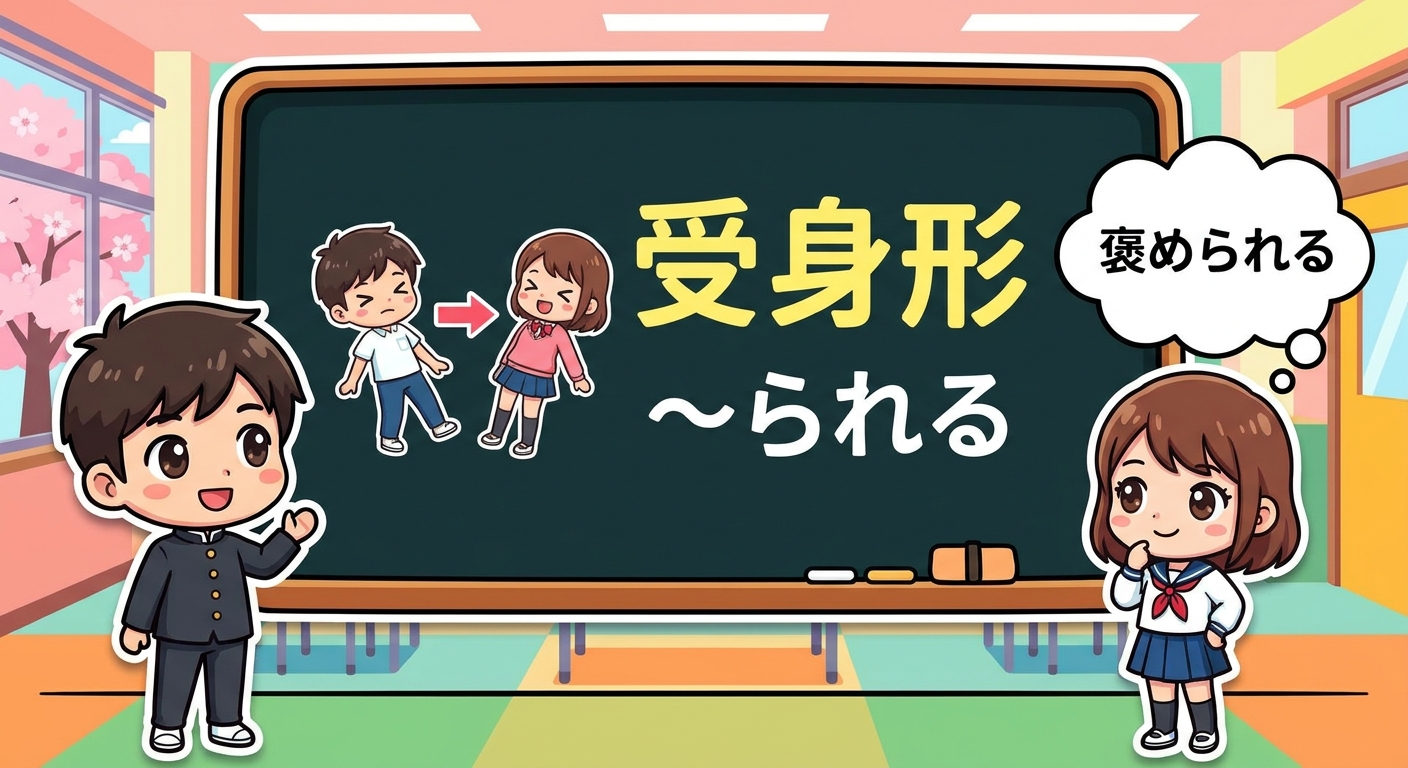
Passive Form (〜られる)
Learn the passive form (受身形) for all verb groups. Understand direct passive (object becomes subject) and indirect passive (someone is affected). Practice with real-world N3 sentences.
🎯 Goal: By the end of this lesson, you will be able to accurately conjugate Group 1, 2, and 3 verbs into the passive form (〜られる) and correctly use them to describe events from the receiver's perspective, including expressing adversity in natural Japanese conversations.
Introduction
Welcome to this N3 lesson on the Japanese passive form (〜られる). Unlike in English, the passive voice in Japanese is highly nuanced and frequently used to express how an action affects someone, often carrying a sense of inconvenience or annoyance—a concept known as the 'adversity passive.' Mastering this structure is crucial for achieving natural fluency, as it allows you to shift the perspective of a sentence to the recipient of the action. In this lesson, you will learn how to conjugate verbs across all groups and apply them accurately in common, everyday N3-level scenarios.
Lesson Content
Master the Japanese Passive Form (〜られる): JLPT N3 Study Guide
In English, the passive voice ("The cake was eaten") is often used to sound objective or formal. In Japanese, however, the Passive Form (受身形 - ukemikei) is highly dynamic. It is frequently used to express how an action affected someone—often negatively.
To pass the JLPT N3, you must master not only how to conjugate this form, but also how to choose the correct particles and identify the speaker's emotional nuance.
1. How to Conjugate the Passive Form
First, let's look at how to transform plain verbs into their passive equivalents.
| Verb Group | Rule | Dictionary Form | Passive Form |
|---|---|---|---|
| Group 1 (U-verbs) | Change final -u to -a + れる | 書く (kaku) <br> 呼ぶ (yobu) | 書かれる (kakareru) <br> 呼ばれる (yobareru) |
| Group 2 (Ru-verbs) | Drop -ru and add られる | 食べる (taberu) <br> 見る (miru) | 食べられる (taberareru) <br> 見られる (mirareru) |
| Group 3 (Irregular) | Memorize the irregular forms | する (suru) <br> 来る (kuru) | される (sareru) <br> 来られる (korareru) |
Note: For Group 1 verbs ending in a hiragana vowel "う" (like 買う - kau), change "う" to "わ" before adding れる (e.g., 買われる - kawareru).
2. Three Essential Sentence Patterns
The N3 exam tests your understanding of three distinct passive patterns. Pay close attention to the particles.
Pattern A: The Direct Passive (Standard)
This is used when an action is directly done to you by someone else.
$$\text{[Receiver]} \ \mathbf{は} \ \text{[Doer]} \ \mathbf{に} \ \text{[Passive Verb]}$$
- 日本語: 私は先生に褒められました。
- Romaji: Watashi wa sensei ni homerareshita.
- English: I was praised by the teacher.
Key Rule: The person who performs the action is always marked with the particle に (ni).
Pattern B: The Adversity / Indirect Passive (迷惑の受身)
This is a uniquely Japanese concept. It is used when someone does an action that causes you inconvenience, annoyance, or sadness.
$$\text{[Victim]} \ \mathbf{は} \ \text{[Doer]} \ \mathbf{に} \ \text{[Possession]} \ \mathbf{を} \ \text{[Passive Verb]}$$
- 日本語: 私は弟にケーキを食べられました。
- Romaji: Watashi wa otouto ni keiki wo taberaremashita.
- English: My cake was eaten by my little brother (and I am upset about it).
Even intransitive verbs (verbs that don't take direct objects, like "to rain" or "to die") can be used in this pattern:
- 日本語: 帰る途中で、雨に降られました。
- Romaji: Kaeru tochu de, ame ni furaremashita.
- English: On my way home, I got rained on (literally: "It rained on me," causing me inconvenience).
Pattern C: The Passive of Creation & Public Facts
When talking about historical facts, inventions, or artistic creations, the agent (creator) is marked with によって (ni yotte) instead of に.
$$\text{[Object]} \ \mathbf{は} \ \text{[Creator]} \ \mathbf{によって} \ \text{[Passive Verb]}$$
- 日本語: このビルは有名な建築家によって設計されました。
- Romaji: Kono biru wa yuumei na kenchikuka ni yotte sekkei saremashita.
- English: This building was designed by a famous architect.
3. Tutor Pro-Tip: Passive vs. Potential
You might have noticed that Group 2 passive verbs (e.g., 食べられる) look identical to their potential form ("can do").
- Potential: 私は納豆が食べられる。 (I can eat natto.)
- Passive: 弟に納豆を食べられた。 (My natto was eaten by my brother.)
How to tell them apart: Look at the particles. Potential verbs usually take が (ga), while passive sentences will feature に (ni) to indicate the doer of the action.
Quick Practice Challenge
Can you translate this sentence into Japanese using the passive form?
"I was laughed at by my friend." (To laugh: 笑う - warau)
Answer:
私は友達に笑われました。 (Watashi wa tomodachi ni warawaremashita.)
Exercises
Passive Form (〜られる) (Exercises)
Exercises for Passive Form (〜られる)
Review the grammar and vocabulary, and try to fill in the blanks or write sentences based on the prompts.
Examples
私は昨日、知らない人に道を聞かれました。
Watashi wa kinou, shiranai hito ni michi o kikaremashita.
Yesterday, I was asked for directions by a stranger.
帰る途中で雨に降られて、服が濡れてしまいました。
Kaeru tochuude ame ni furarete, fuku ga nurete shimaimashita.
I got caught in the rain on my way home, and my clothes got wet.
この美しいお寺は、約500年前に建てられました。
Kono utsukushii otera wa, yaku gohyaku nen mae ni tateraremashita.
This beautiful temple was built about 500 years ago.
Practice Drills
Lesson Materials
Vocabulary (5)
Grammar (0)
No grammar rules in this lesson.
Kanji (0)
No kanji characters in this lesson.
Kana (0)
No kana characters in this lesson.