
Causative Form (〜させる)
Learn the causative form (使役形) for making or letting someone do something. Understand the allow/force nuance. Use in parenting, teaching, and management contexts.
🎯 Goal: By the end of this lesson, you will be able to confidently conjugate verbs into the causative form (〜させる) and use them in context to express both making someone perform an action (coercion) and allowing someone to do something (permission), utilizing the correct particles (を and に) to clearly define the agent of the action.
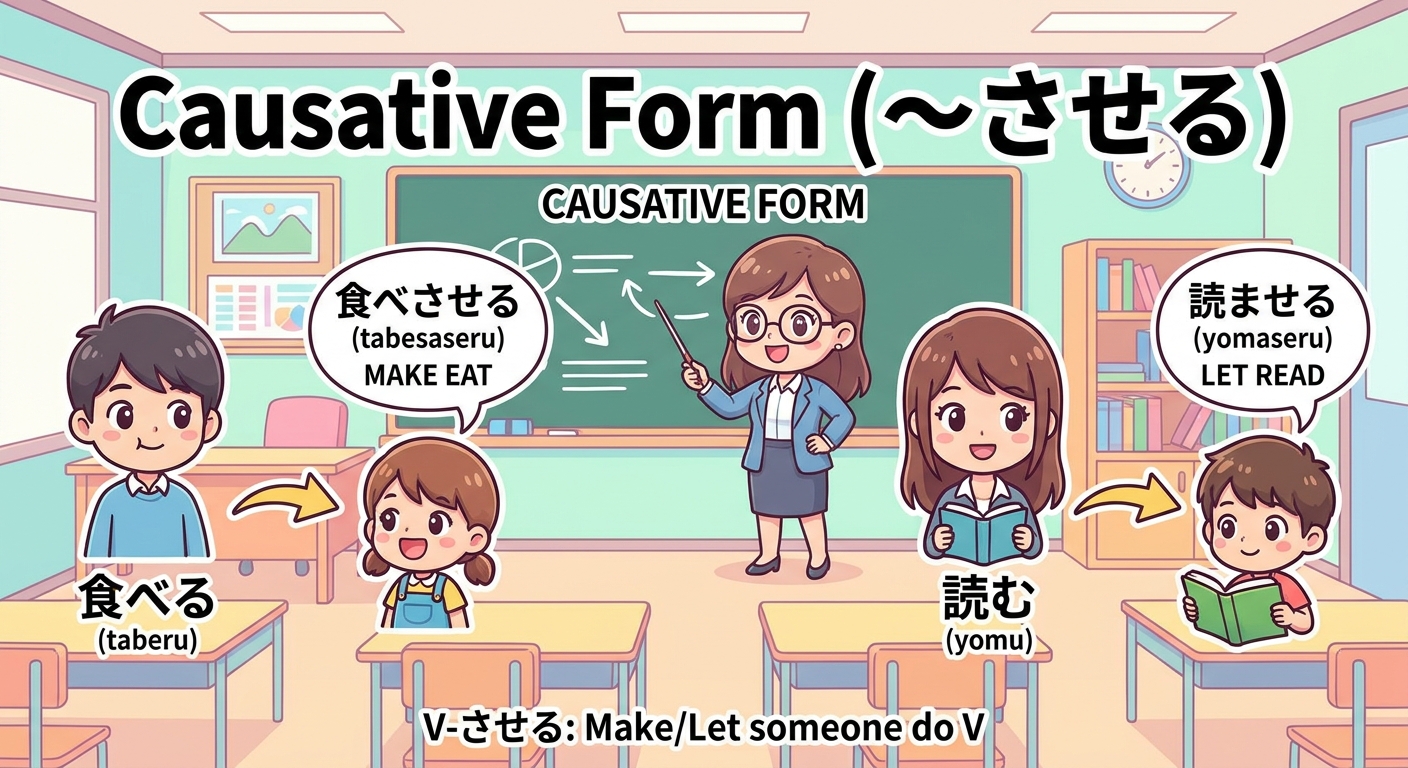
Introduction
Welcome to the study of the Japanese Causative Form (〜させる), a pivotal grammar point at the JLPT N3 level. This structure allows you to express making someone do an action or letting them do it. Mastering the causative form is essential for describing interpersonal dynamics, delegation, and permission in Japanese society. Throughout this lesson, you will learn how to conjugate verbs into their causative forms, understand the crucial role of particles (like を and に) in identifying who performs the action, and distinguish between forcing an action and granting permission based on context.
Lesson Content
Master the Japanese Causative Form (〜させる) | JLPT N3 Study Guide
Welcome, student! Today, we are mastering one of the most powerful and expressive structures in intermediate Japanese: the Causative Form (使役形 - shiekikei).
At the N3 level, you must understand how to express that you are making someone do something (coercion) or letting someone do something (permission).
1. How to Conjugate: The Mechanics
Before we look at sentences, let’s master the verb transformations.
Group 1 (U-Verbs)
Change the final ~u vowel sound to its ~a counterpart, and add せる (seru).
- 書く (kaku / to write) $\rightarrow$ 書かせる (kakaseru)
- 話す (hanasu / to speak) $\rightarrow$ 話させる (hanasaseru)
- 買う (kau / to buy) $\rightarrow$ 買わせる (kawaseru) [Note: ~u becomes ~wa]
Group 2 (Ru-Verbs)
Drop the final 〜る (ru) and add させる (saseru).
- 食べる (taberu / to eat) $\rightarrow$ 食べさせる (tabesaseru)
- 見る (miru / to see) $\rightarrow$ 見させる (misaseru)
Group 3 (Irregular Verbs)
- する (suru / to do) $\rightarrow$ させる (saseru)
- 来る (kuru / to come) $\rightarrow$ 来させる (kosaseru)
2. The Particle Rules (The N3 Trap!)
The biggest hurdle for N3 students is choosing the correct particle for the "actor" (the person being made/allowed to do the action). The rule depends entirely on whether the verb is intransitive or transitive.
Pattern A: With Intransitive Verbs (No direct object)
When the verb does not take a direct object, the actor is marked with を (wo).
$$\text{[Instigator]} \text{ は } \mathbf{[\text{Actor}]} \ \mathbf{\underline{を}} \ \text{[Intransitive Causative Verb]}$$
- Example:
先生は学生を走らせた。
Sensei wa gakusei wo hashiraseta.
The teacher made the students run.
Pattern B: With Transitive Verbs (Has a direct object)
When the verb already has a direct object marked by を, the actor must be marked with に (ni) to avoid "double-を" clashing.
$$\text{[Instigator]} \text{ は } \mathbf{[\text{Actor}]} \ \mathbf{\underline{に}} \ \text{[Object]} \ \mathbf{\text{を}} \ \text{[Transitive Causative Verb]}$$
- Example:
お母さんは子供に野菜を食べさせた。
Okaasan wa kodomo ni yasai wo tabesaseta.
The mother made the child eat vegetables.
3. Nuance: "Make" vs. "Let"
The causative form is dual-natured. How do you know if it means "force" (make) or "allow" (let)? Context is key, but here are two rules of thumb:
- Hierarchy: If a superior orders a subordinate, it usually means "make."
- Requesting Permission (~させてください): This is a crucial N3 conversational pattern meaning "Please let me do [action]."
- 質問させてください。
Shitsumon sasete kudasai.
Please let me ask a question. (Highly polite)
- 質問させてください。
The Emotional Causative
When paired with feeling verbs (like 怒る/to get angry, 喜ぶ/to rejoice, びっくりする/to be surprised), the causative means "to make someone feel [emotion]."
- 彼女をがっかりさせないでください。
Kanojo wo gakkari sasenaide kudasai.
Please don't disappoint her (make her feel disappointed).
Quick Practice Challenge
Translate the following sentence using the correct particles:
"My boss made me write the report." (Boss: 上司 joushi, Report: レポート)
Answer:
上司は私にレポートを書かせました。
(Since "write" is transitive, the actor "me" takes に!)
Exercises
Causative Form (〜させる) (Exercises)
Exercises for Causative Form (〜させる)
Review the grammar and vocabulary, and try to fill in the blanks or write sentences based on the prompts.
Examples
先生は学生に毎日漢字を練習させます。
Sensei wa gakusei ni mainichi kanji o renshū sasemasu.
The teacher makes the students practice kanji every day.
父は私に好きなことをさせてくれました。
Chichi wa watashi ni sukina koto o sasete kuremashita.
My father let me do what I wanted.
彼は面白い冗談を言って、みんなを笑わせました。
Kare wa omoshiroi jōdan o itte, minna o warawasemashita.
He told a funny joke and made everyone laugh.
Practice Drills
Lesson Materials
Vocabulary (5)
Grammar (3)
Kanji (0)
No kanji characters in this lesson.
Kana (0)
No kana characters in this lesson.