
ようになる / ことになる — Change and Decision
Express gradual change (ようになる) and decided outcomes/external decisions (ことになる). Practice describing life changes and institutional decisions.
🎯 Goal: By the end of this lesson, you will be able to confidently distinguish between and apply 〜ようになる to express changes in ability or habit, and 〜ことになる to describe official decisions or external circumstances, enhancing your spoken and written fluency in intermediate Japanese.
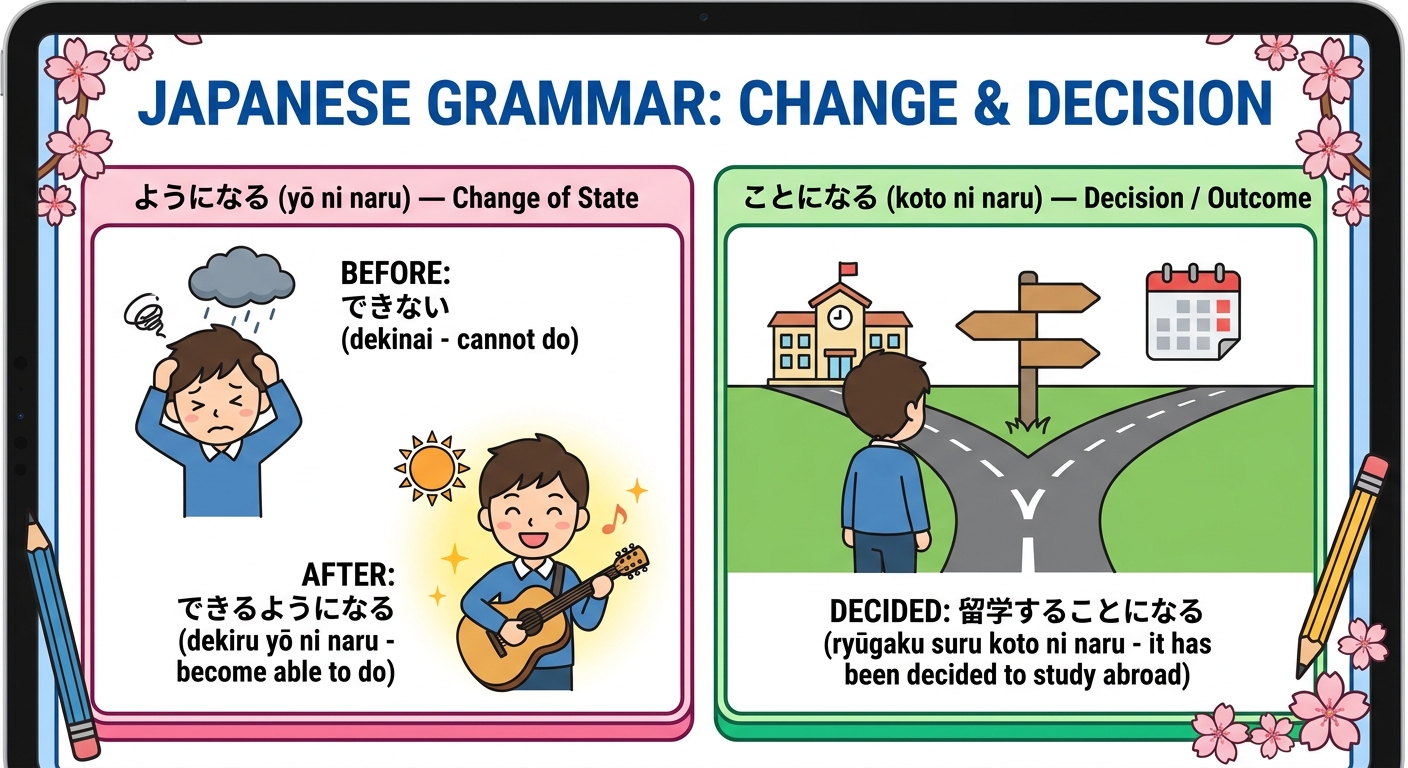
Introduction
Welcome to this N3 grammar lesson focusing on two essential expressions of change and decision-making: 〜ようになる and 〜ことになる. As an intermediate learner, moving beyond basic actions to describing shifts in habits, abilities, and external circumstances is crucial for natural Japanese communication. In this lesson, we will demystify how 〜ようになる expresses a gradual transition into a new state or ability, and how 〜ことになる describes decisions made by organizations, circumstances, or others rather than personal intent. Mastering these nuances will significantly elevate your narrative skills and help you sound more polite and objective in daily conversations.
Lesson Content
N3 Grammar Masterclass: ようになる vs. ことになる
Welcome to your N3 grammar study guide. Today, we are demystifying two essential grammar patterns that intermediate students often confuse: 〜ようになる (change of state) and 〜ことになる (external decisions).
By the end of this guide, you will intuitively understand how to express natural change versus circumstantial decisions.
1. 〜ようになる (Yō ni naru) — Change over Time
The Concept
〜ようになる expresses a gradual change in ability, habit, or state. It describes moving from State A (unable to do / not doing) to State B (able to do / habitually doing).
- English translation: "To reach the point where...", "to become able to...", "to start doing..."
Grammar Structure
- Verb (Potential Form) + ようになる (Indicates a change in ability)
- Verb (Dictionary Form) + ようになる (Indicates a change in habit)
- Verb (Negative Form -ない) + なくなる (Used instead of nai yō ni naru for "ceasing to do")
Examples
-
日本語で自分の意見を言えるようになりました。
- Nihongo de jibun no iken o ieru yō ni narimashita.
- Translation: I have become able to express my opinion in Japanese.
- Nuance: This shows a gradual acquisition of a skill (potential verb: 言える).
-
最近、毎日野菜を食べるようになりました。
- Saikin, mainichi yasai o taberu yō ni narimashita.
- Translation: Lately, I have started eating vegetables every day.
- Nuance: This indicates a new positive habit (dictionary verb: 食べる).
2. 〜ことになる (Koto ni naru) — Decisions & Outcomes
The Concept
〜ことになる is used when a decision, rule, or outcome is established. Crucially, this decision is not made solely by the speaker's direct will. Instead, it is decided by external circumstances, an organization (like a company or school), or fate.
- English translation: "It has been decided that...", "it turns out that...", "is scheduled to..."
Grammar Structure
- Verb (Dictionary Form) + ことになる
- Verb (Negative Form -ない) + ことになる
Examples
-
来月から東京の本社に転勤することになりました。
- Raimetsu kara Tōkyō no honsha ni tenkin suru koto ni narimashita.
- Translation: It has been decided that I will transfer to the Tokyo headquarters starting next month.
- Nuance: The company made this decision, not the speaker.
-
明日、学校を休むことになりました。
- Ashita, gakkō o yasumu koto ni narimashita.
- Translation: It turns out I will be absent from school tomorrow.
- Nuance: External factors (e.g., a doctor's appointment or school closure) led to this outcome.
3. Key Contrast: The "Decision Maker"
To truly master these N3 structures, look at how changing the particle or auxiliary verb alters the agency of the sentence.
| Grammar Pattern | Meaning | Who decides / What causes it? |
|---|---|---|
| 〜ようになる | Change in habit/ability | Time, practice, or natural progression. |
| 〜ことになる | External decision/outcome | Rules, organizations, or circumstances. |
| 〜ことにする | Personal decision | You (the speaker) actively decided it. |
Comparison in Action:
- 日本へ行くようになりました。
- I have reached the point where I go to Japan (e.g., my business now requires regular travel).
- 日本へ行くことになりました。
- It has been decided that I am going to Japan (e.g., my boss ordered it, or I won a trip).
- 日本へ行くことにしました。
- I have decided to go to Japan (my own personal choice and planning).
Quick Mastery Quiz
Choose the correct option (ようになる or ことになる) for the sentences below:
- 練習したおかげで、100メートル泳げる( ようになりました / ことになりました )。
- 社長命令で、来週アメリカへ出張する( ようになりました / ことになりました )。
Answers:
- ようになりました (An acquired ability through effort).
- ことになりました (An external decision made by the CEO).
Exercises
ようになる / ことになる — Change and Decision (Exercises)
Exercises for ようになる / ことになる — Change and Decision
Review the grammar and vocabulary, and try to fill in the blanks or write sentences based on the prompts.
Practice Drills
Lesson Materials
Vocabulary (5)
Kanji (0)
No kanji characters in this lesson.
Kana (0)
No kana characters in this lesson.