
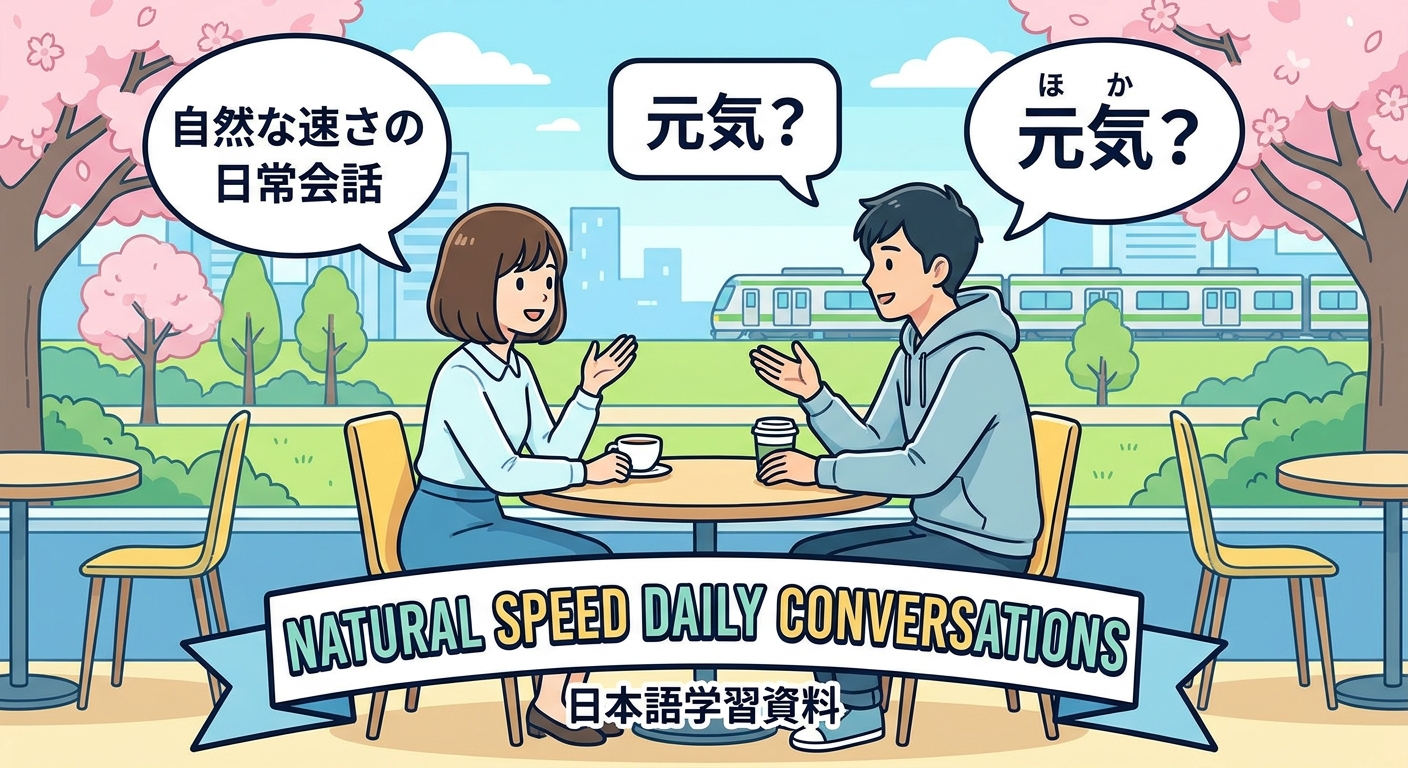
Natural Speed Daily Conversations
Listen to N3-speed daily conversations between native speakers. Focus on identifying speaker intention, emotion, and factual information.
🎯 Goal: To comprehend and participate in natural-speed daily Japanese conversations by identifying common colloquial contractions, informal grammar structures, and native conversational fillers (aizuchi) at an N3 level.
Introduction
Transitioning from textbook Japanese to natural, native-speed conversation can be challenging for N3 learners. This lesson bridges that gap by exposing you to authentic, everyday dialogues spoken at a natural pace. You will learn to identify common contractions (like ~ちゃう or ~とく), casual sentence endings, and natural fillers (aizuchi) that native speakers use unconsciously. By analyzing realistic audio and dialogue scripts, you will train your ears to catch key information in rapid speech and gain the confidence to participate in spontaneous, fluid conversations with Japanese speakers in daily life.
Lesson Content
Master Natural Japanese: N3 Conversational Fluency & Contractions
Welcome to your journey toward sounding like a native Japanese speaker! At the JLPT N3 level, you transition from the structured, polite Japanese of textbooks (Keigo and Desu/Masu form) to the fluid, rapid-fire speech of daily life.
To speak at "natural speed," native speakers constantly use phonetic reductions (contractions) and conversational fillers. This guide breaks down the essential tools you need to understand and participate in natural Japanese conversations.
1. Phonetic Reductions: Speaking with Efficiency
In rapid speech, Japanese speakers naturally take shortcuts to save breath. Here are the three most common N3 contractions you must master:
A. 〜ちゃう / 〜じゃう (from 〜てしまう / 〜でしまう)
Meaning: To do something completely, or to do something accidentally/regrettably.
In casual speech, the て-form + しまう collapses:
- 〜てしまう $\rightarrow$ 〜ちゃう
- 〜でしまう $\rightarrow$ 〜じゃう
| Standard Form | Natural Speed | Meaning |
|---|---|---|
| 宿題を忘れてしまいました。 | 宿題忘れちゃった。 | I accidentally forgot my homework. |
| お酒を飲んでしまいました。 | お酒飲んじゃった。 | I drank the alcohol (and regret it / finished it all). |
B. 〜とく (from 〜ておく)
Meaning: To do something in advance (preparatory action).
The て-form + おく collapses by merging the vowels:
-
〜ておく $\rightarrow$ 〜とく
-
〜でおく $\rightarrow$ 〜どく
-
Standard: 来週のために、ホテルを予約しておきます。
-
Natural: 来週のために、ホテル予約しとくね。 (I'll book the hotel in advance for next week.)
2. The Power of 「って」 (The Ultimate Shortcut)
In daily conversation, the particle って (tte) is a Swiss Army knife. It is most commonly used to replace the quotation particle と (to) or to define a topic (replacing というのは).
- Quoting Heard Information (Replaces と言っている / と聞いた):
- Textbook: 田中さんは「明日休む」と言っていました。
- Natural: 田中さん、明日休むって。 (Tanaka said he's taking tomorrow off.)
- Defining a Topic (Replaces は / というのは):
- Natural: N3って、難しい? (Is "N3" difficult?)
3. Natural Speed Dialogue
Let’s look at these rules in action. Read the dialogue below, paying attention to the bolded terms.
The Situation: Two friends discussing weekend plans.
A: ねえ、明日のバーベキュー、何か買っていく?
Nee, ashita no bābekyū, nanka katte iku?
(Hey, should we buy and bring something for tomorrow's BBQ?)B: あ、お肉は私が買っとくよ。あとの飲み物は任せちゃっていい?
A, oniku wa watashi ga kattoku yo. Ato no nomimono wa makasechatte ii?
(Ah, I'll buy the meat in advance. Can I leave the rest of the drinks to you?)A: りょうかい!あ、雨が降るって聞いたけど大丈夫かな?
Ryōkai! A, ame ga furu tte kiita kedo daijōbu kana?
(Got it! Ah, I heard it's going to rain, will we be okay?)B: 大丈夫、午後から晴れるってさ。準備しちゃおう!
Daijōbu, gogo kara hareru tte sa. Junbi shichaō!
(No worries, they say it'll clear up in the afternoon. Let's get preparing!)
Dialogue Analysis:
- 買っとく (kattoku): Contraction of 買っておく (to buy in advance).
- 任せちゃって (makasechatte): Contraction of 任せてしまって (to leave/entrust completely).
- 降るって (furu tte): Shortcut for 降ると (saying/hearing that it will rain).
- しちゃおう (shichaō): Casual volitional form of してしまう, meaning "Let's get it done!"
Tutor's Tip for Fluency
Do not try to speak fast immediately. Instead, focus on rhythm. Japanese is a mora-timed language; every syllable gets equal time. Using contractions like 〜ちゃう and 〜とく naturally reduces the number of syllables, making your Japanese sound faster and more native without you having to rush your speech!
Exercises
Natural Speed Daily Conversations (Exercises)
Exercises for Natural Speed Daily Conversations
Review the grammar and vocabulary, and try to fill in the blanks or write sentences based on the prompts.
Examples
今週末、もし時間あったら、どっかでお茶でもしない?
Konshūmatsu, moshi jikan attara, dokka de ocha demo shinai?
If you have some time this weekend, why don't we grab a coffee or something?
ごめん、今日はちょっとバタバタしてるから、来週にしてもらえる?
Gomen, kyō wa chotto batabata shiteru kara, raishū ni shite moraeru?
Sorry, I'm a bit rushed today, so could we make it next week instead?
この辺に、どこか美味しいラーメン屋さん知らない?
Kono hen ni, dokoka oishii rāmen-yasan shiranai?
Do you happen to know any good ramen shops around here?
Practice Drills
Lesson Materials
Vocabulary (5)
Grammar (3)
Kanji (0)
No kanji characters in this lesson.
Kana (0)
No kana characters in this lesson.