
Workplace and School Requests
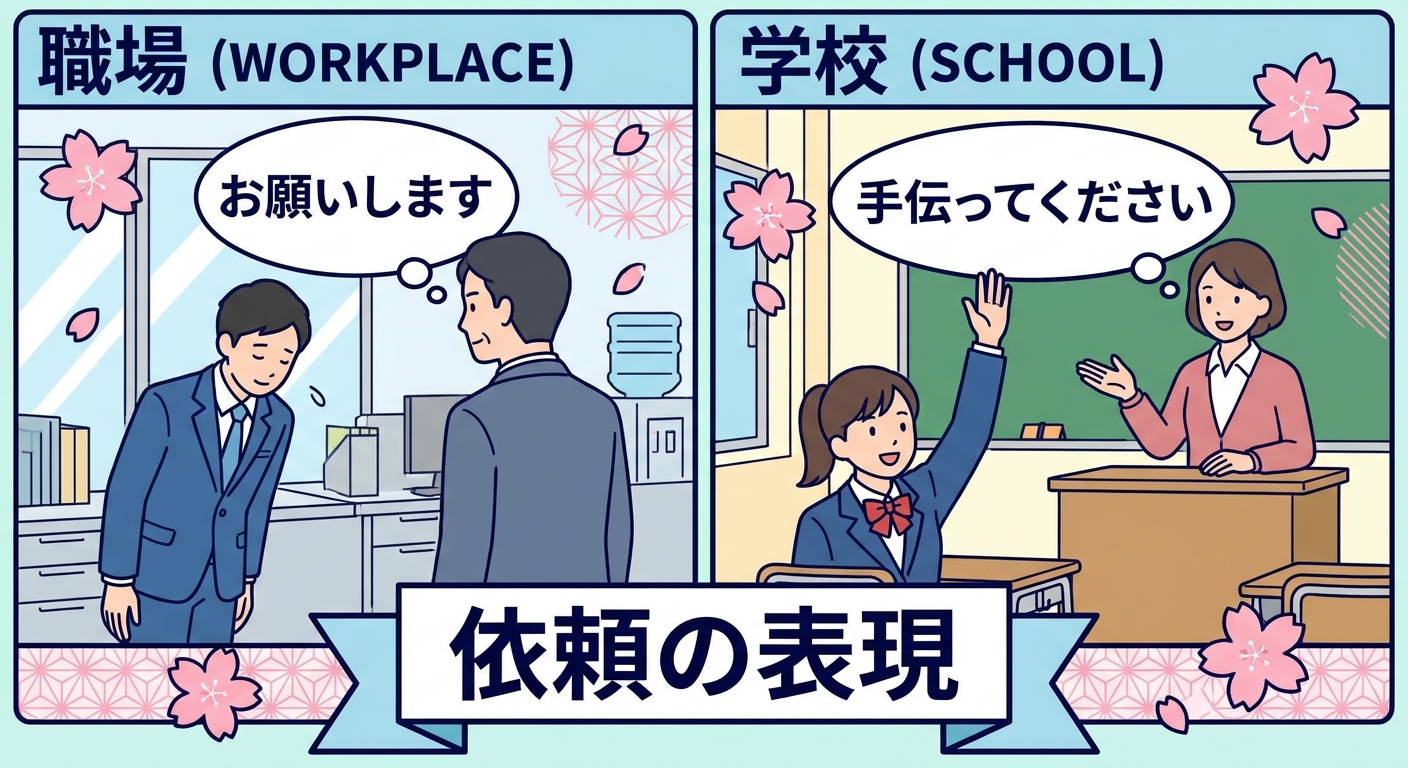
Understand polite requests and responses in professional and academic contexts. Identify what someone is asking for and what the response means.
🎯 Goal: To confidently and politely make requests to colleagues, superiors, and teachers in Japanese using appropriate N3-level grammatical structures (such as 〜ていただけないでしょうか and 〜ていただけるとありがたいです) while maintaining proper workplace and academic etiquette.
Introduction
Navigating daily interactions in a Japanese office or academic setting requires a delicate balance of politeness and clarity. At the JLPT N3 level, mastering the art of making requests is crucial for smooth communication with colleagues, superiors, and teachers. This lesson focuses on transitioning from basic request forms to more natural, nuanced, and respectful expressions. You will learn how to soften your language, explain your situation beforehand, and use appropriate conditional structures to ask for favors or assistance. By understanding these cultural and linguistic nuances, you will build stronger, more cooperative relationships in any professional or educational environment in Japan.
Lesson Content
Mastering Workplace & School Requests (JLPT N3)
In Japanese, asking for help is an art of balancing politeness, social distance, and clarity. At the JLPT N3 level, relying solely on 〜てください (Please do...) can sound too direct, demanding, or even rude in professional and academic settings.
To navigate Japanese workplaces and schools smoothly, you must master indirect and humble requests. This guide covers the three essential request patterns you need for N3.
1. The Standard Polite Request: 〜していただけないでしょうか
- Meaning: "Could you please do [verb] for me?"
- Nuance: This is the gold standard for asking a superior (boss, teacher) or colleague to perform an action. It is highly polite because it asks about the listener's ability/willingness (itadakenai = "can I not receive?").
Sentence Structure
$$\text{Verb (Te-form)} + \textbf{いただけないでしょうか}$$
Examples
-
School Context (To a Teacher):
- 先生、この作文を直していただけないでしょうか。
- Sensei, kono sakubun o naoshite itadakenai deshō ka.
- "Teacher, could you please correct this essay for me?"
- Grammar Note: 直す (naosu / to correct) becomes 直して (naoshite).
-
Workplace Context (To a Client/Boss):
- お忙しいところ恐縮ですが、もう一度説明していただけないでしょうか。
- O-isogashii tokoro kyōshuku desu ga, mō ichido setsumei shite itadakenai deshō ka.
- "I am terribly sorry to bother you while you are busy, but could you please explain it once more?"
2. Requesting Permission: 〜させていただけないでしょうか
- Meaning: "Could you please let/allow me to do [verb]?"
- Nuance: This combines the Causative Form (make/let do) with a humble request. You are asking for the listener’s permission to perform an action yourself.
Sentence Structure
$$\text{Verb (Causative Te-form)} + \textbf{いただけないでしょうか}$$
- Group 1 (U-verbs): 書く $\rightarrow$ 書かせて $\rightarrow$ 書かせていただけないでしょうか
- Group 2 (Ru-verbs): 見る $\rightarrow$ 見させて $\rightarrow$ 見させていただけないでしょうか
- Group 3 (Irregular): する $\rightarrow$ させて / 来る $\rightarrow$ 来させて (こさせて)
Examples
-
Workplace Context (Asking for time off):
- 体調が悪いので、本日は早退させていただけないでしょうか。
- Taichō ga warui node, honjitsu wa sōtai sashite itadakenai deshō ka.
- "Since I am not feeling well, could you please allow me to leave early today?"
-
School Context (Asking to submit late):
- レポートの提出を明日まで待ってさせていただけないでしょうか。
- Repōto no teishutsu o ashita made matte sashite itadakenai deshō ka.
- "Could you please let me wait until tomorrow to submit the report?"
3. The Soft Collaborative Request: 〜していただけると助かります
- Meaning: "It would be a great help if you could do [verb]."
- Nuance: Best used with peers, close colleagues, or when you want to make a request sound less burdensome. The conditional 〜と (if) combined with 助かります (tasukarimasu / it helps) softens the pressure on the recipient.
Sentence Structure
$$\text{Verb (Te-form)} + \textbf{いただけると助かります}$$
Example
- Workplace Context (Coordinating deadlines):
- 会議の資料を明日までに送っていただけると助かります。
- Kaigi no shiryō o ashita made ni okutte itadakenal to tasukarimasu.
- "It would really help me out if you could send the meeting materials by tomorrow."
Pro-Tip: The Power of "Cushion Words" (クッション言葉)
Before making any request in a Japanese professional environment, always soften the blow using a "cushion word" followed by the particle が (but/however). This signals that you acknowledge you are interrupting them.
- お忙しいところ恐縮ですが、... (O-isogashii tokoro kyōshuku desu ga...)
- "I am sorry to trouble you while you are busy, but..."
- お手数をおかけしますが、... (O-tesū o o-kake shimasu ga...)
- "I am sorry to cause you extra hassle, but..."
Quick Practice
Turn this direct command into a polite business request:
- Direct: この資料をコピーしてください。 (Copy this document.)
- Polite N3 Level: お手数をおかけしますが、この資料をコピーしていただけないでしょうか。
Exercises
Workplace and School Requests (Exercises)
Exercises for Workplace and School Requests
Review the grammar and vocabulary, and try to fill in the blanks or write sentences based on the prompts.
Examples
すみません、この資料を明日までに確認していただけないでしょうか。
Sumimasen, kono shiryou o ashita made ni kakunin shite itadakenai deshou ka.
Excuse me, could you please check this document by tomorrow?
先生、奨学金の申請のために推薦状を書いていただきたいんですが。
Sensei, shougakukin no shinsei no tame ni suisenjou o kaite itadakitai n desu ga.
Teacher, I would like you to write a recommendation letter for my scholarship application.
申し訳ありませんが、明日の会議の準備を手伝っていただけると助かります。
Moushiwake arimasen ga, ashita no kaigi no junbi o tetsudatte itadakeru to tasukarimasu.
I am sorry to bother you, but it would be really helpful if you could help me prepare for tomorrow's meeting.
Practice Drills
Lesson Materials
Vocabulary (5)
Grammar (3)
Kanji (0)
No kanji characters in this lesson.
Kana (0)
No kana characters in this lesson.