
Skimming and Keyword Reading
Learn efficient JLPT reading strategies: skim for the general topic, then keyword-search for specific answers. Improve speed without losing accuracy.
🎯 Goal: To equip students with the ability to quickly identify the main idea of N3-level texts through skimming and to locate specific details efficiently using keyword search strategies, ultimately improving reading speed and accuracy under exam conditions.
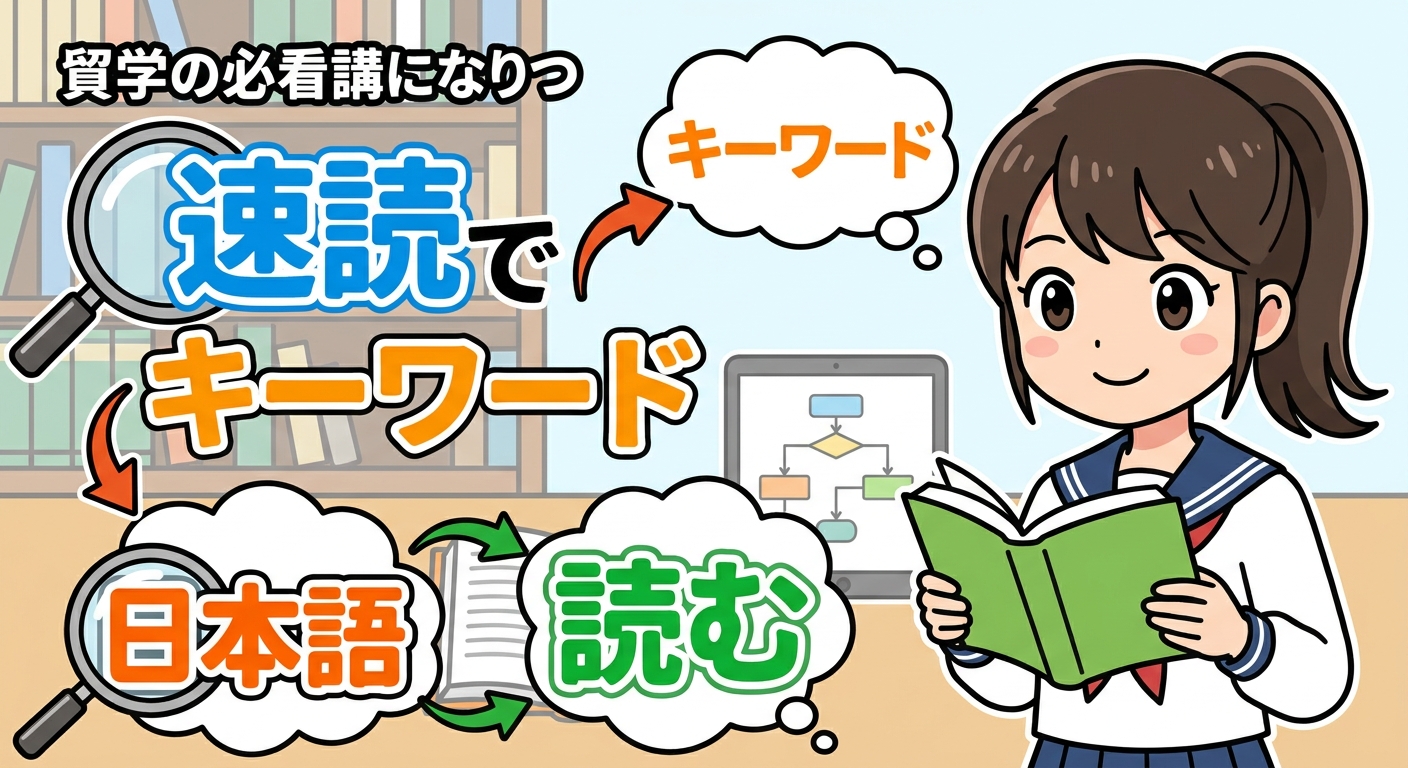
Introduction
At the JLPT N3 level, the volume of reading material increases significantly, making time management a critical skill. To succeed, you can no longer afford to read every single word in a text. This lesson introduces "Skimming and Keyword Reading," two essential strategies designed to boost your reading speed and comprehension. You will learn how to quickly grasp the main idea of a passage (skimming) and efficiently locate specific information (keyword reading) by identifying transition words, topic markers, and key vocabulary. Mastering these techniques will help you navigate N3 reading sections with confidence and efficiency.
Lesson Content
Master Class: Skimming and Keyword Reading (N3 読解)
Welcome to your N3 Reading Comprehension (読解 - Dokkai) master class.
The biggest hurdle for N3 students is not a lack of vocabulary, but time management. Reading every single character in the Dokkai section is a trap. To pass, you must transition from "translating" to strategic scanning.
Today, we will master two essential techniques: Skimming (スキミング) and Keyword Reading (キーワード読解).
1. Skimming: Finding the "Gist" in 10 Seconds
Skimming is reading rapidly to get a general overview of the text. In Japanese writing, authors structure arguments logically. You can find the main idea by focusing on specific zones:
- The Introduction (導入部): Usually sets the topic. Look for phrases like 〜について (about...) or 〜を知っていますか (Do you know...?).
- The Conclusion (結論部): Japanese writers love to save their main point for the very end. Always read the last 2–3 sentences first.
2. Keyword Reading: The "Signpost" Particles & Conjunctions
Keywords are your guideposts. When skimming, your eyes should "bounce" from one signpost to the next. Learn to spot these three categories instantly:
Category A: The Pivot (逆接 - Contrast)
The author’s true opinion almost always appears after these words.
- しかし (However)
- だが / ところが (But / On the contrary)
- 一方で (On one hand... on the other hand)
Category B: The Summary (要約 - Conclusion)
These words introduce the author’s final verdict or a simplification of a complex point.
- つまり (In other words)
- したがって (Therefore)
- 要するに (In short)
Category C: Author’s Opinion Endings
Scan the ends of sentences for these grammatical structures, which signal the author's personal belief:
- 〜のではないだろうか (Isn't it the case that...?)
- 〜に違いない (Without a doubt...)
- 〜べきだ (Should / Must)
3. Practical Drill: Apply the Strategy
Read the passage below. Do not read word-for-word. Apply your new skills to locate the author's main point.
最近、スマートフォンの普及によって、いつでもどこでも連絡が取れるようになり、生活は非常に便利になった。しかし、その便利さの裏で、私たちは対面のコミュニケーションを軽視しているのではないだろうか。忙しい現代人だからこそ、直接会って話す時間を大切にすべきだ。
Step-by-Step Walkthrough:
- Skip the fluff: The first sentence talks about smartphones being convenient. This is just background context.
- Spot the Pivot: Your eyes should immediately lock onto しかし (However). This signals that the tone is shifting to the author's real argument.
- Spot the Opinion Ending: Look at the end of the second sentence: 〜のではないだろうか (Isn't it the case that...?). The author is questioning our neglect of face-to-face communication.
- Confirm the Conclusion: The last sentence ends with 〜べきだ (should). This is the ultimate takeaway: We should value face-to-face time.
Tutor's Pro-Tip for Exam Day
When you open the reading section, read the questions first.
If a question asks "Why did the author say X?", scan the text only for X and the immediate sentences surrounding it. Never read the whole text first. Scan, target, and conquer!
Exercises
Skimming and Keyword Reading (Exercises)
Exercises for Skimming and Keyword Reading
Review the grammar and vocabulary, and try to fill in the blanks or write sentences based on the prompts.
Examples
長い文章を読むときは、まず全体をざっと読んで、キーワードを探しましょう。
Nagai bunshō o yomu toki wa, mazu zentai o zatto yonde, kīwādo o sagashimashō.
When reading long texts, first skim the whole passage to look for keywords.
質問を先に読んでおくと、必要な情報を素早く見つけることができます。
Shitsumon o saki ni yonde oku to, hitsuyō na jōhō o subayaku mitsukeru koto ga dekimasu.
If you read the questions first, you can quickly find the necessary information.
細かい文法にこだわらず、文章のテーマや結論を意識して読みましょう。
Komakai bunpō ni kodawarazu, bunshō no tēma ya ketsuron o ishiki shite yomimashō.
Don't get caught up in detailed grammar; focus on the theme and conclusion of the text as you read.
Practice Drills
Lesson Materials
Vocabulary (5)
Kanji (0)
No kanji characters in this lesson.
Kana (0)
No kana characters in this lesson.