
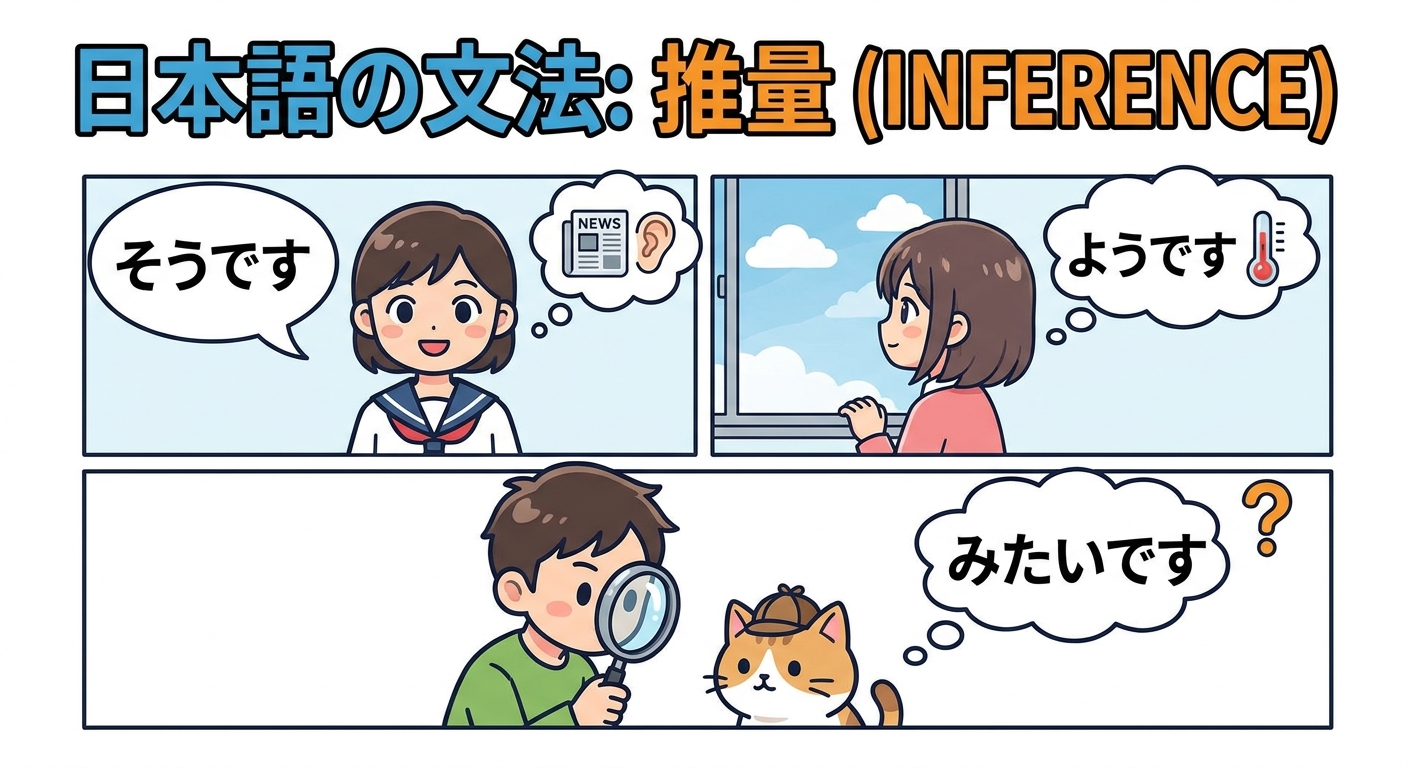
そうです / ようです / みたいです
Express appearance (looks like), inference, and similarity. そうです (looks/seems from direct observation), ようです (seems from information), みたいです (like/similar to, casual). Master these three look-alike patterns.
🎯 Goal: By the end of this lesson, you will be able to confidently distinguish between そうです, ようです, and みたいです, accurately identify the source of information required for each, and apply them correctly in both polite and casual spoken Japanese.
Introduction
Welcome to this JLPT N3 lesson focusing on three essential expressions of conjecture and appearance: そうです, ようです, and みたいです. While they all translate similarly to 'seems like' or 'looks like' in English, they rely on vastly different sources of information—ranging from direct visual impressions to logical deductions and casual hearsay. Mastering these subtle nuances is a major milestone in transitioning to intermediate Japanese. In this lesson, we will dissect their unique grammatical structures, analyze context-specific usage, and practice choosing the correct expression to express probability and resemblance naturally in daily conversations.
Lesson Content
Master N3 Grammar: Expressing Conjectures with そう, よう, and みたい
In Japanese, saying "it seems like" or "it looks like" isn't a one-size-fits-all deal. The trio of そうです (sō desu), ようです (yō desu), and みたいです (mitai desu) represents one of the most common hurdles for N3 learners.
By the end of this guide, you will intuitively grasp their nuances and know exactly when to use which.
1. そうです (Visual Impression / Imminence)
Use そうです when you make a conjecture based solely on immediate visual evidence or when something is on the verge of happening. You are looking at something and making an instant, intuitive guess.
Grammar Rules
- Verbs (Stem form): 雨が降りそうです。 (It looks like it's about to rain.)
- I-Adjectives (Drop 〜い): 美味しそうなケーキ。 (A delicious-looking cake.)
- Exception: いい $\rightarrow$ よさそう; ない $\rightarrow$ なさそう
- Na-Adjectives (Drop 〜な): 元気そうですね。 (You look energetic.)
⚠️ Warning: Do not use nouns with this pattern. To say "He looks like a teacher," you cannot use そうです.
2. ようです (Inference Based on Evidence)
Use ようです when you make a logical deduction based on reliable information, physical evidence, or your five senses (smell, taste, hearing, touch). It is formal and often used in writing.
Grammar Rules
- Verbs (Plain form): 彼はもう帰ったようです。 (It seems he has already gone home—e.g., his desk is empty.)
- Nouns: 本物のようです。 (It seems like the real thing.)
- I-Adjectives: 忙しいようです。 (They seem busy.)
- Na-Adjectives: 簡単なようです。 (It seems easy.)
3. みたいです (The Casual Cousin & Simile)
みたいです functions almost identically to ようです, but with two key differences:
- It is highly colloquial and conversational.
- It is frequently used for metaphors/similes ("like a...").
Grammar Rules
- Verbs (Plain form): 雨が降るみたいです。 (Looks like it's going to rain.)
- Nouns (No particles): 夢みたいです! (It's like a dream!)
- Na-Adjectives (No 〜な): 元気みたいです。 (He seems well.)
The Ultimate Comparison Matrix
Let's look at how the meaning shifts using the word おいしい (delicious):
| Grammar | Example | Nuance |
|---|---|---|
| そうです | このケーキは美味しそうです。 | You are looking at the cake right now. It looks beautifully decorated and tasty. |
| ようです | このケーキは美味しいようです。 | You read highly-rated reviews online, or you see a long line outside the bakery. |
| みたいです | このケーキ、美味しいみたいだよ。 | Same as よう, but you are chatting casually with a friend. |
Quick Practice Quiz
Choose the correct option for each scenario:
- (Looking up at dark, heavy clouds)
雨が __________。- a) 降りそうです
- b) 降るようです
- (Looking at your friend's dog acting like a human)
人間 __________ ですね!- a) そう
- b) みたい
Answers
- a) 降りそうです (Immediate visual evidence of an imminent event).
- b) みたい (A metaphor/simile comparing a dog to a human; nouns cannot attach directly to そう).
Exercises
そうです / ようです / みたいです (Exercises)
Exercises for そうです / ようです / みたいです
Review the grammar and vocabulary, and try to fill in the blanks or write sentences based on the prompts.
Examples
空が暗くなってきたので、今にも雨が降りそうです。
Sora ga kuraku natte kita node, ima ni mo ame ga furi sou desu.
The sky has become dark, so it looks like it's going to rain at any moment.
彼は最近忙しいようで、一度もイベントに来ていません。
Kare wa saikin isogashii you de, ichido mo ibento ni kite imasen.
He seems to be busy lately, as he hasn't come to any events even once.
あの二人はいつも仲が良くて、まるで本当の兄弟みたいですね。
Ano futari wa itsumo naka ga yokute, marude hontou no kyoudai mitai desu ne.
Those two always get along so well, they look just like real brothers.
Practice Drills
Lesson Materials
Vocabulary (5)
Grammar (3)
Kanji (0)
No kanji characters in this lesson.
Kana (0)
No kana characters in this lesson.